
Theodor Seuss Geisel
Comics debut 1927
![The Tough Coughs as He Ploughs the Dough: Early Writings and Cartoons by Dr. Seuss #[nn]](https://img.comicbooks.com/covers/openlibrary/9780688065485.jpg)
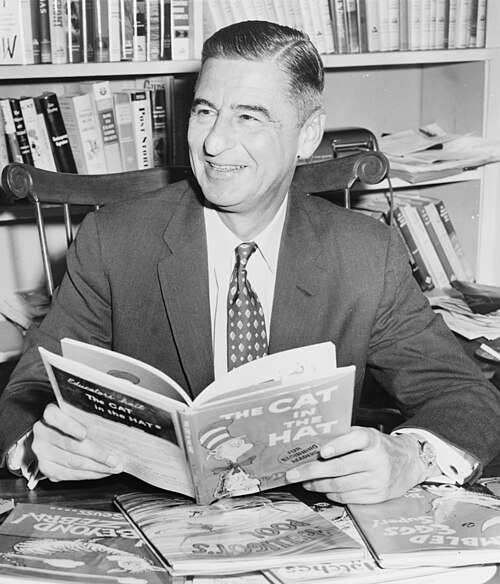
Theodor Seuss Geisel, born March 2, 1904, in Springfield, Massachusetts, and died September 24, 1991, in La Jolla, California, is best known as Dr. Seuss, the pen name he adopted as a Dartmouth undergraduate and later at Oxford. After leaving Oxford in 1927, he began illustrating for *Vanity Fair*, *Life*, and other magazines, and worked on ad campaigns for Flit and Standard Oil. He also drew political cartoons for the New York newspaper *PM*. His first children’s book, *And to Think That I Saw It on Mulberry Street*, appeared in 1937. During World War II, he paused children’s literature to create political cartoons and work in the U.S. Army’s animation and film unit.
![The Seuss, the Whole Seuss and Nothing but the Seuss: A Visual Biography of Theodor Seuss Geisel #[nn]](https://img.comicbooks.com/covers/openlibrary/9780375822483.jpg)
After the war, Geisel produced a string of beloved books, including *The Cat in the Hat*, *How the Grinch Stole Christmas!*, *Green Eggs and Ham*, and *The Lorax*. His signature style—playful, rhythmic verse paired with whimsical, exaggerated linework—defined children’s publishing for decades. He collaborated with editors like Bennett Cerf and worked alone on most projects, co-creating characters that became cultural fixtures. His books have sold over 600 million copies in more than 20 languages and inspired numerous TV specials, films, and a Broadway musical.
![Just What the Doctor Disordered: Early Writings & Cartoons of Dr. Seuss #[nn]](https://img.comicbooks.com/covers/amazon/0486498468.jpg)
Geisel won two Primetime Emmys for his Grinch specials and a 1984 Pulitzer Prize Special Citation. His March 2 birthday is now National Read Across America Day. His work remains a cornerstone of children’s literature, though some titles have been reexamined for racial stereotypes.
Known for
Shop Theodor Seuss Geisel's comics
✦ Is this your page? Are you Theodor Seuss Geisel, or represent their estate? Claim it.
Full bibliography · 6 series
Original biography and editorial content © ComicBooks.com LLC. Information drawn in part from Wikipedia and the Grand Comics Database. Portrait by Al Ravenna, New York World-Telegram and the Sun staff photographer / Wikimedia Commons (Public domain). Cover thumbnails shown under fair use, each linking to its issue.