
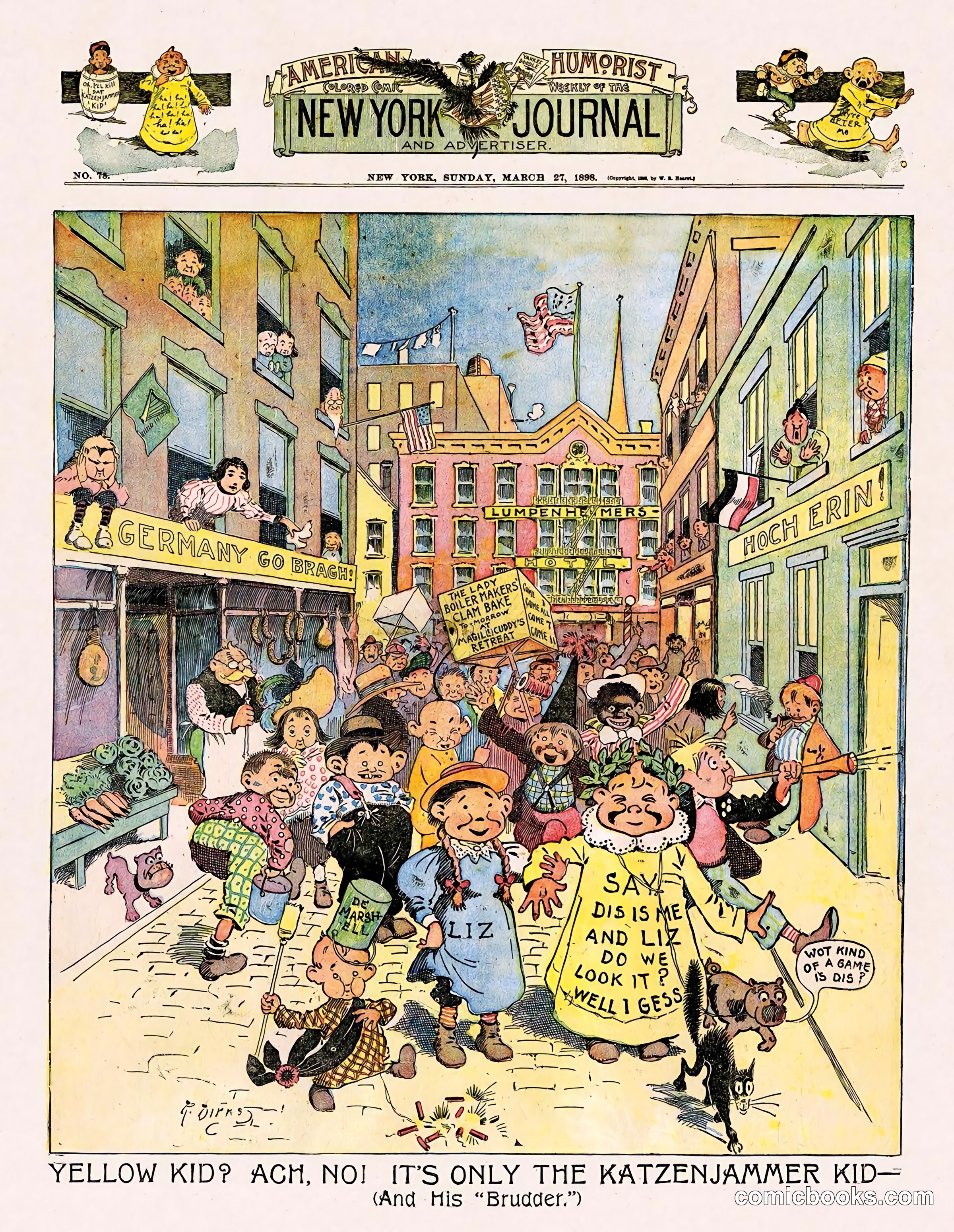
Rudolph Dirks's The Katzenjammer Kids is one of the most important strips in comics history — and, remarkably, a version of it ran for more than a century. Created for Hearst's Sunday supplement, it followed Hans and Fritz, two incorrigible boys whose pranks tormented their long-suffering elders. Dirks adapted the mayhem from Max und Moritz, the illustrated tales of German humorist Wilhelm Busch, translating that mischief into a weekly American feature.
Its significance is structural. More consistently than almost anything before it, the Katzenjammer Kids used sequences of panels to tell a story in time, and put words in speech balloons to let characters talk on the page. These devices — sequential panels and the balloon — became the load-bearing grammar of the comic strip, and Dirks helped make them standard rather than experimental.
The strip's later history reads like a parable of the medium's growing value: a famous legal fight over ownership let the feature continue under a new artist while Dirks drew his own near-identical version elsewhere, so two rival 'Katzenjammer' families ran for years. That anyone would go to court over cartoon children shows just how much comics had come to be worth.
About this artifact
- Creator
- Rudolph Dirks
- Date
- 1898
- Rights
- Public domain — free to view, share, and reuse.
- Restoration
- Digitally restored and hosted by ComicBooks.com · high-resolution version available.
Part of our mission to preserve and restore the public-domain heritage of the medium.