
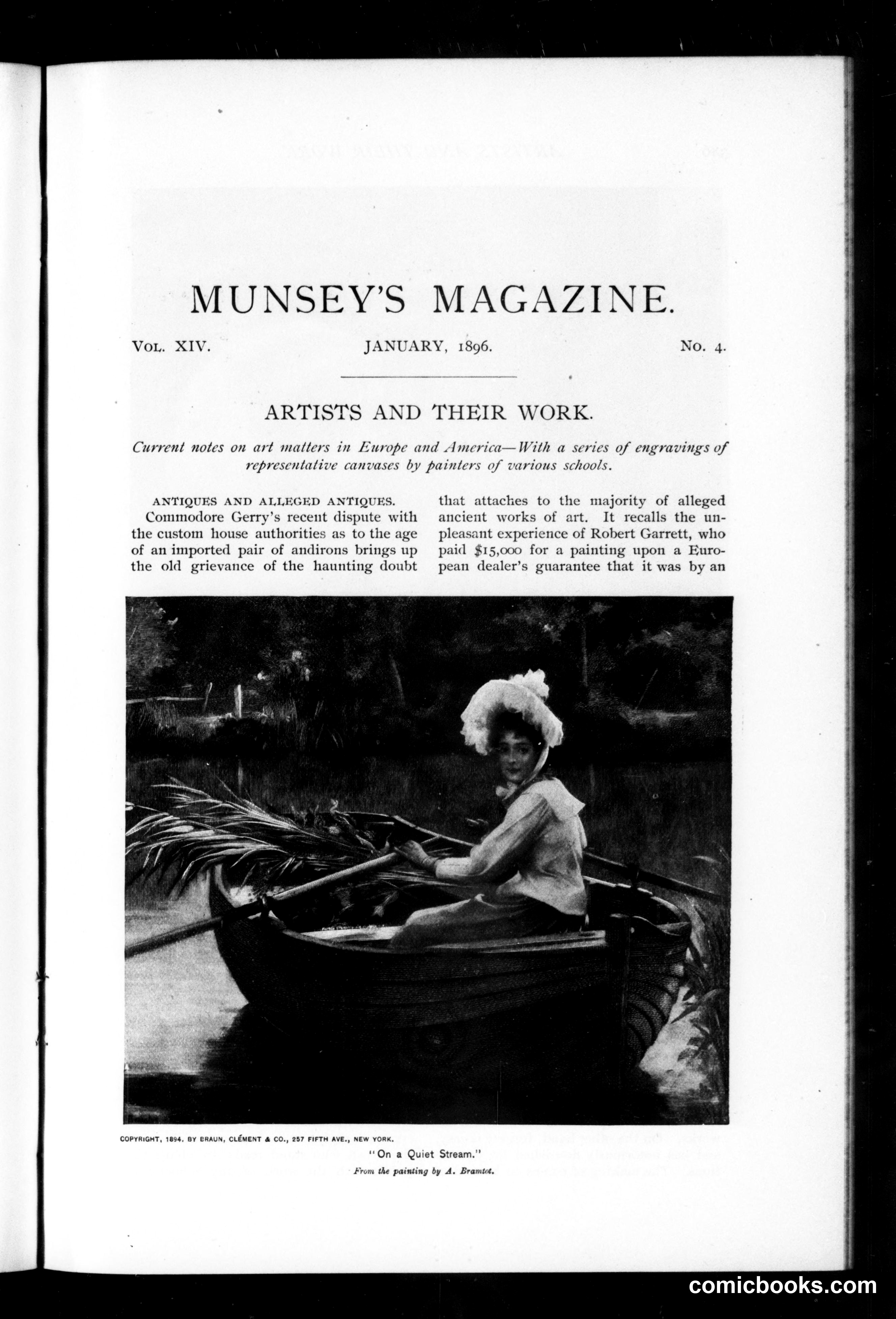
# Munsey's Magazine, Vol. XIV, January 1896, No. 4
This issue contains two substantive features. "Artists and Their Work" surveys contemporary and classical painting through reproductions and critical discussion. It addresses the problem of art forgery and authentication, discussing Commodore Gerry's customs dispute over imported andirons and Robert Garrett's costly error purchasing a painting misidentified as an old master. The article details Corot's practice of signing works by struggling artists and Courbet's Geneva "picture factory," where he produced salable canvases with minimal personal input to raise funds for fines imposed after the Paris Commune. A featured painting—Turner's "St. Mark's Place, Venice" (1830)—commands $50,000 in a New York dealer's gallery; Cornelius Vanderbilt recently paid similar sums for Turners. The piece discusses potential acquisition by the Metropolitan Museum.
"Prominent American Families: The Harrisons" traces the colonial Puritan officer Colonel Harrison through his descendants, emphasizing inherited qualities of courage and integrity. Benjamin Harrison signed the Declaration of Independence; his son William Henry Harrison served in the Northwest Territory, refusing opportunities for personal wealth while establishing federal land policy. William Henry became the ninth President. His grandson, also named Benjamin, was elected the twenty-third President.
📖 This public-domain issue is being restored page-by-page for our free reader — check back soon.
About this artifact
- Date
- January 1896
- Rights
- Public domain — free to view, share, and reuse.
- Restoration
- Digitally restored and hosted by ComicBooks.com · high-resolution version available.
Part of our mission to preserve and restore the public-domain heritage of the medium.