
Judge, 1904-11-19 · page 2 of 16
Judge — November 19, 1904 — page 2: what you’re looking at
What you’re looking at
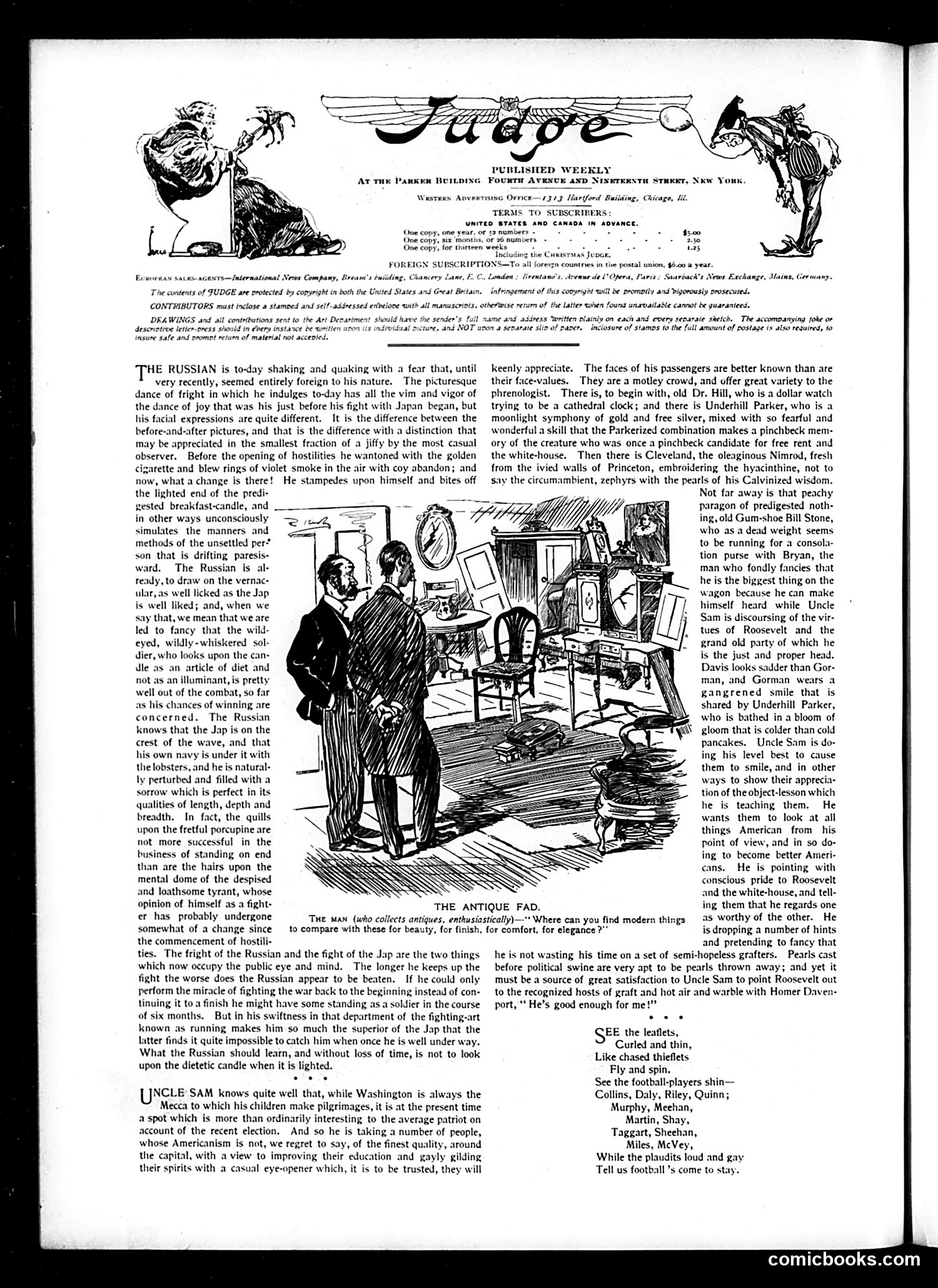
This cartoon satirizes the early 1900s craze for collecting antiques. The illustration shows a man enthusiastically examining old furniture and objects, comparing modern manufactured items unfavorably to these "beautiful" antiques. The satire targets wealthy Americans' snobbish fascination with European antiquities—they're positioned as pretentious collectors willing to pay inflated prices for secondhand goods simply because they're old. The caption's rhetorical question—"Where can you find modern things to compare with these for beauty, finish, comfort, elegance?"—is ironic, suggesting such collectors value age and European provenance over actual quality or practicality. The accompanying text references political figures and social commentary typical of Judge's era, but the main cartoon mocks consumerism and class pretension around collecting.
📄 Transcribed text from this page (OCR, searchable)
Machine-transcribed from the original scan — historical spelling and the odd misread are preserved.
At THe Parxxe BorLpixG Wastexy Apvexnisine Orrice TERMS unireo syari One copy, one year, or 52 numbers - One copy, six Months, of 26 numbers + One copy, for thirteen weeks Evxornan satns-acenrs—/ntermational News Company, Bream’ s building, C The contents of JUDGE are protected by copyright in both the United States a postal union, $6.00 a year. ue ie L’ Opera, Paris: Saaréack's News Exchange, Mains, Germany. right will be promptly and digorousiy prosecuted. CONTRIBUTORS must inciose a stamoed and self-addressed entoeiove with all manuscriots, otherivise return of the latter when found unavailadle cannot be guarantees. DRAWINGS and all contributions sent to the Art Devartment should have the sender's full name and address Yori descriotive letter-oress should in every instance be witlen acon its indrvigaal insure safe and promot return of material not accepied. n plainly on each and every arate sketch. The accompanying Joke or per. inciosure of Stamos 10 the il amount of postage 1s also reauired, 10 'HE RUSSIAN is to-day shaking and quaking with a fear that, until very recently, seemed entirely foreign to his nature. The picturesque dance of fright in which he indulges to-day has all the vim and vigor of ce of joy that was his just before his fight with Japan began, but expressions are quite different. It is the difference between the after pictures, and that is the difference with a distinction that may be appreciated in the smallest fraction of a jiffy by the most casual observer. Before the opening of hostilities he wantoned with the golden ette and blew rings of violet smoke in the air with coy abandon; and He stampedes upon himself and bites off now, what a change is there! the lighted end of the predi- gested breakfast-candle, and in other ways unconsciously simulates the manners and methods of the unsettled per? son that is drifting paresis- ward. The Russian is al- ready, to draw on the vernac- ular, as well licked as the Jap is well liked; and, when we say that, we mean that we are led to fancy that the wild- eyed, wildly-whiskered sol- dier, who looks upon the can- dle as an article of diet and not as an illuminant, is pret well out of the combat, so as his chs concerned. The Russian knows that the Jap is on the crest of the wave, and that his own navy is under it with the lobsters, and he is natural- ly perturbed and filled with a sorrow which is perfect in its qualities of length, depth and breadth. In fact, the quills upon the fretful porcupine are not more successful in the business of standing on end than are the hairs upon the mental dome of the despised and loathsome tyrant, whose opinion of himself as a fight- er has probably undergone somewhat of a change since the commencement of hostili- ties. The fright of the Russian and the fight of the Jap are the two things which now occupy the public eye and mind. The longer he keeps up the fight the worse does the Russian appear to be beaten. If he could only perform the miracle of fighting the war back to the beginning instead of con- tinuing it toa finish he might have some ding as a soldier in the course of six months. But in his swiftness in that department of the fighting-art known as running makes him so much the superior of the Jap that the latter finds it quite impossible to catch him when once he is well under way. What the Russian should learn, and without loss of time, is not to look upon the dietetic candle when it is lighted. UNCLE SAM knows quite well that, while Washington is always the Mecca to which his children make pilgrimages, it is at the present time a spot which is more than ordinarily interesting to the average patriot on account of the recent election. And so he is taking a number of people, whose Americanism is not, we regret to say, of the finest quality, around the capital, with a view to improving their education and gayly gilding their spirits with a casual eye-opener which, it is to be trusted, they will THE ANTIQUE FAD. Tue MAN (who collects antiques, enthusiastically)—'* Where can you find modern things to compare with these for beauty, for finish, for comfort, for elegance ?” keenly appreciate. The faces of his passengers are better known than are their face-values. They are a motley crowd, and offer great variety to the phrenologist. There is, to begin with, old Dr. Hill, who is a dollar watch trying to be a cathedral clock; and there is Underhill Parker, who is a moonlight symphony of gold and free silver, mixed with so fearful and wonderful a skill that the Parkerized combination makes a pinchbeck mem- ory of the creature who was once a pinchbeck candidate for free rent and the white-house. Then there is Cleveland, the oleaginous Nimrod, fresh from the ivied walls of Princeton, embroidering the hyacinthine, not to say the circumambient, zephyts with the pearls of his Calvinized wisdom. Not far away is that peachy paragon of predigested noth- ing, old Gum-shoe Bill Stone, who as a dead weight seems to be running for a consola- tion purse with Bryan, the man who fondly fancies that he is the biggest thing on the wagon because he can make himself heard while Uncle Sam is discoursing of the vir- tues of Roosevelt and the grand old party of which he is the just and proper head. Davis looks sadder than Gor- man, and Gorman w gangrened smile that is shared by Underhill Parker, who is bathed in a bloom of gloom that is colder than cold pancakes. Uncle Sam is do- ing his level best to cause them to smile, and in other ways to show their apprecia tion of the object-lesson which he is teaching them. He wants them to look at all things American from his point of view, and in so do- ing to become better Ameri- ns. He is pointing with conscious pride to Roosevelt and the white-house, and tell- ing them that he regards one as worthy of the other. He is dropping a number of hints and pretending to fancy that he is not wasting his time on a set of semi-hopeless grafters. Pearls cast before political swine are very apt to be pearls thrown away; and yet it must be a source of great satisfaction to Uncle Sam to point Roosevelt out to the recognized hosts of graft and hot air and warble with Homer Daven- port, ** He’s good enough for me!” EE the leaflets, Curled and thin, Like chased thieflets Fly and spin. See the football-players shin— Collins, Daly, Riley, Quinn; Murphy, Meehan, Martin, Shay, Taggart, Sheehan, Miles, McVey, While the plaudits loud and gay Tell us football ’s come to stay. comicbooks.com