
Judge, 1929-02-09 · page 18 of 36
Judge — February 9, 1929 — page 18: what you’re looking at
What you’re looking at
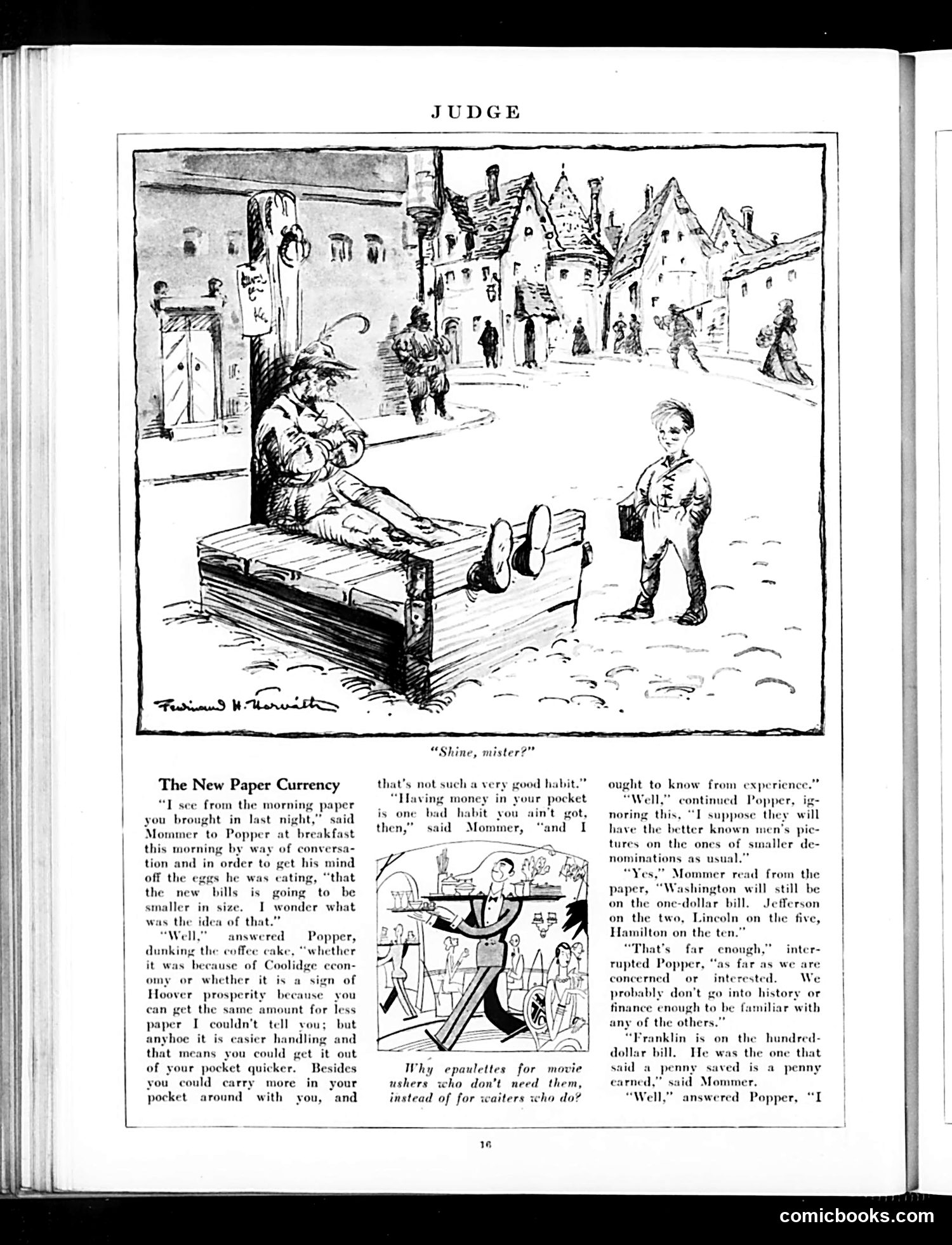
This page satirizes the U.S. government's introduction of smaller paper currency (likely the 1929 redesign). The main cartoon shows a child asking an adult about the practical purpose of reducing bill size. The dialogue humorously attributes the smaller currency to **President Coolidge's economy measures** or **Hoover's prosperity**—suggesting the government shrinks money when times are good (less paper needed) or bad (easier to carry what little you have). The satire mocks Depression-era anxiety about finances. The secondary joke questions why movie theater ushers receive decorative **epaulettes** when they "don't need them," while waiters—who actually do—receive nothing. This targets visible status symbols given to low-wage workers. The currency discussion references real figures: Washington, Jefferson, Lincoln, Hamilton, and Franklin on various denominations, poking gentle fun at how ordinary people ignore historical details beyond the most famous figures.
📄 Transcribed text from this page (OCR, searchable)
Machine-transcribed from the original scan — historical spelling and the odd misread are preserved.
JUDGE The New Paper Currency “I sce from the morning p: you brought in last night,” Mommer to Popper at breakfast this morning by way of conv tion and in order to get hi | off th he was ¢ the new bills is going to be smaller in size. I wonder what was the ic of that.” “Well,” swered — Popper, dunki he co) ake, “whe | it was use of Coolidge omy or whether it is as Hoover prosperity because you can get the same amount for less paper I couldn't tell. yo a i easier handli means you could get it out i of your pocket quicker. Besides you could carry more in your pocket around with you, and is one then,” Why epaulettes for movi ushers who don’t need the instead of for waiters who do? ought to know from experience. “Well,” continued Popper, ig- noring this, “I suppose they will have the better known men’s pic- tures on the ones of smaller de- nominations as usual.” “Yes,” Mommer read from the paper, “Wash on will still be on the one-¢ r bill. Jefferson on the two, Lincoln on the five, Hamilton on the ten.” “That's far enough,” inter- rupted Popper concerned “as far as we a interested. We jon't go into history or nough to be familiar with of the others.” “Franklin is on the hundred- dollar bill. He was the one that said a penny saved is a penny carne i Mommer. nswered Popper, “I comicbooks.com