
Judge, 1929-02-23 · page 19 of 36
Judge — February 23, 1929 — page 19: what you’re looking at
What you’re looking at
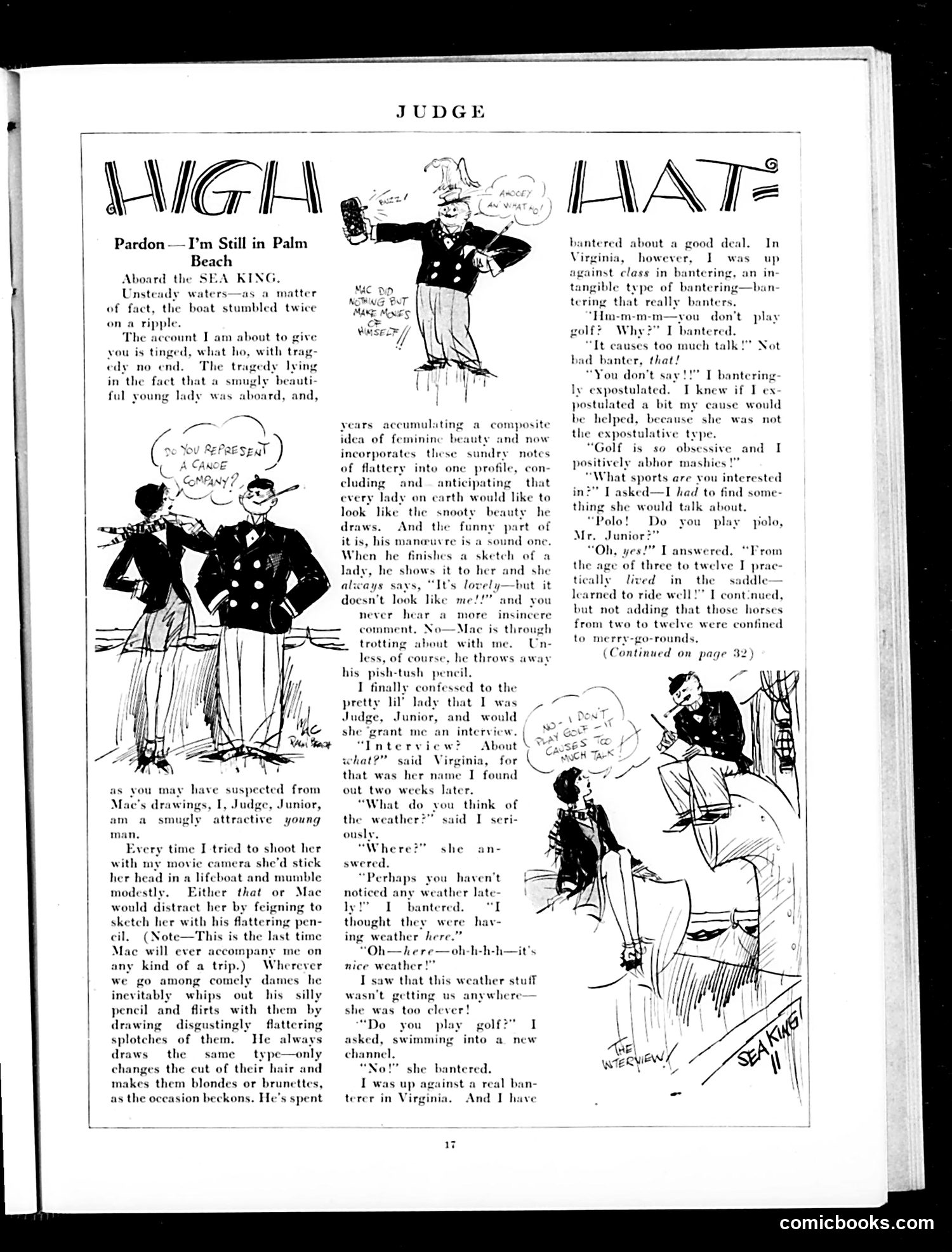
This page is a humorous first-person narrative by "Judge, Junior" about attempting to court a woman named Virginia while aboard a yacht in Palm Beach. The satire targets masculine vanity and failed seduction tactics. The protagonist is portrayed as smugly self-assured but repeatedly outmaneuvered. Virginia, depicted as intelligent and witty, consistently deflates his attempts at clever banter about weather and sports. When he claims polo expertise from ages three to twelve, the joke's implication—that he rode children's toys, not real horses—undermines his credibility. The accompanying sketches show the narrator's frustration as Virginia remains unimpressed by both his charm and his companion Mac's flattering portrait sketches. The satire mocks the narrator's transparent attempts at sophistication while celebrating the woman's refusal to be easily manipulated by conventional masculine tactics. The tone suggests early 20th-century gender dynamics where women were beginning to resist traditional seduction strategies.
📄 Transcribed text from this page (OCR, searchable)
Machine-transcribed from the original scan — historical spelling and the odd misread are preserved.
JUDGE A Pardon —I’m Still in Palm Beach Aboard the SEA KING. Unsteady waters—as a matter f fact, the boat stumbled twice vou is tinged, whi cdy no end. The in the ho, with trag- tragedy lying fact that a smu s accumulating a composite of feminine beauty and now incorporates these sundry notes of flattery into one profile, con cluding ‘and anticipating — that every lady on earth would like to look like the snooty beauty he draws. And the funny part of itis, his maneuvre is a sound one. When he finishes a sketch of a lady, he shows it to her and she always says, “It’s lovely—but it doesn’t look like me!!” and you never hear a comment, No- trotting about A CANCE \ COMPANY more insincere Mae is through with me. Un- less, of course, he throws away his pish-tush pencil. I finally confessed to the pretty lil’ lady that I was iy Ju Junior, and would SRO sh an interview. Interview? About \ what?” said Virginia, for that was her name I found out two weeks Jater. “What do think of grant me as you may have suspected from Mac's drawings, I, Judge, Junior, you am a smugly attractive young the weather?” said I seri- man, ously. Every time I tried to shoot her “Where?” she an- with my movie camera she'd stick — swered. her head in a lifeboat and mumble modestly. Either that or Mac would distract her by feigning to sketch her with his flattering pen- cil. (Note—This is the last time Mae will ever accompany me on ny kind of a trip.) Wherever w among comely dames he inevitably whips out his silly pencil and flirts with them by “Perhaps you haven't noticed any weather late- ly!’ T bantered. "I thought they were hav- ing weather here.” “Oh—he nice weather I saw that this weather stuff wasn't getting us anywhere she was too clever! oh-h-h-h—it's drawing disgustingly _ flattering “Do you play golf?” I splotches of them. He always d, swimming into a new draws the same — type—only changes the cut of their hair and makes them blondes or brunettes, as the occasion beckons. He’s spent nel, “No!” she I was up antered, inst a real ban- And I have terer in Virginia. i | bantered about a good deal. In Virginia, however, I was up against class in bantering, > type of bantering x that really banters. ‘Hm-m-m-m—you don't play Mf? Why?" T bantered. It causes too much talk!” bad banter, that! “You don’t say !!" T bantering- ly expostulated.” I knew if T ex postulated a bit my cause would be helped, she the expostulative type. olf is so obsessive positively abhor mashies !” an in- yan teri cause was not and I “What sports are you interested in?" Tasked—I had to find some- thing she would talk a “Polo! Do you play jiolo, Mr. Junior?” “Oh, yes!” T answered, “From the age of three to twelve I prac- tically lived in’ the saddle— learned to ride well!” 1 cont:nued, but not adding that those horses from two to twelve were confined to mer »-rounds, (Continued on page 32) comicbooks.com