
Judge, 1929-03-09 · page 27 of 36
Judge — March 9, 1929 — page 27: what you’re looking at
What you’re looking at
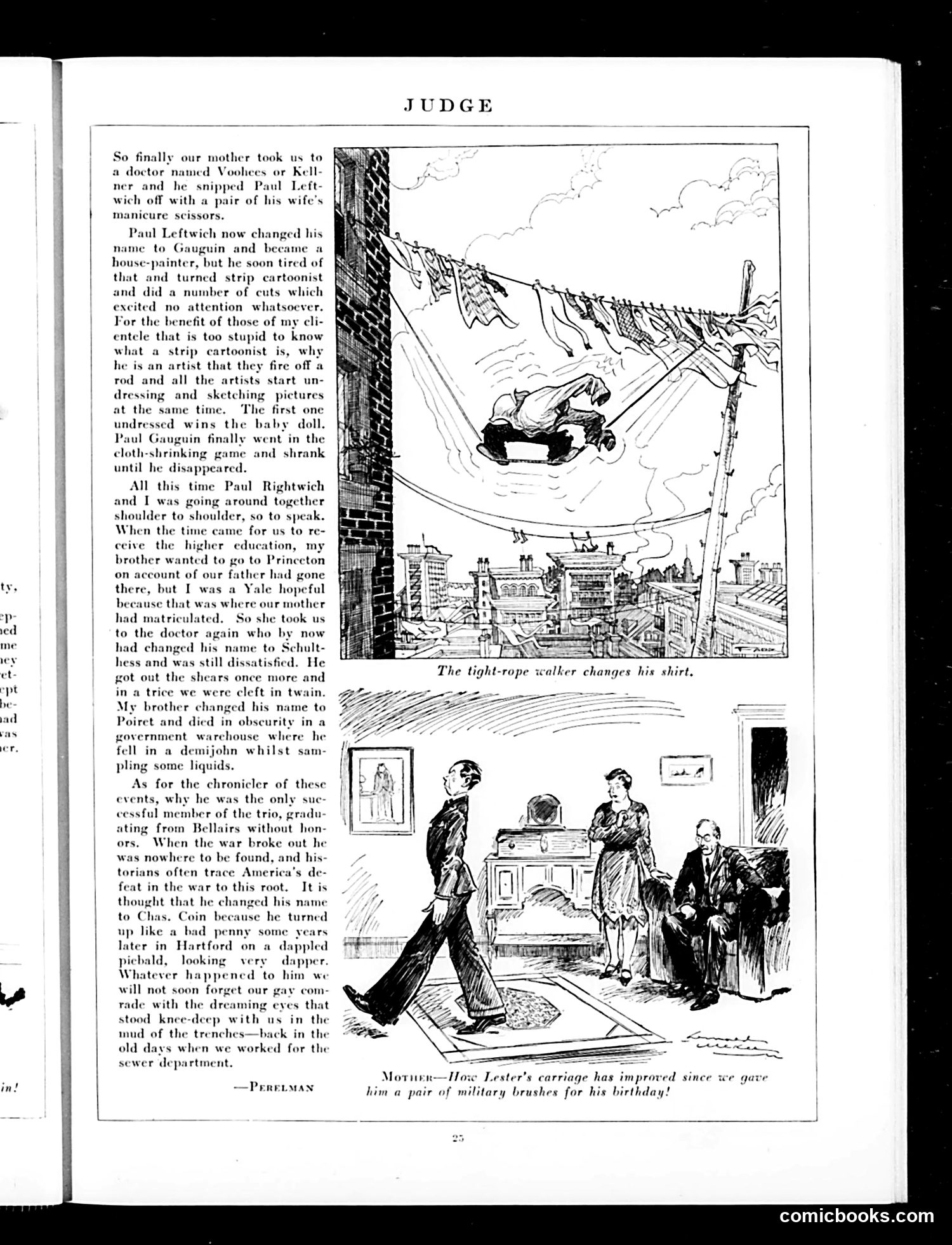
This satirical piece uses absurdist humor to mock several early-20th-century American concerns: artistic pretension, class aspirations, and wartime patriotism. The main narrative is a rambling monologue about twins—Paul Leftwich and Paul Rightwich—separated by their mother's doctor at birth (via comically inappropriate scissors). Each subsequent "Paul" adopts a new identity and fails spectacularly: house-painter, strip cartoonist, Gauguin imitator, fashion designer (Poiret), and failed soldier. The joke targets bohemian artists, aspiring social climbers, and those who claim war service. The final cartoon caption mocks parental gift-giving—suggesting military brushes ("military" being used ironically) improved someone's carriage/deportment, a dig at superficial social improvement. The humor relies on exaggeration and non-sequiturs typical of Judge's satirical style, poking fun at pretense and self-reinvention in American society.
📄 Transcribed text from this page (OCR, searchable)
Machine-transcribed from the original scan — historical spelling and the odd misread are preserved.
JUDGE pur mother took us to | @ a doctor named Voohees or Kell- / ner and he snipped Paul Left- | wich off with a pair of his wife's manicure scissors. Paul Leftwich now changed his name to uin and tb ] house-painter, but he soon tired o | that and turned strip cartoonist | and did a number of cuts which rd no attention whatsoeve For the benefit of those of my cli- entele that is too stupid to know what a strip cartoonist is, why he is an artist that they fire off a rod and all the artists start un- dressing and sketching pictures at the same time. The first one undressed wins the baby doll. Paul Gauguin finally went in the | ] ) | eloth-shrinking game and shrank | until he disappeared. | All this time Paul Rightwich ] and I was going around together shoulder to shoulder, so to speak. When the time came for us to re- ceive the higher education, my brother wanted to go to Princeton | on account of our father had gone there, but I was a Yale hopeful because that where our mother Pp | had matriculated. So she took us to the doctor again who by now had changed his name to Schult- hess and was still dissatisfied. He got out the shears once more and in a trice we were cleft in twain. r My brother changed his name to jad Poiret and diced in obscurity in a government warehouse where he fell in a demijohn whilst sam- pling some liquids. me ey et- ppt ras | er, | As for the chronicler of these events, why he was the only suc- cessful member of the trio, gradu- ating from Bellairs without hon- ors, When the war broke out he ras nowhere to be found, and his- ns often trace America’s de- in the war to this root. It is thought that he changed his name to Chas. Coin because he turned up like a bad penny some years later in Hartford on a dappled piebald, looking very dapper. | Whatever happened to him we ¥ will not soon forget our gay com- , rade with the dreaming eves that stood knee-deep with us in the inud of the trenches—back in the old days when we worked for the sewer department. Moturn—Horwe Lester's carriage has improved since we gave him a pair of military brushes for his birthday! i in! } —Prrreeman | comicbooks.com