
Life, 1928-12-07 · page 22 of 64
Life — December 7, 1928 — page 22: what you’re looking at
What you’re looking at
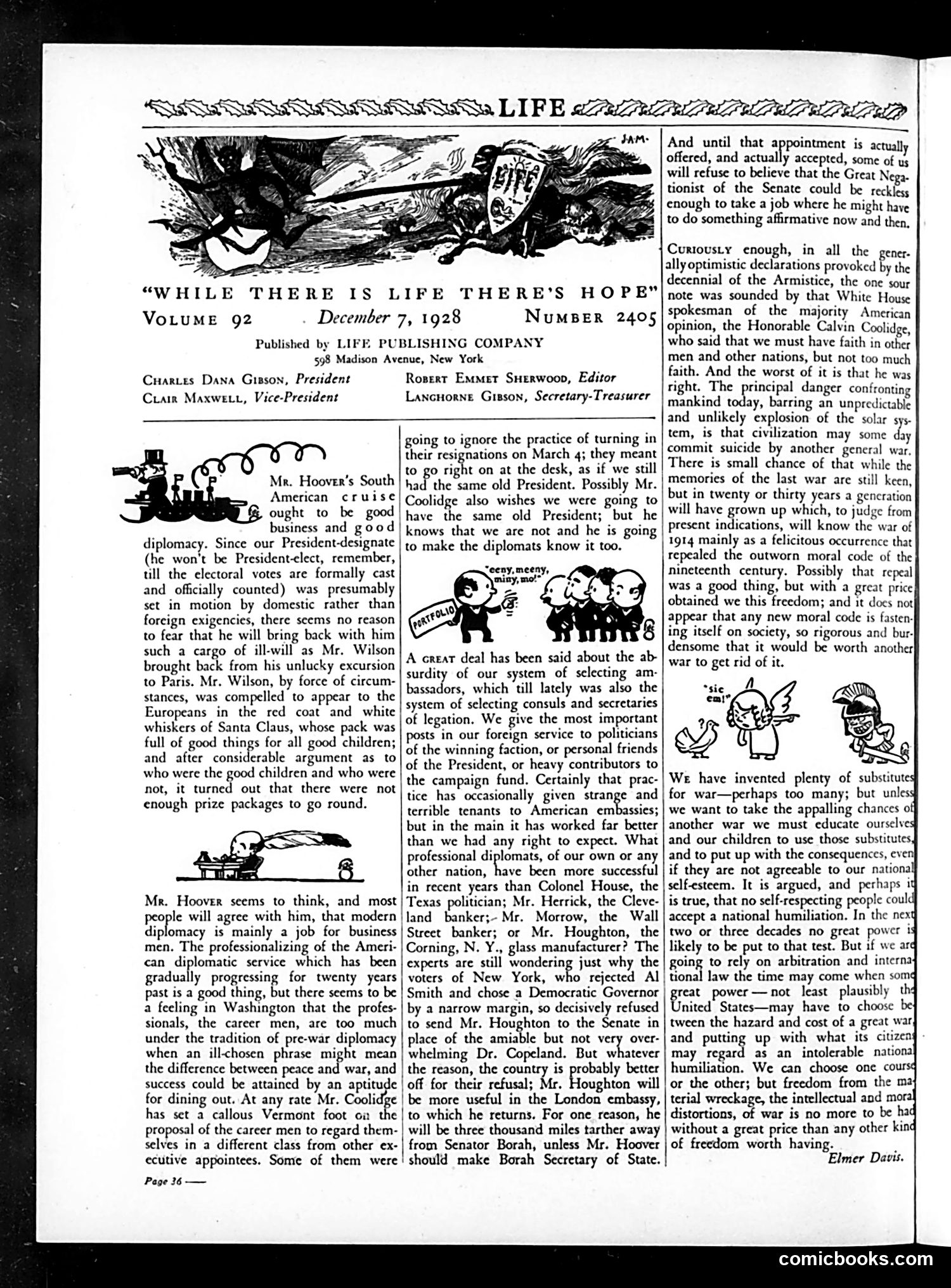
This editorial discusses President-elect Herbert Hoover's (incoming President after Calvin Coolidge) approach to appointing ambassadors and diplomats. The cartoons appear to satirize the traditional spoils system—giving diplomatic posts to wealthy political allies and campaign contributors rather than career professionals. The text references specific controversial appointees: Colonel House, Myron Herrick, Dwight Morrow, and Alanson Houghton. The editorial criticizes how American ambassadorships have historically gone to politicians, wealthy businessmen, and party loyalists rather than merit-based career diplomats. A notable reference: the editorial mocks the New York electorate for voting against sending Houghton to the Senate, then approving his appointment to the London embassy instead—suggesting voters inadvertently moved an unpopular politician further away from home. The piece questions whether Hoover will break with this patronage tradition or whether career diplomats will retain their positions after his inauguration on March 4, 1929.
📄 Transcribed text from this page (OCR, searchable)
Machine-transcribed from the original scan — historical spelling and the odd misread are preserved.
DQSVQse Rs Ws swiss LIFE VoLUME 92 December 7, 1928 damn: NuMBER 2405 Published by LIFE. PUBLISHING COMPANY 598 Madison Avenue, New York Cuarces Dana Gisson, President Crain Maxwett, Vice-President Rosert Emmet SHerwoon, Editor LancHorne Gisson, Secretary-Treasurer or South American cruise ought to be good business and good| diplomacy. Since our President-designate (he won't be President-elect, remember, till the electoral votes are formally cast and officially counted) was presumably set in motion by domestic rather than foreign exigencies, there seems no reason to fear that he will bring back with him such a cargo of ill-will as Mr. Wilson brought back from his unlucky excursion to Paris. Mr. Wilson, by force of circum- stances, was compelled to appear to the Europeans in the red coat and white whiskers of Santa Claus, whose pack was full of good things for all good children; and after considerable argument as to who were the good children and who were not, it turned out that there were not enough prize packages to go round. Mr. Hoover seems to think, and most people will agree with him, that modern | diplomacy is mainly a job for business men. The professionalizing of the Ameri- can diplomatic service which has been gradually progressing for twenty years past is a good thing, but there seems to be a feeling in Washington that the profes- sionals, the career men, are too much under the tradition of pre-war diplomacy when an ill-chosen phrase might mean the difference between peace and war, and success could be attained by an aptitude | for dining out. At any rate Mr. Coolidge has set a callous Vermont foot ou the proposal of the career men to regard them- selves in a different class from other ex- going to ignore the practice of turning in their resignations on March 4; they meant to go right on at the desk, as if we still had the same old President. Possibly Mr. Coolidge also wishes we were going to have the same old President; but he knows that we are not and he is going to make the diplomats know it too. ~ceny,meeny, cy, A creat deal has been said about the ab- surdity of our system of selecting am- bassadors, which till lately was also the system of selecting consuls and secretaries of legation. We give the most important posts in our foreign service to politicians of the winning faction, or personal friends of the President, or heavy contributors to the campaign fund. Certainly that prac- tice has occasionally given strange and terrible tenants to American embassies; but in the main it has worked far better than we had any right to expect. What professional diplomats, of our own or any other nation, have been more successful in recent years than Colonel House, the Texas politician; Mr. Herrick, the Cleve- land banker;- Mr. Morrow, the Wall Street banker; or Mr. Houghton, the Corning, N. Y., glass manufacturer? The experts are still wondering just why the voters of New York, who rejected Al) Smith and chose a Democratic Governor by a narrow margin, so decisively refused to send Mr. Houghton to the Senate in place of the amiable but not very over- whelming Dr. Copeland. But whatever the reason, the country is probably better off for their refusal; Mr. Houghton will be more useful in the London embassy, to which he returns. For one reason, he will be three thousand miles tarther away from Senator Borah, unless Mr. Hoover ecutive appointees. Some of them were! should make Borah Secretary of State. Page 36 — GLE RLLE LEE OLE LAELE ELE LLLP And until that appointment is ac offered, and actual Paced, some wal will refuse to believe that the Great Nega- tionist of the Senate could be reckless enough to take a job where he might have to do something affirmative now and then, } Cuniousty enough, in all the gener- ally optimistic declarations provoked by the decennial of the Armistice, the one sour note was sounded by that White House spokesman of the majority American opinion, the Honorable Calvin Coolidge, who said that we must have faith in other men and other nations, but not too much faith. And the worst of it is that he was right. The principal danger confronting mankind today, barring an unpredictable and unlikely explosion of the solar sys- tem, is that civilization may some iy commit suicide by another general war, There is small chance of that while the memories of the last war are still keen, but in twenty or thirty years a gencration will have grown up which, to judge from | present indications, will know the war of 1914 mainly as a felicitous occurrence that repealed the outworn moral code of the nineteenth century. Possibly that repeal was a good thing, but with a great price obtained we this freedom; and it does not! appear that any new moral code is fasten- ing itself on society, so rigorous and bur- densome that it would be worth another war to get rid of it. We have invented plenty of substitutes for war—perhaps too many; but unle: we want to take the appalling chances o! another war we must educate ourselves and our children to use those substitutes and to put up with the consequences, even if they are not agreeable to our nationa self-esteem. It is argued, and perhaps ig is true, that no self-respecting people coul accept a national humiliation. In the nexq two or three decades no great power ig likely to be put to that test. But if we arg going to rely on arbitration and interna tional law the time may come when somq frat power —not least plausibly th nited States—may have to choose be tween the hazard and cost of a great war and putting up with what its citizen may regard as an intolerable nationa humiliation. We can choose one coursq or the other; but freedom from the ma terial wreckage, the intellectual and mo distortions, of war is no more to be had without a great price than any other kind of freedom worth having. F Elmer Davis. comicbooks.com