
Life, 1928-12-07 · page 3 of 64
Life — December 7, 1928 — page 3: what you’re looking at
What you’re looking at
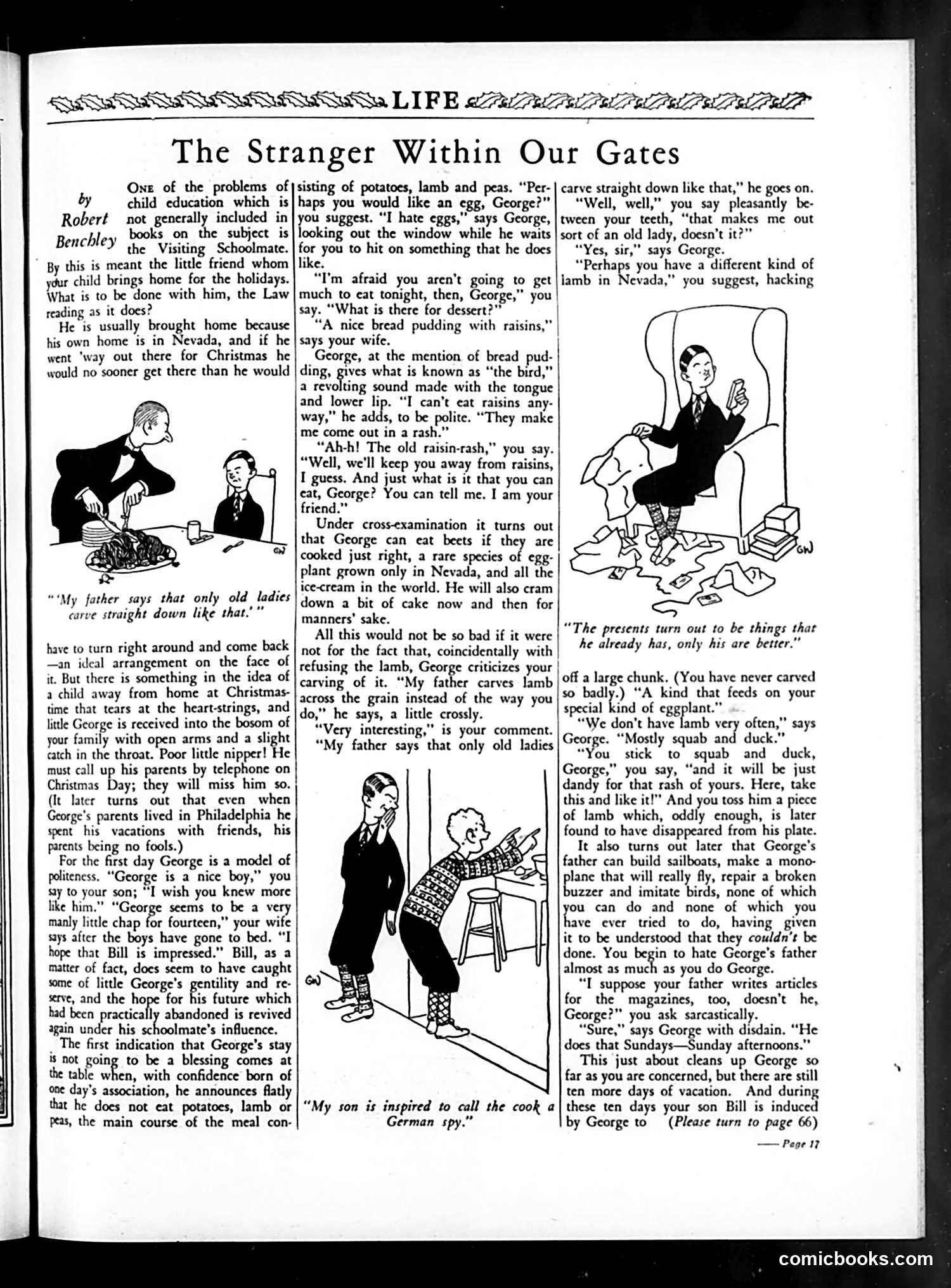
This satirical story by Robert Benchley mocks the awkwardness of hosting a visiting child during Christmas holidays. The humor centers on cultural and regional differences: George, a boy from Nevada, has unfamiliar eating habits and manners that baffle his Eastern host family. The cartoons illustrate George's peculiar behaviors—his unconventional way of carving meat, his preference for squash and duck, his father's work as a magazine writer and airplane builder. The satire gently pokes fun at regional American stereotypes (Nevada versus the East Coast), child-rearing philosophies, and the discomfort of hosting someone whose family customs differ sharply from one's own. The piece reflects early 20th-century American attitudes about regional identity and social etiquette.
📄 Transcribed text from this page (OCR, searchable)
Machine-transcribed from the original scan — historical spelling and the odd misread are preserved.
DPQ WAST LUKE LALA PLE ELLE The Stranger Within Our Gates by child education which is Robert not generally included in Benchley books on the subject is the Visiting Schoolmate. By this is meant the little friend whom ydur child brings home for the holidays. What is to be done with him, the Law reading as it does? He is usually brought home because his own home is in Nevada, and if he went ‘way out there for Christmas he would no sooner get there than he would “‘My father says that only old ladies carve straight down like that.” have to turn right around and come back —an ideal arrangement on the face of it. But there is something in the idea of a child away from home at Christmas- time that tears at the heart-strings, and litle George is received into the bosom of your family with open arms and a slight catch in the throat. Poor little nipper! He must call up his parents by telephone on Christmas Day; they will miss him so. (It later turns out that even when George's parents lived in Philadelphia he spent his vacations with friends, his parents being no fools.) For the first day George is a model of politeness. “George is a nice boy,” you say to your son; “I wish you knew more like him.” “George seems to be a very manly little chap for fourteen,” your wife says after the boys have gone to bed. “I hope that Bill is impressed.” Bill, as a matter of fact, does seem to have caught some of little George's gentility and re- serve, and the hope for his future which had been practically abandoned is revived again under his schoolmate’s influence. _ The first indication that George’s stay is not going to be a blessing comes at the table when, with confidence born of one day's association, he announces flatly that he does not eat potatoes, lamb or peas, the main course of the meal con- haps you would like an egg, George?” you suggest. “I hate eggs,” says George, looking out the window while he waits fe you to hit on something that he does ike. “I'm afraid you aren't going to get much to eat tonight, then, George,” you say. “What is there for dessert?” “A nice bread pudding with raisins,” says your wife. George, at the mention of bread pud- ding, gives what is known as “the bird,” a revolting sound made with the tongue and lower lip. “I can’t eat raisins any- way,” he adds, to be polite. “They make me come out in a rash.” “Ah-h! The old raisin-rash,” you say. “Well, we'll keep you away from raisins, T guess. And just what is it that you can eat, George? You can tell me. I am your friend.” Under cross-examination it turns out that George can eat beets if they are cooked just right, a rare species of egg- plant grown only in Nevada, and all the ice-cream in the world. He will also cram down a bit of cake now and then for manners’ sake. All this would not be so bad if it were not for the fact that, coincidentally with refusing the lamb, George criticizes your carving of it. “My father carves lamb across the grain instead of the way you do,” he says, a little crossly. “Very interesting,” is your comment. “My father says that only old ladies “My son is inspired to call the cook a German spy.” One of the problems of) sisting of potatoes, lamb and peas. “Per-| carve straight down like that,” he goes on. “Well, well,” you say pleasantly be- tween your teeth, “that makes me out sort of an old lady, doesn’t it?” “Yes, sir,” says George. “Perhaps you have a different kind of lamb in Nevada,” you suggest, hacking “The presents turn out to be things that | he already has, only his are better.” | | off a large chunk. (You have never carved so badly.) “A kind that feeds on your special kind of eggplant.” Pie don’t have amb very often,” says George. “Mostly squab and duck.” “You stick to squab and duck, George,” you say, “and it will be just dandy for that rash of yours. Here, take this and like it!” And you toss him a piece of lamb which, oddly enough, is later found to have disappeared from his plate. Tt also turns out later that George's father can build sailboats, make a mono- lane that will really fly, repair a broken buzzer and imitate birds, none of which ou can do and none of which you fave ever tried to do, having given it to be understood that they couldn't be done. You begin to hate George's father almost as much as you do George. “I suppose your father writes articles for the magazines, too, doesn’t he, George?” you ask sarcastically. “Sure,” says George with disdain. “He does that Sundays—Sunday afternoons.” This just about cleans up George so far as you are concerned, but there are still ten more days of vacation. And during these ten days your son Bill is induced by George to (Please turn to page 66) — Pege 17 comicbooks.com