
Life, 1928-12-14 · page 18 of 48
Life — December 14, 1928 — page 18: what you’re looking at
What you’re looking at
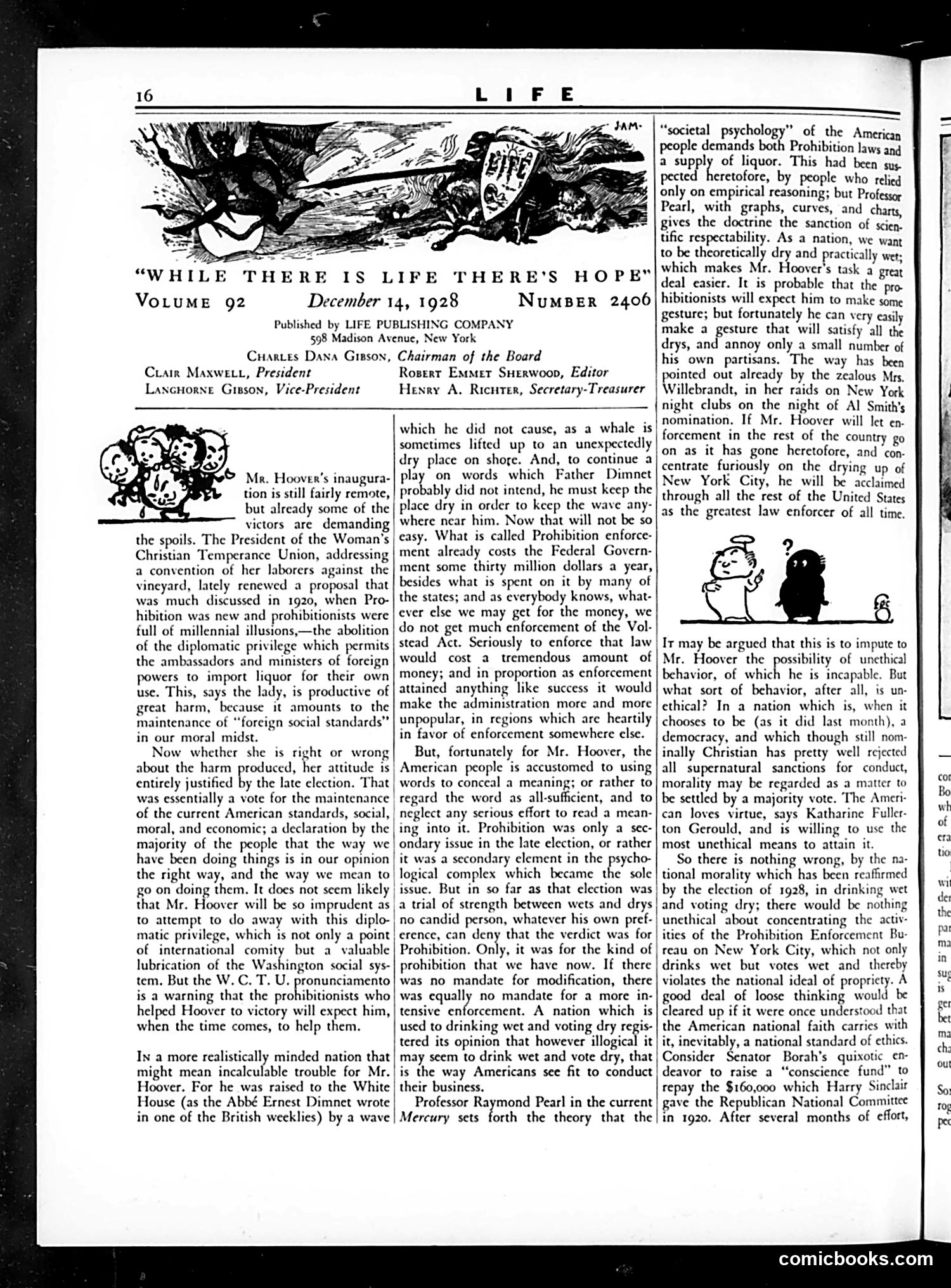
This page critiques President Herbert Hoover's stance on Prohibition enforcement. The main cartoon depicts a figure (likely Hoover) gesturing while a dark shadow figure looms beside him, illustrating the tension between public and private positions on alcohol policy. The text discusses how Hoover, despite being raised in the White House and aware of Prohibition's unpopularity and enforcement costs ($30 million annually to the federal government), would continue supporting the law. The article sarcastically suggests Hoover cannot simultaneously maintain diplomatic privilege while enforcing Prohibition, calling this a moral compromise. The satire targets the perceived hypocrisy of Prohibition policy under Hoover's administration—the gap between what Americans actually wanted and what their government enforced.
📄 Transcribed text from this page (OCR, searchable)
Machine-transcribed from the original scan — historical spelling and the odd misread are preserved.
“WHILE THERE IS L VoLUME 92 December 14, 1928 THERE'S HOPE" NuMBER 2406 IFE Published by LIFE PUBLISHING COMPANY 598 Madison Avenue, New York Crartes Dana Grason, Crain Maxwe tt, President LancHorne Gisson, Vice-President Chairman of the Board Rosert Emmet Suerwoop, Editor Henry A. Ricuter, Secretary-Treasurer Mr. Hoover's inaugura- tion is still fairly remote, but already some of the victors are demanding the spoils. The President of the Woman's Christian Temperance Union, addressing a convention of her laborers against the vineyard, lately renewed a proposal that was much discussed in 1920, when Pro- hibition was new and prohibitionists were full of millennial illustons,—the abolition of the diplomatic privilege which permits the ambassadors and ministers of foreign powers to import liquor for their own use. This, says the lady, is productive of great harm, because it amounts to the maintenance of “foreign social standards” in our moral midst. Now whether she is right or wrong about the harm produced, her attitude is entirely justified by the late election. That | was essentially a vote for the maintenance of the current American standards, social, moral, and economic; a declaration by the | majority of the people that the way we have been doing things is in our opinion | the right way, and the way we mean to go on doing them. It does not seem likely that Mr. Hoover will be so imprudent as | to attempt to do away with this diplo- matic privilege, which is not only a point} of international comity but a valuable lubrication of the Washington social sys- tem, But the W. C. T. U. pronunciamento is a warning that the prohibitionists who helped Hoover to victory will expect him, when the time comes, to help them. Iv a more realistically minded nation that might mean incalculable trouble for Mr. | Hoover. For he was raised to the White | House (as the Abbé Ernest Dimnet wrote in one of the British weeklies) by a wave which he did not cause, as a whale is sometimes lifted up to an unexpectedly dry place on shore. And, to continue a play on words which Father Dimnet probably did not intend, he must keep the place dry in order to keep the wave any- where near him. Now that will not be so easy. What is called Prohibition enforce- ment already costs the Federal Govern- ment some thirty million dollars a year, besides what is spent on it by many of the states; and as everybody knows, what- ever else we may get for the moncy, we do not get much enforcement of the Vol- stead Act. Seriously to enforce that law | would cost a tremendous amount of money; and in proportion as enforcement attained anything like success it would make the administration more and more unpopular, in regions which are heartily in favor of enforcement somewhere else. But, fortunately for Mr. Hoover, the American people is accustomed to using words to conceal a meaning; or rather to regard the word as all-sufficient, and to neglect any serious effort to read a mean- ing into it. Prohibition was only a sec- ondary issue in the late election, or rather it was a secondary element in the psycho- logical complex which became the sole issue. But in so far as that election was a trial of strength between wets and drys no candid person, whatever his own pref- erence, can deny that the verdict was for Prohibition. Only, it was for the kind of prohibition that we have now. If there was no mandate for modification, there was equally no mandate for a more in- tensive enforcement. A nation which is used to drinking wet and voting dry regis- tered its opinion that however illogical it may seem to drink wet and vote dry, that is the way Americans see fit to conduct their business. Professor Raymond Pearl in the current Mercury sets forth the theory that the “societal psychology” of the Ameri people demands both Prohibition lawi ant a sup ly of liquor. This had been sus. pected heretofore, by people who relied only on empirical reasoning; but Professor Pearl, with graphs, curves, and charts, gives the doctrine the sanction of scien. tific respectability. As a nation, we want to be theoretically dry and practically wet; which makes Mr. Hoover's task a great deal easier. It is probable that the pro- hibitionists will expect him to make some gesture; but fortunately he can very easily make a gesture that will satisfy all the drys, and annoy only a small number of his own partisans. The way has been pointed out already by the zealous Mrs. Willebrandt, in her raids on New York night clubs on the night of Al Smith’s nomination. If Mr. Hoover will let en- forcement in the rest of the country go on as it has gone heretofore, and ‘con- centrate furiously on the drying up of New York City, he will be acclaimed through all the rest of the United States as the greatest law enforcer of all time. a 2 me It may be argued that this is to impute to Mr. Hoover the possibility of unethical behavior, of which he is incapable. But what sort of behavior, after all, is un- ethical? In a nation which is, when it chooses to be (as it did last month), a democracy, and which though still nom- inally Christian has pretty well rejected all supernatural sanctions for conduct, morality may be regarded as a matter to be settled by a majority vote. The Ameri- can loves virtue, says Katharine Fuller- ton Gerould, and is willing to use the most unethical means to attain it. So there is nothing wrong, by the na- tional morality which has been reaffirmed by the election of 1928, in drinking wet and voting dry; there would be nothing unethical about concentrating the activ- ities of the Prohibition Enforcement Bu- reau on New York City, which not only drinks wet but votes wet and_ thereby violates the national ideal of propriety. A good deal of loose thinking would be cleared up if it were once understood that the American national faith carries with it, inevitably, a national standard of ethics. Consider Senator Borah’s quixotic en- deavor to raise a “conscience fund” to repay the $160,000 which Harry Sinclair gave the Republican National Committee in 1920. After several months of effort, comicbooks.com