
Life, 1928-12-14 · page 32 of 48
Life — December 14, 1928 — page 32: what you’re looking at
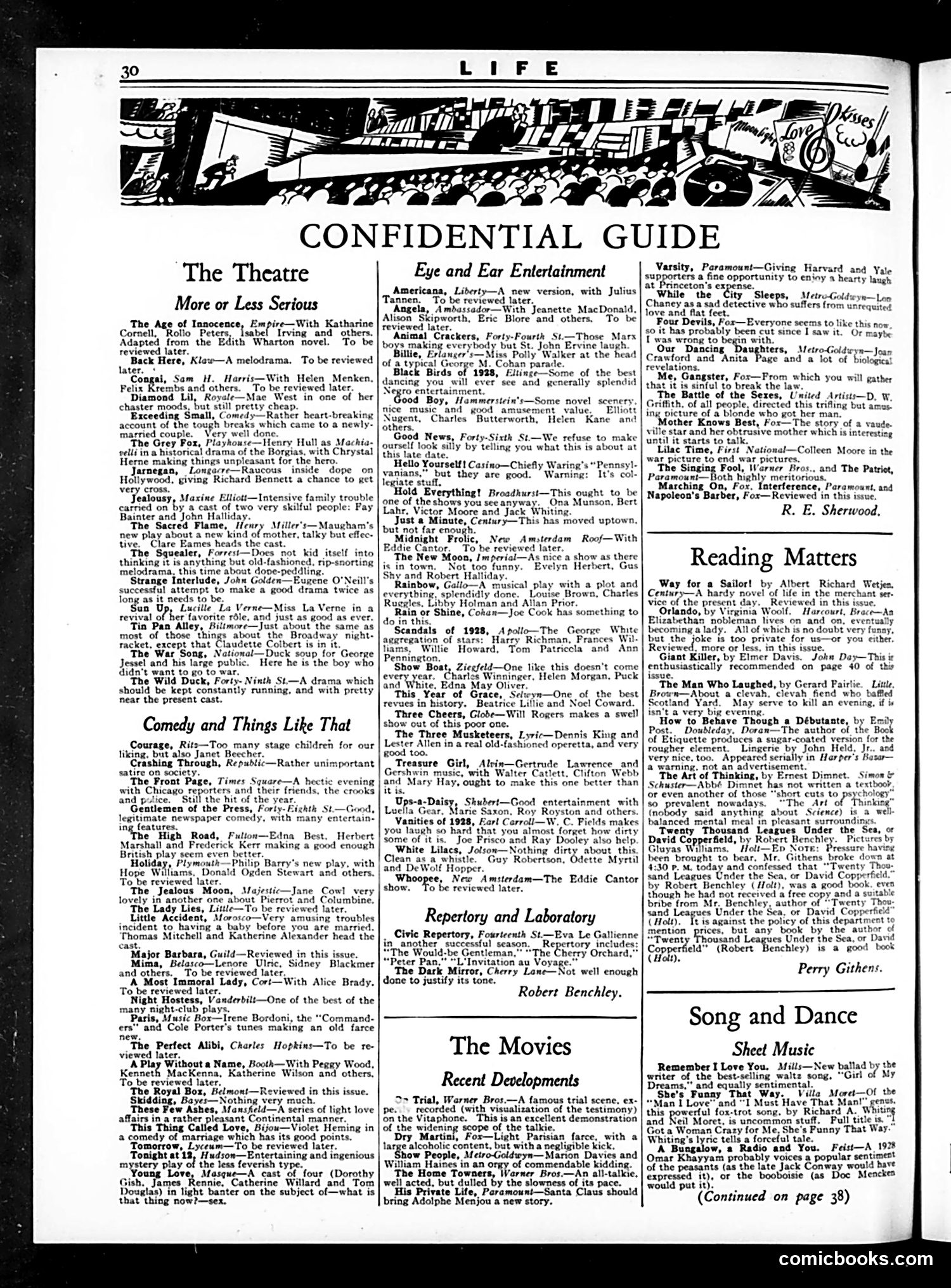
What you’re looking at
This page is a **theatre review guide**, not a political cartoon. It's a "Confidential Guide" listing Broadway shows with brief critical assessments—a standard entertainment feature in Life magazine. The satirical tone appears in the **capsule reviews themselves**. Life's critics offer sharp, witty judgments: "Diamond Lil" is "pretty cheap," "Strange Interlude" is "twice as long as it needs to be," and "Skidding" rates "Nothing very much." The page also includes sections on **movies, music, and dance**. Rather than targeting specific political figures, this represents Life's role as a **cultural arbiter**—using humor and snark to guide readers on entertainment consumption during what appears to be the late 1920s Broadway season. The satire is **social commentary through taste-making**: Life positions itself as sophisticated judges dismissing inferior art while celebrating quality productions.
📄 Transcribed text from this page (OCR, searchable)
Machine-transcribed from the original scan — historical spelling and the odd misread are preserved.
CONFIDENTIAL GUIDE The Theatre More or Less Serious The Age of Innocence, Empire—With Katharine Cornell, Rollo Peters, Isabel Irving and others. Adapted from the Edith Wharton novel. To be reviewed later. . Back Here, Klow—A melodrama, To be reviewed later. * Congai, Sam H. Harris—With Helen Menken, Pelix Krembs and others. To be reviewed later. Diamond Lil, Royale—Mac West in one of her chaster moods, but still pretty cheap. Exceeding Small, Comedy—Rather heart-breaking account of the tough breaks which came to a newly- married couple. Very well done. The Grey Fox, Playhouse—Henry Hull as Machia- velli in a historical drama of the Borgias, with Chrystal Herne making things unpleasant for the hero. Jarnegan, Longacre—Raucous inside dope on Hollywood, giving Richard Bennett a chance to get very cross, 7 Jealousy, Maxine Elliott—Intensive family trouble carried on by a cast of two very skilful people: Bainter and John Halliday. The Sacred Flame, Henry Miller's new play about a new kind of mother, talky but effec tive, Clare Eames heads the cast." The Squealer, Forresi—Does not kid its thinking it is anything but old-fashioned, ri melodrama. this time about dove-peddling. Strange interlude, John Golden—Eugene O'Neill's successful attempt to make a good drama twice as long as it needs to be. ‘Sun Up, Lucille La Verne Miss La Verne ina revival of her favorite role, and just as good as ever. Tin Pan Alley, Biltmore—Just about the same as most of those things about the Broadway night- racket, except that Claudette Colbert is in it. The War Song, Notional—Duck soup for George Jessel and his large public. Here he is the boy who didn't want to go to war. The Wild Duck, For: nth St—A drama which should be kept constantly running, and with pretty near the present cast. Comedy and Things Like That Courage, Rits—Too many stage children for our liking. but'also Janet Beecher. Crashing Through, Republic—Rather unimportant satire on society. The Front Page, Times Square—A hectic evening with Chicago reporters and their friends, the crooks and police. Still the hit of the ye Gentlemen of the Press, Forty- legitimate newspaper comedy, wit ing features. ‘phe High Road, Fulon—Edna Best. Herbert Marshall and Frederick Kerr making a good enough Bnitish play seem even better. Holiday, Plymouth Philip Barry's new play. with Hope Williams, Donald Ogden Stewart and others. To be reviewed later. The Jealous Moon, Majesti—Jane Cowl very lovely in another one about Pierrot and Columbine. The Lady Lies, Little—To be reviewed later. Little Accident, Morosco—Very amusing troubles incident to having a baby before you are married. Thomas Mitchell and Katherine Alexander head the cast. Major Barbara, Guild—Reviewed in this issue. Mima, Belasco—Lenore Ulric, Sidney Blackmer and others. To be reviewed later. ‘A Most Immoral Lady, Cori—With Alice Brady. To be reviewed later. Night Hostess, Vanderbilt—One of the best of the many night-club plays. Paris, Music Box—Irene Bordoni, the “Command- ers” and Cole Porter's tunes making an old farce new, The Perfect Alibi, Charles Hopkins—To be re- viewed later. A Play Without a Name, Booth—With Peggy Wood, Kenneth MacKenna, Katherine Wilson and others, To be reviewed later. . oo The Royal Box, Belmont—Reviewed in this issue. Skidding, Bayes—Nothing very much. These Few Ashes, Mansfeld—A series of light love in a rather pleasant Continental manner. Called Love, Bijou—Violet Heming in a comedy of marriage which has its good points. Tomorrow, Lyceum—To be reviewed later. Tonight at'12, Hudson—Entertaining and ingenious mystery play of the less feverish type. ‘Young Love, Masque—A cast of four (Dorothy Gish, James Rennie, Catherine Willard and Tom Douglas) in light banter on the subject of—what is that thing now?—sex. many entertain: Eye and Ear Entertainment Americana, Liberty—A new version, with Julius ‘annen. To be reviewed later. Angela, Ambassador—With Jeanette MacDonald, Alison Skipworth, Eric Blore and others, To be reviewed later. Animal Crackers, Forty-Fourth St.—Those Marx boys making everybody but St. John Ervine laugh lillie, Erlanger‘s—Miss Polly Walker at the hea: of a typical George M. Cohan parade. Buck Birds of 1938, Eltinge—Some of the best dancing you will ever’ see and generally splendid Negro entertainment. ood Boy, Hammerstecin's—Some novel scenery. nice music and ent value. Elliott Nugent, Charles Helen Kane and others. Good News, Forty-Sixth St.—We refuse to make ourself look silly by telling you what this is about at this late date. Hello Yourself! Casino—Chiefly Waring’: vanians,” but they are good. Warning: legiate stuff. Hold Everything! Broadhurst—This ought to be one of the shows you seeanyway. Ona Munson, Bert Lahr, Victor Moore and Jack Whiting. Just a Minute, Century—This has moved uptown, but not far enough. Midnight Frolic, New Eddie Cantor. To'be rev The New Moon, I mper is in town. Not too funny. hy and Robert Hallida: Rainbow, Gallo—A 2 everything, splendidly se Brown, Charles Ruggles, Libby Holman and Allan Prior. Rain or Shine, Cohan—Joe Cook has something to do in this. . Scandais of 1928, Apollo—The George White aggregation of stars: ‘Harry Richman, Prances Wil- liams, Willie Howard, Tom Patriccla and Ann Pennington. Show Boat, Ziesfeld—One like this doesn't come every year. Charles Winninger, Helen Morgan, Puck and White, Edna May Oliv This Year of Grace, One of the best revues in history. Beatri nd Noel Coward. Three Cheers, Globe—Will Rogers makes a swell show out of this poor one. The Three Musketeer Lester Allen in a real old g00d too. Treasure Girl, Alvin—Gertrude Lawrence and Gershwin music, ‘with Walter Catlett. Clifton Webb and Mary Hay, ought to make this one better than it is. Ups-a-Daisy, Skuber!—Good entertainment with Luella Gear. Mari Vanities of 1928, Earl Carroll—W. C. Pields makes you laugh so hard’ that you almost forget how dirty some of it is. Joe Prisco and Ray Dooley also help White Lilacs, Jolson—Nothing dirty about this lean as a whistle. Guy Robertson, Odette Myrtil and DeWolf Hopper. Whoopee, New Amsterdam—The Eddie Cantor show. To be reviewed later. good amuse: Butterworth, Pennsy!- It's col- Amsterdam Roof—With wed later. —As nice a show as there Evelyn Herbert, Gus with a plot and and very Lyric—Dennis Kin shioned operetta, Repertory and Laboratory __ Civic Repertory, Fourteenth St—Eva Le Gallienne in ‘another successful sea Repertory include The Would-be Gentleman,” “The Cherry Orchard, “Peter Pan,” “L'Invitation au Voyage. The Dark Mirror, Cherry Lane—Not well enough done to justify its tone. Robert Benchley. The Movies Recent Developments ‘D> Trial, Warner Bros.—A famous trial scene, ex- pe... recorded (with visualization of the testimony) on the Vitaphone. This is an excellent demonstration of the widening scope of the talkie. Dry Martini, For—Light Parisian farce, with a large alcoholic content, but with a negligible kick. how People, Metro-Goldwyn—Marion Davies and William Haines in an orgy of commendable kidding. The Home Towners, Warner Bros.—An all-talkie, well acted, but dulled by the slowness of its pace. His Private Life, Paramount—Santa Claus should bring Adolphe Menjou a new story. rie Saxon, Roy Royston and others. | Varsity, Paramount— sup] at sg Harvard and Yat rters a fine opportunity to eniny a hearts Nak While the City “Si MW je the ‘Sleeps, Metro-Goldwyn— Chaney asa sad detective who suffers from unvequtek love and flat fect. Four Devils, For—Everyone seems to so it has probably been cut since I saw I was wrong to begin with, _ Our Dancing Di jughters, Metro-Goldweyn—Joan Crawford and Anita Page and a lot of biologica: revelations. Me, Gangster, For—From which you will gat! that it is sinful to break the law. mie The Battle of the Sexes, United Artists—D. W, Griffith, of all people, directed this trifling but ames. ing picture of a blonde who got her man. Mother Knows Best, Fox—The story of a vaude. ville star and her obtrusive mother which is interes until it starts to talk. Lilac Time, First National—Colleen Moore in the war picture to end war pictures, ‘The Singing Fook, Werner Pros. and The Patret, Paramount— Both highly meritorious. Marching On, For, Interference, this now Or maybe aramount, and Napoleon's Barber, Fox—Reviewed in this issue. R. E. Sherwood, Reading Matters Way for a Sailor! by Albert Richard Wetjes. Century—A hardy novel of life in the merchant ser- vice of the present day. Reviewed in this issue. Orlando, by Virginia Woolf, Harcourt, Brace—Aa Elizabethan nobleman lives on and on, eventually becoming a lady. All of which is no doubt very funny, but the joke is too private for us—or you either. Reviewed, more or less, in this issue. Giant Killer, by Elmer Davis. Joh Day—This ic enthusiastically recommended on page 40 of thir issue. The Man Who Laughed, by Gerard Pairlie. Little Brown—About a clevah, ‘clevah fiend who baflied Scotland Yard. May serve to kill an evening, if is isn't a very big evening. How to Behave Though a Débutante, by Emily Post. Doubleday, Doren—The author of the Book of Etiquette produces a sugar-coated version for the rougher element. Lingerie by John Held, Jr... and very nice, too. Appeared serially in Harper's Basar— a warning, not an advertisement. The Art of Thinking, by Ernest Dimnet. Simon & Schuster—Abbé Dimnet has not written a textboo?, or even another of those “short cuts to psychology” so prevalent nowadays, “The Art of Thinking’ (nobody said anything about Science) is a well balanced mental meal in pleasant surround Twenty Thousand Leagues Under the Sea, or David Copperfield, by Robert Benchley. Pictures by Gluyas Williams. ' Holt—Ep Nore: been brought to bear, Mr. Githens broke 4:30 p. M. today and confessed that “Twenty Th sand Leagues Under the Sea, or David Copperfield, by Robert Benchley (Holt), was a good book. even though he had not received a free copy and a suitable bribe from Mr. Benchley, author of “Twenty Thov: sand Leagues Under the Sea, or David Coppe (Holt). fe is against the policy of this department mention prices, but any book by the author of “Twenty Thousand Leagues Under the Sea, or David Copperfield” (Robert (Holt), jenchley) is a good book Perry Githens. Song and Dance Sheet Music Remember I Love You. Mills—New ballad by tbe writer of the best-selling waltz song, “Girl of My Dreams,”’ and equally sentimental. * ‘She's Funny That Way. Villa Moret—Of the ian I Love” and “I Must Have That Man!” genss. this powerful fox-trot song. by Richard A. Whit and Neil Moret, is uncommon stuff. Pull title is. Got a Woman Crazy for Me, She's Panny That Way. Whiting’s lyric tells. a forceful tale. = A Bungalow, a Radio and You. Feist—A 192 Omar Khayyam probably voices a popular sentimest of the peasants (as the late Jack Conway would have expressed it), of the booboisie (as Doc Menckes would put it). (Continued on page 38) comicbooks.com