
Life, 1929-01-25 · page 23 of 36
Life — January 25, 1929 — page 23: what you’re looking at
What you’re looking at
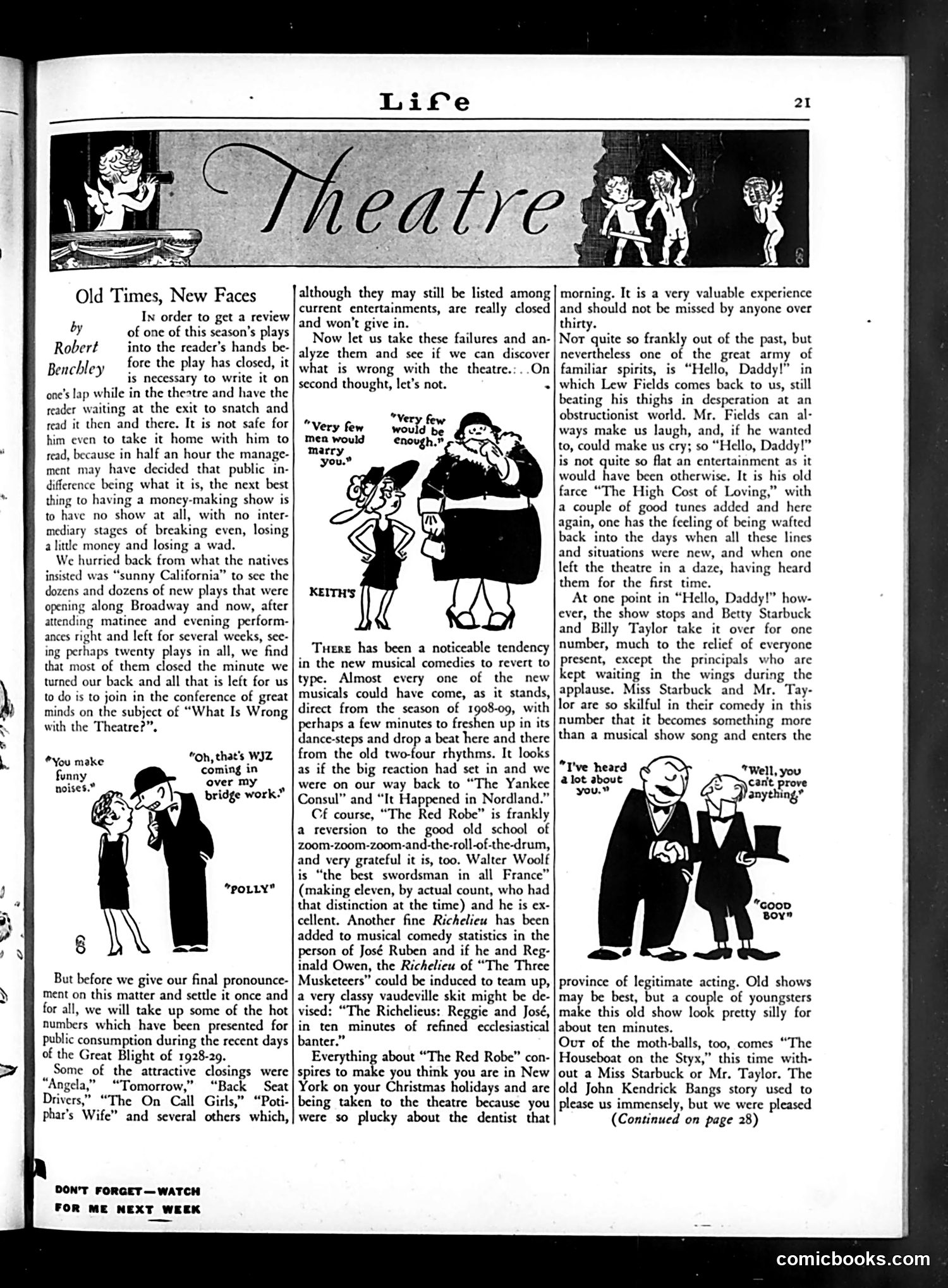
Robert Benchley satirizes Broadway's rapid turnover in 1928-29, complaining that plays close so quickly he must review them in the theatre itself rather than taking notes home. The piece mocks both the theatre industry's instability and critics' endless debate about "What Is Wrong with the Theatre?" The scattered cartoons illustrate conversational snippets—a couple discussing bridge-work interference, another about "funny noises"—representing overheard theatre chitchat that adds little insight. Benchley reviews several current shows, notably praising "The Red Robe" (starring Walter Woolf) as nostalgic spectacle reminiscent of early-1900s musical comedy, and "Hello, Daddy!" featuring veteran performer Lew Fields. He observes that modern musicals are simply revivals of outdated 1908-09 styles rather than innovative work, suggesting Broadway has creatively stalled while churning through productions at unsustainable speed.
📄 Transcribed text from this page (OCR, searchable)
Machine-transcribed from the original scan — historical spelling and the odd misread are preserved.
Old Times, New Faces In order to get a review by of one of this season's plays Robert into the reader’s hands be- Benchley fore the play has closed, it is necessary to write it on one’s lap while in the thestre and have the reader waiting at the exit to snatch and read it then and there. It is not safe for him even to take it home with him to read, because in half an hour the manage- ment may have decided that public in- difference being what it is, the next best thing to having a money-making show is to have no show at all, with no inter- mediary stages of breaking even, losing alittle money and losing a wad. We hurried back from what the natives insisted was “sunny California” to see the dozens and dozens of new plays that were opening along Broadway and now, after attending matinee and evening perform- ances right and left for several weeks, see- ing perhaps twenty plays in all, we find that most of them closed the minute we turned our back and all that is left for us to do is to join in the conference of great minds on the subject of “What Is Wrong with the Theatre?”. “oh, that’s WJZ coming in * over my bridge work.” #You make funny noises. "POLLY" 8 =~ But before we give our final pronounce- ment on this matter and settle it once and for all, we will take up some of the hot numbers which have been presented for public consumption during the recent days of the Great Blight of 1928-29. “ Some of the attractive closings were Angela,” “Tomorrow,” “Back Seat Drivers,” “The On Call Girls,” “Poti- phar’s Wife” and several others which, DON'T FORGET— WATCH FOR ME NEXT WEEK although they may still be listed among current entertainments, are really closed and won't give in. Now let us take these failures and an- alyze them and see if we can discover what is wrong with the theatre.:..On second thought, let’s not. * ve “Very few Ture has been a noticeable tendency in the new musical comedies to revert to type. Almost every one of the new musicals could have come, as it stands, direct from the season of 1908-09, with perhaps a few minutes to freshen up in its dance-steps and drop a beat here and there from the old two-four rhythms. It looks as if the big reaction had set in and we were on our way back to “The Yankee Consul” and “It Happened in Nordland.” Cf course, “The Red Robe” is frankly a reversion to the good old school of zoom-zoom-zoom-and-the-roll-of-the-drum, and very grateful it is, too. Walter Woolf is “the best swordsman in all France” (making eleven, by actual count, who had that distinction at the time) and he is ex- cellent. Another fine Richelieu has been added to musical comedy statistics in the person of José Ruben and if he and Reg- inald Owen, the Richelieu of “The Three Musketeers” could be induced to team up, a very classy vaudeville skit might be de- vised: “The Richelieus: Reggie and José, in ten minutes of refined ecclesiastical banter.” Everything about “The Red Robe” con- spires to make you think you are in New York on your Christmas holidays and are being taken to the theatre because you were so plucky about the dentist that morning. It is a very valuable experience and should not be missed by anyone over thirty. Nor quite so frankly out of the past, but nevertheless one of the great army of familiar spirits, is “Hello, Daddy!” in which Lew Fields comes back to us, still beating his thighs in desperation at an obstructionist world. Mr. Fields can al- ways make us laugh, and, if he wanted to, could make us cry; so “Hello, Daddy!” is not quite so flat an entertainment as it would have been otherwise. It is his old farce “The High Cost of Loving,” with a couple of good tunes added and here again, one has the feeling of being wafted back into the days when all these lines and situations were new, and when one left the theatre in a daze, having heard them for the first time. At one point in “Hello, Daddy!” how- ever, the show stops and Betty Starbuck and Billy Taylor take it over for one number, much to the relief of everyone present, except the principals who are kept waiting in the wings during the applause. Miss Starbuck and Mr. Tay- lor are so skilful in their comedy in this number that it becomes something more than a musical show song and enters the “I've heard alot about province of legitimate acting. Old shows may be best, but a couple of youngsters make this old show look pretty silly for about ten minutes. Out of the moth-balls, too, comes “The Houseboat on the Styx,” this time with- out a Miss Starbuck or Mr. Taylor. The old John Kendrick Bangs story used to please us immensely, but we were pleased (Continued on page 28) comicbooks.com