
Life, 1929-01-25 · page 34 of 36
Life — January 25, 1929 — page 34: what you’re looking at
What you’re looking at
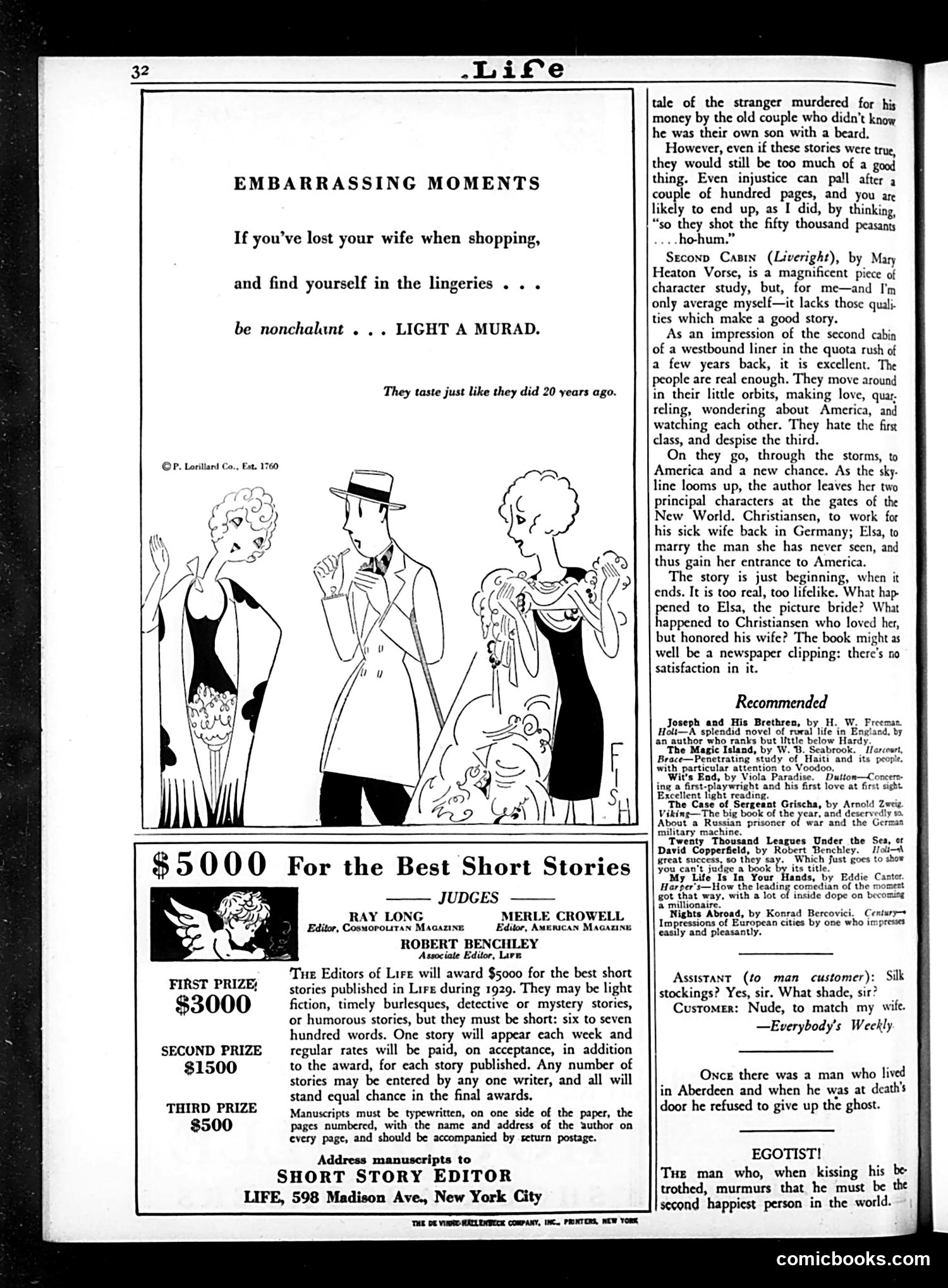
This 1920s advertisement masquerades as humor. The cartoon depicts a man awkwardly confronted by women while shopping in the lingerie section—a scenario considered mortifying for the era's standards of male modesty. The joke relies on gender embarrassment: a man in a women's intimate apparel department was considered deeply uncomfortable social transgression. The "solution" is to smoke a Murad cigarette and appear nonchalant—suggesting cigarettes convey casual sophistication and mask social awkwardness. The tagline "They taste just like they did 20 years ago" emphasizes product consistency. This represents early 20th-century advertising psychology: associating a commercial product with solving social anxiety and projecting masculine confidence. The humor now reads as period-specific gender anxiety rather than genuinely funny.
📄 Transcribed text from this page (OCR, searchable)
Machine-transcribed from the original scan — historical spelling and the odd misread are preserved.
EMBARRASSING MOMENTS If you’ve lost your wife when shopping, and find yourself in the lingeries . . . be nonchalant . . . LIGHT A MURAD. ©P. Lorillard Co., Est, 1760 FIRST PRIZE; $3000 SECOND PRIZE $1500 THIRD PRIZE $500 They taste just like they did 20 years ago. JUDGES RAY LONG MERLE CROWELL Editor, Cosworoutan Macazine Editor, Amnnican Macazixe ROBERT BENCHLEY Associate Editor, Lire Tue Editors of Lire will award $5000 for the best short stories published in Lire during 1929. They may be light fiction, timely burlesques, detective or mystery stories, or humorous stories, but they must be short: six to seven hundred words. One story will appear each week and regular rates will be paid, on acceptance, in addition to the award, for each story published. Any number of stories may be entered by any one writer, and all will stand equal chance in the final awards. Manuscripts must be typewritten, on one side of the paper, the Pages num , with the name and address of the author on every page, and should be accompanied by return postage. Address manuscripts to SHORT STORY EDITOR LIFE, 598 Madison Ave., New York City ‘THE DE VIRNO-WALENBECK COMPANY, INC PRINTERS, NEW YORK tale of the stranger murdered for his money by the old couple who didn’t know he was their own son with a beard. However, even if these stories were true, they would still be too much of a good thing. Even injustice can pall after 3 couple of hundred pages, and you are likely to end up, as I did, by thinking, “so they shot the fifty thousand peasants . ho-hum.” Seconp Canin (Liveright), by Mary Heaton Vorse, is a magnificent piece of character study, but, for me—and I'm only average myself—it lacks those quali- ties which make a good story. As an impression of the second cabin of a westbound liner in the quota rush of a few years back, it is excellent. The people are real enough. They move around in their little orbits, making love, quar. reling, wondering about America, and watching each other. They hate the firs class, and despise the third. On they go, through the storms, to America and a new chance. As the sky- line looms up, the author leaves her two principal characters at the gates of the New World. Christiansen, to work for his sick wife back in Germany; Elsa, to marry the man she has never seen, and thus gain her entrance to America. The story is just beginning, when it ends. It is too real, too lifelike. What hap- pened to Elsa, the picture bride? What happened to Christiansen who loved her, but honored his wife? The book might as well be a newspaper clipping: there's no satisfaction in it. Recommended Joseph and His Brethren, by H. W. Freeman Holi—A splendid novel of rural life in England, by an author who ranks but Ifttle below Hardy. ‘The Magic Island, by W. B. Seabrook. Iarcesrt, Brace—Penetrating ‘study of Haiti and its people, with particular attention to Voodoo. _ Wit's End, by Viola Paradise. Dutton—Concere- ing a first-playwright and his first love at first sight Excellent light reading. The Case of Sergeant Grischa, by Arnold Zweig Vikinge—The big book of the year, and deservedly 2. About a Russian prisoner of war and the German military machine. Twenty Thousand Leagues Under the Sea, er David Copperfield, by Robert Benchley. Holi sgreat success; so they say. Which fast goes to sho you can’t judge a book by its title. My Life Is In Your Hands, by Eddie Canter Har per's—How the leading comedian of the moment got that way, with a lot of inside dope on becoming a millionaire. Oe Nights Abroad, by Konrad Bercovici, C Impressions of European cities by one who i easily and pleasantly. ry Assistant (to man customer): Silk stockings? Yes, sir. What shade, sir? Customer: Nude, to match my wife. —Everybody’s Weekly Once there was a man who lived in Aberdeen and when he was at death’s door he refused to give up the ghost. EGOTIST! Tue man who, when kissing his be trothed, murmurs that he must be the second happiest person in the world. comicbooks.com