
Life, 1929-02-08 · page 11 of 44
Life — February 8, 1929 — page 11: what you’re looking at
What you’re looking at
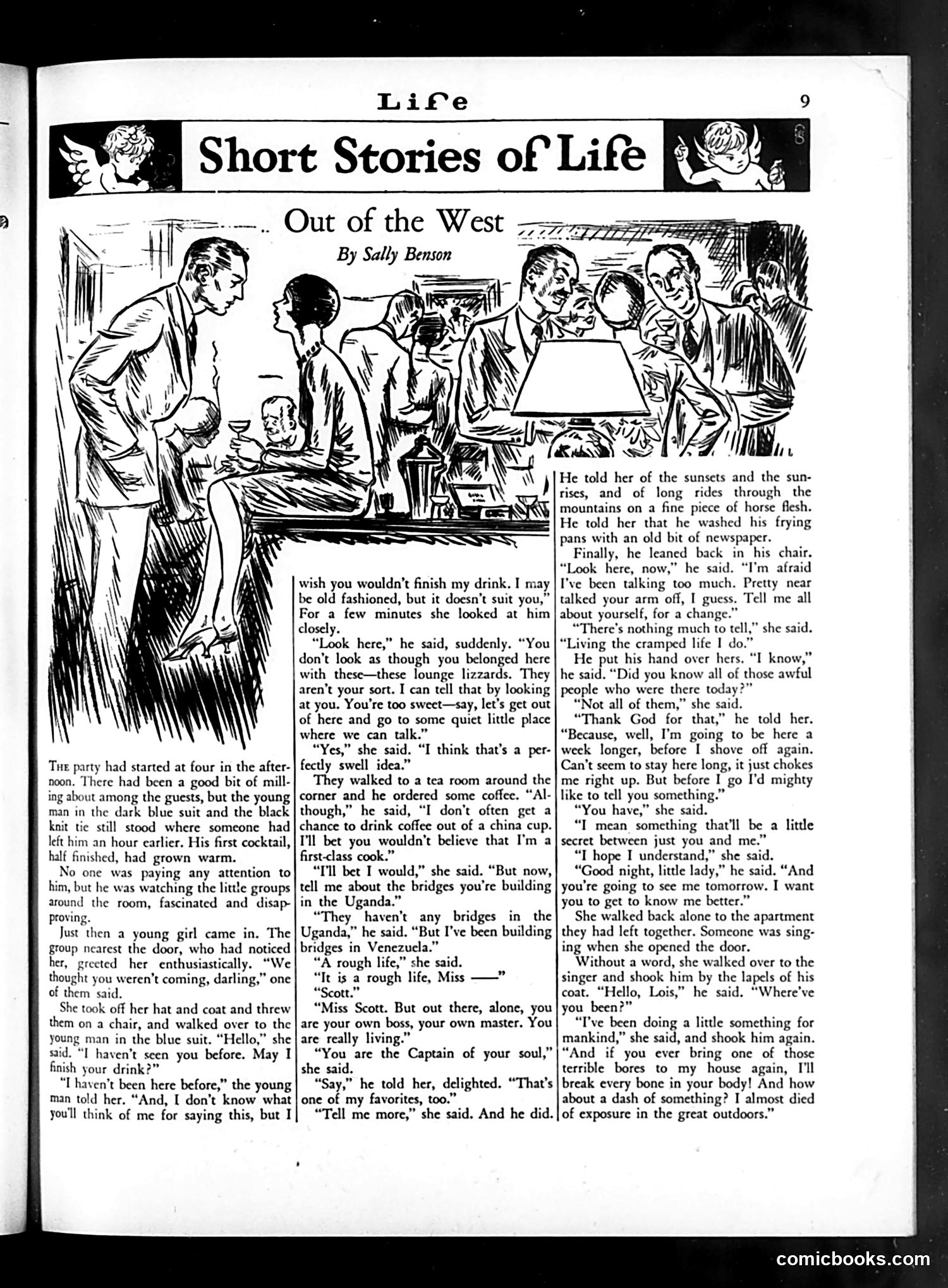
This is a short story, not political satire. The illustration shows a social scene at what appears to be a 1920s-30s cocktail party, where a young woman from the American West has captured a man's attention at an urban gathering. The story's humor derives from class and regional contrasts: the Western woman represents rural authenticity and independence ("you are your own boss, your own master"), while the urban sophistication of the party-goers emphasizes artificiality and constraint. The man finds her refreshing precisely because she's different from the "lounge lizards" surrounding him. The satire targets urban sophistication as shallow, positioning Western directness and frontier values as genuinely appealing alternatives to Eastern pretension.
📄 Transcribed text from this page (OCR, searchable)
Machine-transcribed from the original scan — historical spelling and the odd misread are preserved.
Tue party had started at four in the after- noon. There had been a good bit of mill- ing about among the guests, but the young man in the dark blue suit and the black knit tie still stood where someone had left him an hour earlier. His first cocktail, half finished, had grown warm. No one was paying any attention to him, but he was watching the little groups around the room, fascinated and disap- proving. Just then a young girl came in. The group nearest the door, who had noticed her, greeted her enthusiastically, “We thought you weren’t coming, darling,” one of them said. She took off her hat and coat and threw them on a chair, and walked over to the young man in the blue suit. “Hello,” she said. “I haven't seen you before. May I finish your drink?” “L haven't been here before,” the young man told her. “And, [ don’t know what you'll think of me for saying this, but I wish you wouldn’t finish my drink. I may be old fashioned, but it doesn’t suit you,” For a few minutes she looked at him closely. “Look here,” he said, suddenly. “You don’t look as though you belonged here with these—these lounge lizzards. They aren't your sort. I can tell that by looking at you. You're too sweet—say, let’s get out of here and go to some quiet little place where we can talk.” “Yes,” she said. “I think that’s a per- fectly swell idea.” They walked to a tea room around the corner and he ordered some coffee. “Al- though,” he said, “I don’t often get a chance to drink coffee out of a china cup. T'll bet you wouldn’t believe that I'm a first-class cook.” “T'll bet I would,” she said. “But now, tell me about the bridges you're building in the Uganda.” “They haven't any bridges in the Uganda,” he said. “But I've been building bridges in Venezuela.” “A rough life,” she said. “It is a rough life, Miss “Scott.” “Miss Scott. But out there, alone, you are your own boss, your own master. You are really living.” “You are the Captain of your soul,” she said. “Say,” he told her, delighted. “That's one of my favorites, too.” “Tell me more,” she said. And he did. He told her of the sunsets and the sun- rises, and of long rides through the mountains on a fine piece of horse flesh. He told her that he washed his frying pans with an old bit of newspaper. Finally, he leaned back in his chair. “Look here, now,” he said. “I’m afraid I've been talking too much. Pretty near talked your arm off, I guess. Tell me all about yourself, for a change.” There's nothing much to tell,” “Living the cramped life I do.” He put his hand over hers. “I know,” he said. “Did you know all of those awful people who were there today?” “Not all of them,” she said. “Thank God for that,” he told her. “Because, well, I'm going to be here a week longer, before I shove off again. Can't seem to stay here long, it just chokes me right up. But before I go I'd mighty like to tell you something.” “You have,” she said. “I mean something that'll be a litle secret between just you and me.” “T hope I understand,” she said. “Good night, little lady,” he said. “And you're going to see me tomorrow. I want you to get to know me better.” She walked back alone to the apartment they had left together. Someone was sing- ing when she opened the door. Without a word, she walked over to the singer and shook him by the lapels of his coat. “Hello, Lois,” he said. “Where've you been?” “T've been doing a little something for mankind,” she said, and shook him again. “And if you ever bring one of those terrible bores to my house again, I'll break every bone in your body! And how about a dash of something? I almost died of exposure in the great outdoors.” she said. comicbooks.com