
Life, 1929-02-08 · page 26 of 44
Life — February 8, 1929 — page 26: what you’re looking at
What you’re looking at
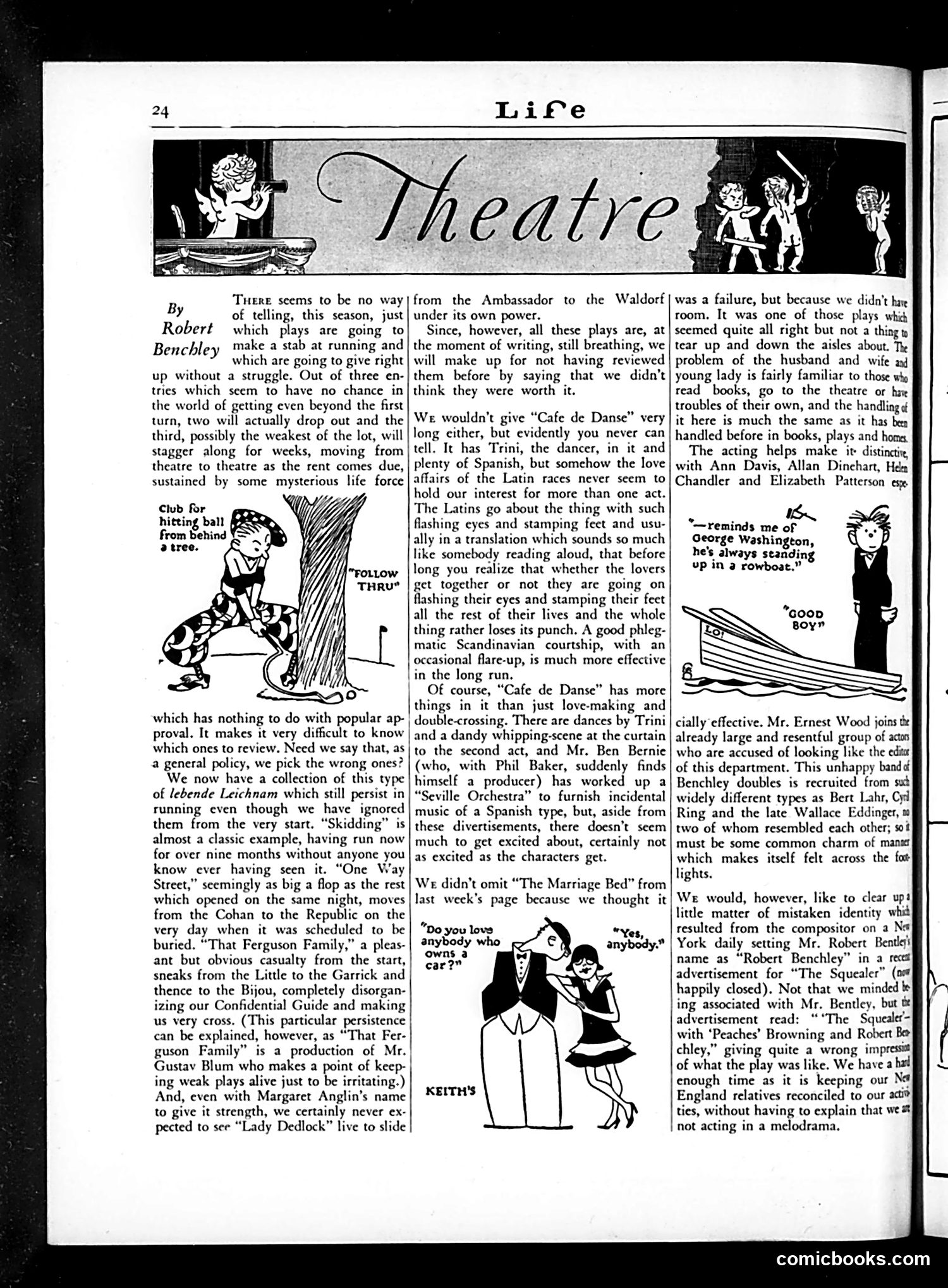
This is a theatre criticism column by Robert Benchley reviewing several Broadway plays. The cartoons illustrate his points humorously: **Left cartoon**: A character "hitting ball from behind a tree" with "FOLLOW THRU" caption—likely mocking weak plays that inexplicably persist despite poor quality, like "Skidding" which ran nine months despite being universally ignored. **Right cartoon**: A domestic scene captioned "Do you love anybody who owns a car?" from Keith's theatre, illustrating "The Marriage Bed"—a play about marital problems Benchley mentions but didn't review due to space. Benchley's main satirical point: Broadway's unpredictability is maddening. Some obviously doomed plays ("Skidding," "Lady Dedlock") inexplicably survive while others disappear. He criticizes "Cafe de Danse" as formulaic Spanish romance with flashy but hollow passion—Scandinavian restraint being more theatrically effective. The satire targets both the theatre industry's randomness and predictable dramatic conventions.
📄 Transcribed text from this page (OCR, searchable)
Machine-transcribed from the original scan — historical spelling and the odd misread are preserved.
There seems to be no way of telling, this season, just which plays are going to make a stab at running and which are going to give right up without a struggle. Out of three en- tries which seem to have no chance in the world of getting even beyond the first turn, two will actually drop out and the third, possibly the weakest of the lot, will stagger along for weeks, moving from theatre to theatre as the rent comes due, sustained by some mysterious life force By Robert Benchley Club for hitting ball which has nothing to do with popular ap- | proval. It makes it very difficult to know which ones to review. Need we say that, as a general policy, we pick the wrong ones? We now have a collection of this type of lebende Leichnam which still persist in running even though we have ignored them from the very start. “Skidding” is almost a classic example, having run now for over nine months without anyone you know ever having seen it. “One Way Street,” seemingly as big a flop as the rest which opened on the same night, moves from the Cohan to the Republic on the very day when it was scheduled to be buried. “That Ferguson Family,” a pleas- ant but obvious casualty from the start, sneaks from the Little to the Garrick and thence to the Bijou, completely disorgan- izing our Confidential Guide and making us very cross. (This particular persistence can be explained, however, as “That Fer- guson Family” is a production of Mr. Gustav Blum who makes a point of keep- ing weak plays alive just to be irritating.) And, even with Margaret Anglin’s name to give it strength, we certainly never ex- pected to see “Lady Dedlock” live to slide from the Ambassador to the Waldorf under its own power. Since, however, all these plays are, at the moment of writing, still breathing, we will make up for not having reviewed them before by saying that we didn’t think they were worth it. We wouldn't give “Cafe de Danse” very long either, but evidently you never can tell. It has Trini, the dancer, in it and plenty of Spanish, but somehow the love affairs of the Latin races never seem to hold our interest for more than one act. The Latins go about the thing with such flashing eyes and stamping feet and usu- ally in a translation which sounds so much like somebody reading aloud, that before long you realize that whether the lovers get together or not they are going on flashing their eyes and stamping their feet all the rest of their lives and the whole thing rather loses its punch. A good phleg- matic Scandinavian courtship, with an occasional flare-up, is much more effective in the long run. OF course, “Cafe de Danse” has more things in it than just love-making and double-crossing. There are dances by Trini and a dandy whipping-scene at the curtain to the second act, and Mr. Ben Bernie (who, with Phil Baker, suddenly finds himself a producer) has worked up a “Seville Orchestra” to furnish incidental music of a Spanish type, but, aside from these divertisements, there doesn’t seem much to get excited about, certainly not as excited as the characters get. We didn’t omit “The Marriage Bed” from last week's page because we thought it ° ‘Do you love anybody who owns a car?” KEITH'S was a failure, but because we didn’t hae room. It was one of those plays whid seemed quite all right but not a thing tear up and down the aisles about. The problem of the husband and wife aj young lady is fairly familiar to those who read books, go to the theatre or hie troubles of their own, and the handling ¢ it here is much the same as it has bea handled before in books, plays and homa. The acting helps make it distinctie, with Ann Davis, Allan Dinehart, Hees Chandler and Elizabeth Patterson ese * . i, —reminds me of George Washington, he’s always standing vp in a rowboat.” cially effective. Mr. Ernest Wood joins te already large and resentful group of actos who are accused of looking like the editor of this department. This unhappy band d Benchley doubles is recruited from sud widely different types as Bert Lahr, Cyd Ring and the late Wallace Eddinger, » two of whom resembled each other; sot must be some common charm of manst which makes itself felt across the fot lights. We would, however, like to clear up4 little matter of mistaken identity whit resulted from the compositor on a Ne York daily setting Mr. Robert Bently name as “Robert Benchley” in a rece advertisement for “The Squealer” (ne happily closed). Not that we minded be ing associated with Mr. Bentley, but & advertisement read: “ “The Squealer- with ‘Peaches’ Browning and Robert Be chley,” giving quite a wrong impress of what the play was like. We have a hal enough time as it is keeping our Na England relatives reconciled to our acti? ties, without having to explain that we & | not acting in a melodrama. comicbooks.com