
Life, 1929-02-15 · page 11 of 44
Life — February 15, 1929 — page 11: what you’re looking at
What you’re looking at
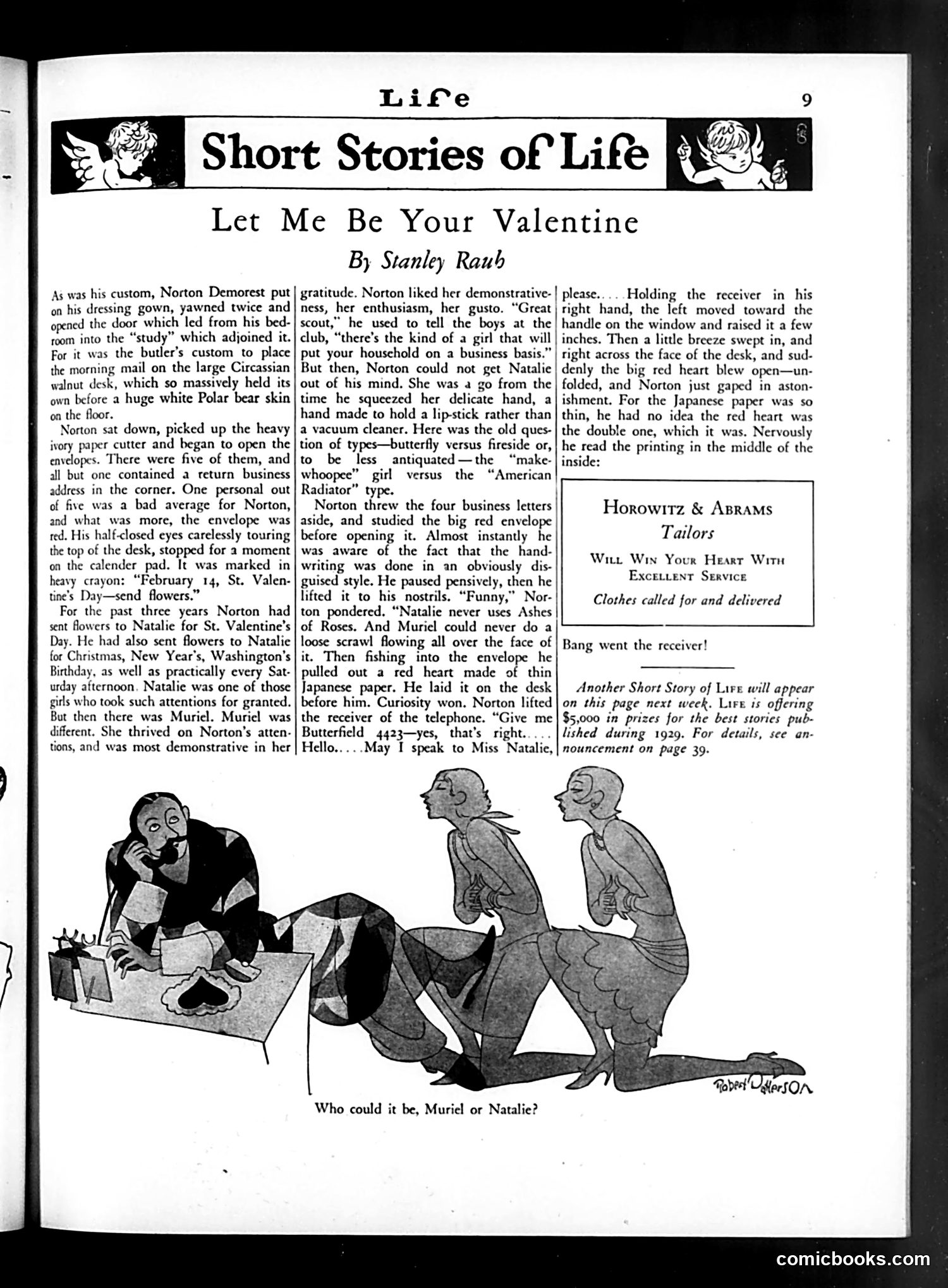
This short story satirizes romantic conventions of the 1930s. The plot follows Norton Demorest, who receives business mail and discovers a Valentine's Day heart from an admirer—but cannot determine whether it's from Natalie or Muriel, two women vying for his attention. The cartoon at bottom, captioned "Who could it be, Muriel or Natalie?", shows two identical mermaid-like figures approaching Norton at his desk, making the ambiguity visual. The satire mocks male indecision in romance and the similar, interchangeable nature of his suitors—both women present themselves identically, suggesting Norton views them as essentially the same despite their competitive efforts for his affection.
📄 Transcribed text from this page (OCR, searchable)
Machine-transcribed from the original scan — historical spelling and the odd misread are preserved.
Let Me Be Your Valentine ‘As was his custom, Norton Demorest put on his dressing gown, yawned twice and opened the door which led from his bed- room into the “study” which adjoined it. For it was the butler’s custom to place the morning mail on the large Circassian walnut desk, which so massively held its own before a huge white Polar bear skin on the floor. Norton sat down, picked up the heavy ivory paper cutter and began to open the envelopes. There were five of them, and all but one contained a return business address in the corner. One personal out of five was a bad average for Norton, and what was more, the envelope was red. His half-closed eyes carelessly touring the top of the desk, stopped for a moment on the calender pad. It was marked in heavy crayon: “February 14, St. Valen- tine’s Day—send flowers.” For the past three years Norton had sent fowers to Natalie for St. Valentine's Day. He had also sent flowers to Natalie for Christmas, New Year's, Washington's Birthday, as well as practically every Sat- urday afternoon, Natalie was one of those girls who took such attentions for granted. But then there was Muriel. Muriel was different. She thrived on Norton’s atten- tions, and was most demonstrative in her By Stanley Raub gratitude. Norton liked her demonstrative- | ness, her enthusiasm, her gusto. “Great scout,” he used to tell the boys at the! club, “there’s the kind of a girl that will put your houschold on a business basis.” But then, Norton could not get Natalie out of his mind. She was a go from the time he squeezed her delicate hand, a hand made to hold a lip-stick rather than a vacuum cleaner. Here was the old ques- tion of types—butterfly versus fireside or, to be less antiquated—the “make- whoopee” girl versus the “American Radiator” type. Norton threw the four business letters aside, and studied the big red envelope before opening it. Almost instantly he was aware of the fact that the hand- writing was done in an obviously dis- guised style. He paused pensively, then he lifted it to his nostrils. “Funny,” Nor- ton pondered, “Natalie never uses Ashes of Roses. And Muriel could never do a loose scrawl flowing all over the face of it. Then fishing into the envelope he pulled out a red heart made of thin Japanese paper. He laid it on the desk before him. Curiosity won. Norton lifted the receiver of the telephone. “Give me Butterfield 4423—yes, that’s right..... Hello.....May I speak to Miss Natalie, Who could it be, Muriel or Natalie? please.... Holding the receiver in his right hand, the left moved toward the handle on the window and raised it a few inches. Then a little breeze swept in, and right across the face of the desk, and sud- denly the big red heart blew open—un- folded, and Norton just gaped in aston- ishment. For the Japanese paper was so thin, he had no idea the red heart was the double one, which it was. Nervously he read the printing in the middle of the inside: Horowitz & ABRAMS Tailors Wit Wis Your Heart Witt Exce.tent Service Clothes called for and delivered Bang went the receiver! Another Short Story of Lire will appear on this page next week. Lire is offering $5,000 in prizes for the best stories pub- lished during 1929. For details, see an- nouncement on page 39. comicbooks.com