
Life, 1929-03-22 · page 22 of 36
Life — March 22, 1929 — page 22: what you’re looking at
What you’re looking at
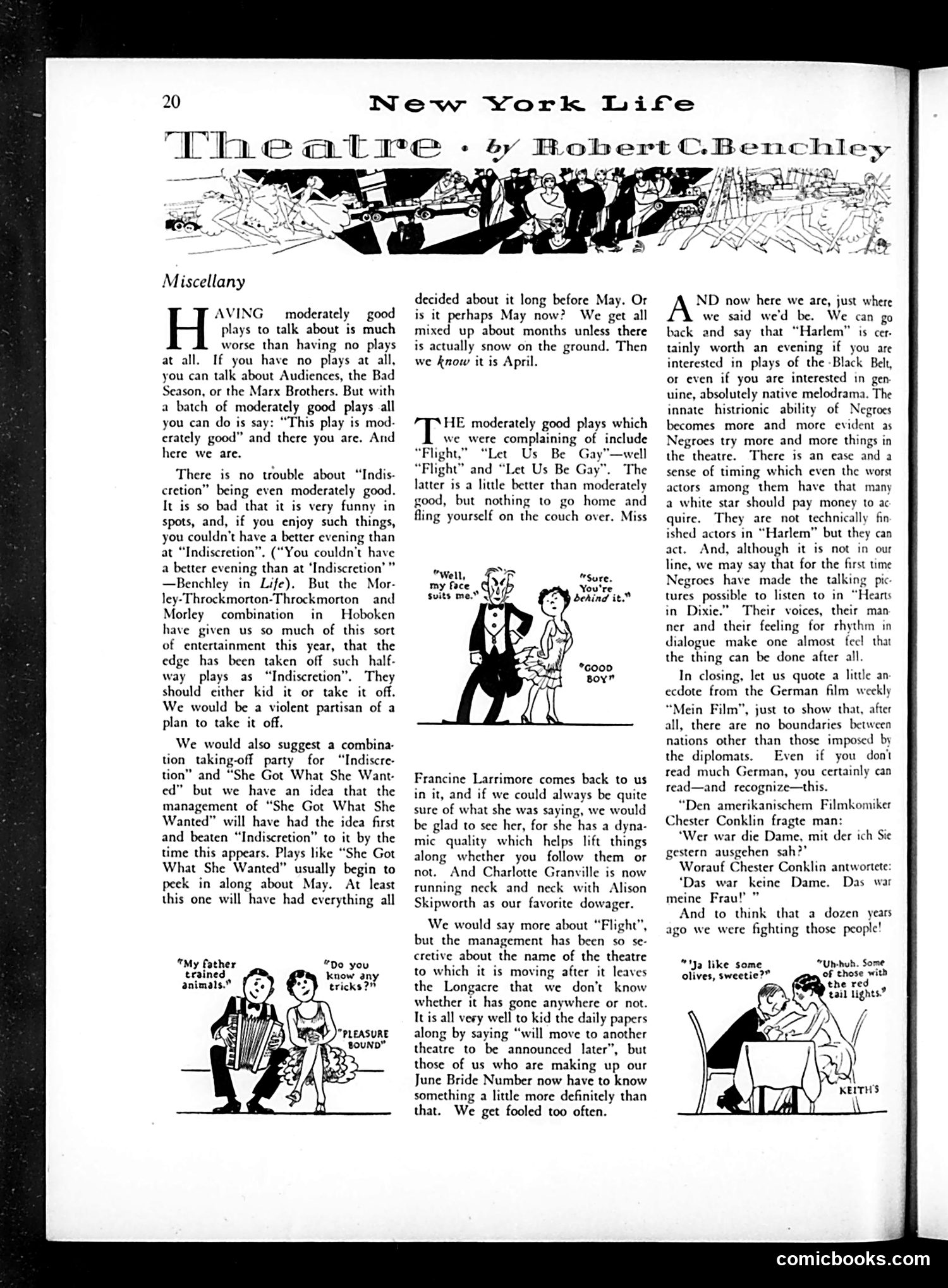
This is Robert C. Benchley's theatrical column reviewing several moderately good Broadway plays. The satirical point: moderately good plays are worse than having nothing to discuss, because you can only repeat "this play is moderately good." Benchley discusses specific productions: "Indiscretion," "She Got What She Wanted," "Flight," and "Let Us Be Gay" (featuring actress Francine Larrimore). He also reviews "Harlem," praising Black performers' natural acting ability and rhythm in dialogue—notably progressive for the era, though still paternalistic in tone. The small cartoons illustrate mundane conversation ("My father trained animals"/"Do you know tricks?") representing the banality of moderate entertainment. Benchley's complaint: theatres moving productions without announcing venues frustrates magazine deadlines. The humor relies on insider theatrical knowledge and Benchley's distinctive, rambling critical voice.
📄 Transcribed text from this page (OCR, searchable)
Machine-transcribed from the original scan — historical spelling and the odd misread are preserved.
20 New York Life Miscellany AVING — moderately good H plays to talk about is much worse than having no plays at all. If you have no plays at all, you can talk about Audiences, the Bad Season, or the Marx Brothers. But with a batch of moderately good plays all you can do is say: “This play is mod- erately good” and there you are. And here we are. There is no trouble about “Indis- cretion” being even moderately good. It is so bad that it is very funny in spots, and, if you enjoy such things, you couldn’t have a better evening than at “Indiscretion”. (“You couldn't have a better evening than at ‘Indiscretion’ ” —Benchley in Life). But the Mor- ley-Throckmorton-Throckmorton and Morley combination in Hoboken have given us so much of this sort of entertainment this year, that the edge has been taken off such half- way plays as “Indiscretion”. They should either kid it or take it off. We would be a violent partisan of a plan to take it off. We would also suggest a combina- tion taking-off party for “Indiscre- tion” and “She Got What She Want- ed” but we have an idea that the management of “She Got What She Wanted” will have had the idea first and beaten “Indiscretion” to it by the time this appears. Plays like “She Got What She Wanted” usually begin to peck in along about May. At least this one will have had everything all "My father trained animals.” "Do you know eny tricks?” decided about it long before May. Or is it perhaps May now? We get all mixed up about months unless there is actually snow on the ground. Then we know it is April. HE moderately good plays which we were complaining of include “Flight,” “Let Us Be Gay"—well “Flight” and “Let Us Be Gay”. The latter is a little better than moderately good, but nothing to go home and fling yourself on the couch over. Miss Well, my face suits me.* Francine Larrimore comes back to us in it, and if we could always be quite sure of what she was saying, we would be glad to see her, for she has a dyna- mic quality which helps lift things along whether you follow them or not. And Charlotte Granville is now running neck and neck with Alison Skipworth as our favorite dowager. We would say more about “Flight”, but the management has been so se- cretive about the name of the theatre to which it is moving after it leaves the Longacre that we don’t know whether it has gone anywhere or not. It is all very well to kid the daily papers along by saying “will move to another theatre to be announced later”, but those of us who are making up our June Bride Number now have to know something a little more definitely than that. We get fooled too often. ND now here we are, just where we said we'd be. We can go back and say that “Harlem” is cer. tainly worth an evening if you are interested in plays of the Black Belt, or even if you are interested in gen. uine, absolutely native melodrama. The innate histrionic ability of Negroes becomes more and more evident as Negroes try more and more things in the theatre. There is an ease and a sense of timing which even the worst actors among them have that many a white star should pay money to ac quire. They are not technically fin ished actors in “Harlem” but they can act. And, although it is not in our line, we may say that for the first time Negroes have made the talking pic- tures possible to listen to in “Hears in Dixie.” Their voices, their man ner and their feeling for rhythm in dialogue make one almost fecl that the thing can be done after all. In closing, let us quote a little an ecdote from the German film weekly “Mein Film”, just to show that, after all, there are no boundaries between nations other than those imposed by the diplomats. Even if you don't read much German, you certainly can read—and_recognize—this. “Den amerikanischem Filmkomiker Chester Conklin fragte man: ‘Wer war die Dame, mit der ich Sie gestern ausgehen sah?* Worauf Chester Conklin antwortete: ‘Das war keine Dame. Das war meine Frau!’ ” And to think that a dozen years ago we were fighting those people! “Ja like some "Ub-huh. Some olives, sweetie?” of those with the red, 4 tail Lights’ % ZI ff BN | }\) \ Pu KEITH'S comicbooks.com