
Life, 1929-05-03 · page 27 of 44
Life — May 3, 1929 — page 27: what you’re looking at
What you’re looking at
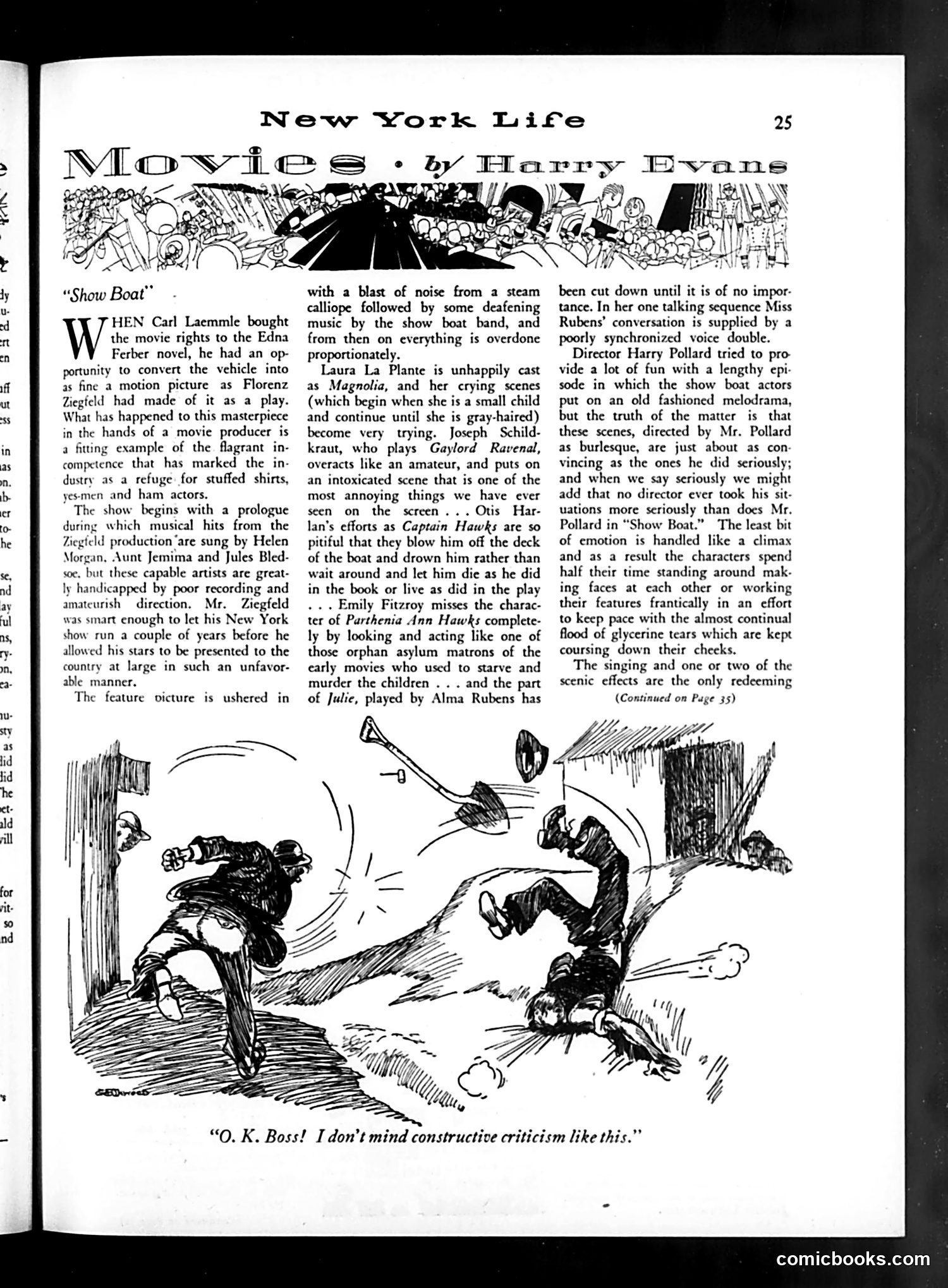
This page reviews the 1929 film adaptation of Edna Ferber's novel "Show Boat." The critic savagely attacks director Harry Pollard and the cast (Laura La Plante, Joseph Schildkraut, Alma Rubens) for overwrought, amateurish performances—excessive crying, overacting, and melodramatic gestures. The review contrasts this unfavorably with the original stage production by Florenz Ziegfeld. The accompanying cartoon illustrates the review's point: two men engage in physical comedy—one knocked backward by the other's punch. The caption reads: "O.K. Boss! I don't mind constructive criticism like this." This is satire: the cartoon suggests the film itself relies on slapstick and broad physical humor rather than genuine artistry, and that such "criticism" (literal violence) is more honest than the movie's pretentious emotional displays. The joke targets both the film's quality and Hollywood's general incompetence during early sound cinema.
📄 Transcribed text from this page (OCR, searchable)
Machine-transcribed from the original scan — historical spelling and the odd misread are preserved.
OV ee ES aat= New York Life 25 “Show Boat’* HEN Carl Laemmle bought W the movie rights to the Edna Ferber novel, he had an op- portunity to convert the vehicle into as fine a motion picture as Florenz Ziegfeld had made of it as a play. What has happened to this masterpiece in the hands of a movie producer is a fitting example of the flagrant in- competence that has marked the in- dustry as a refuge for stuffed shirts, yesmen and ham actors. " The show begins with a prologue during which musical hits from the Ziegield production ‘are sung by Helen Morgan, Aunt Jemima and Jules Bled- soe, but these capable artists are great- ly handicapped by poor recording and amateurish direction. Mr. Ziegfeld was smart enough to let his New York show run a couple of years before he allowed his stars to be presented to the country at large in such an unfavor- able manner. The feature victure is ushered in with a blast of noise from a steam calliope followed by some deafening music by the show boat band, and from then on everything is overdone proportionately. Laura La Plante is unhappily cast as Magnolia, and her crying scenes (which begin when she is a small child and continue until she is gray-haired) become very trying. Joseph Schild- kraut, who plays Gaylord Ravenal, overacts like an amateur, and puts on an intoxicated scene that is one of the most annoying things we have ever seen on the screen... Otis Har- lan’s efforts as Captain Hawks are so pitiful that they blow him off the deck of the boat and drown him rather than wait around and let him die as he did in the book or live as did in the play . . » Emily Fitzroy misses the charac- ter of Parthenia Ann Hawks complete- ly by looking and acting like one of those orphan asylum matrons of the early movies who used to starve and murder the children . . . and the part of Julie, played by Alma Rubens has rey Hwans ee been cut down until it is of no impor- tance. In her one talking sequence Miss Rubens’ conversation is supplied by a poorly synchronized voice double. Director Harry Pollard tried to pro vide a lot of fun with a lengthy epi- sode in which the show boat actors put on an old fashioned melodrama, but the truth of the matter is that these scenes, directed by Mr. Pollard as burlesque, are just about as con- vincing as the ones he did seriously; and when we say seriously we might add that no director ever took his sit- uations more seriously than does Mr. Pollard in “Show Boat.” The least bit of emotion is handled like a climax and as a result the characters spend half their time standing around mak- ing faces at each other or working their features frantically in an effort to keep pace with the almost continual flood of glycerine tears which are kept coursing down their cheeks. The singing and one or two of the scenic effects are the only redeeming (Continued on Page 35) “O. K. Boss! I don’t mind constructive criticism like this.” comicbooks.com