
Life, 1929-05-17 · page 30 of 52
Life — May 17, 1929 — page 30: what you’re looking at
What you’re looking at
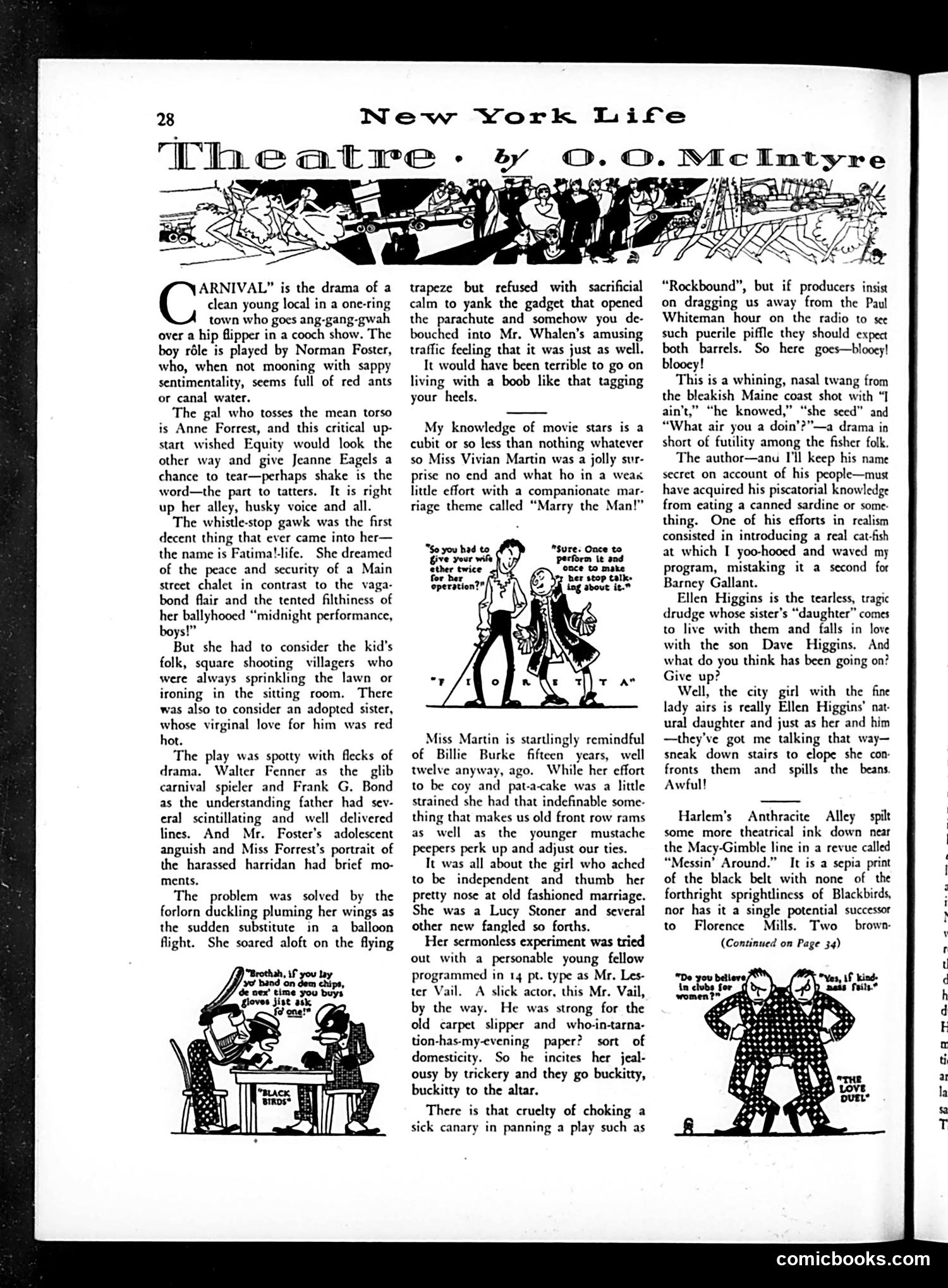
This is a theatre criticism column by O.O. McIntyre reviewing three stage productions. The cartoons and illustrations are largely decorative, depicting generic theatrical scenes rather than specific political commentary. **Content summary:** McIntyre reviews "Carnival" (starring Norman Foster and Anne Forrest), criticizing it as melodramatic drivel about a carnival dancer. He praises supporting actors but finds the plot absurd—particularly the climactic balloon scene. "Marry the Man!" starring Vivian Martin receives mixed praise: Martin reminds him of a younger Billie Burke, and the plot about a "Lucy Stoner" (reference to Lucy Stone, women's independence advocate) who rejects traditional marriage amuses him, though he finds it ultimately silly. "Rockbound" gets harsh dismissal as Maine-dialect melodrama so bad the author supposedly used a real catfish as a prop, which McIntyre mistook for part of the set. The column is satirical theatre criticism using exaggerated language ("bloocy! blooey!") typical of 1920s entertainment journalism—mocking contemporary theatre's pretensions rather than addressing politics.
📄 Transcribed text from this page (OCR, searchable)
Machine-transcribed from the original scan — historical spelling and the odd misread are preserved.
28 New York Life ARNIVAL” is the drama of a clean young local in a one-ring town who goes ang-gang-gwah over a hip flipper in a cooch show. The boy réle is played by Norman Foster, who, when not mooning with sappy sentimentality, seems full of red ants or canal water. The gal who tosses the mean torso is Anne Forrest, and this critical up- start wished Equity would look the other way and give Jeanne Eagels a chance to tear—perhaps shake is the word—the part to tatters. It is right up her alley, husky voice and all. The whistle-stop gawk was the first decent thing that ever came into her— the name is Fatimal-life. She dreamed of the peace and security of a Main street chalet in contrast to the vaga- bond flair and the tented filthiness of her ballyhooed “midnight performance, boys!” But she had to consider the kid's folk, square shooting villagers who were always sprinkling the lawn or ironing in the sitting room. There was also to consider an adopted sister, whose virginal love for him was red hot. The play was spotty with flecks of drama. Walter Fenner as the glib carnival spieler and Frank G. Bond as the understanding father had sev- eral scintillating and well delivered lines. And Mr. Foster's adolescent anguish and Miss Forrest’s portrait of the harassed harridan had brief mo- ments. The problem was solved by the forlorn duckling pluming her wings as the sudden substitute in a_ balloon flight. She soared aloft on the flying trapeze but refused with sacrificial calm to yank the gadget that opened the parachute and somehow you de- bouched into Mr. Whalen’s amusing traffic feeling that it was just as well. It would have been terrible to go on living with a boob like that tagging your heels, My knowledge of movie stars is a cubit or so less than nothing whatever so Miss Vivian Martin was a jolly sur- prise no end and what ho in a weax little effort with a companionate mar- riage theme called “Marry the Man!” Miss Martin is startlingly remindful of Billie Burke fifteen years, well twelve anyway, ago. While her effort to be coy and pat-a-cake was a little strained she had that indefinable some- thing that makes us old front row rams as well as the younger mustache peepers perk up and adjust our ties. Tt was all about the girl who ached to be independent and thumb her pretty nose at old fashioned marriage. She was a Lucy Stoner and several other new fangled so forths. Her sermonless experiment was tried out with a personable young fellow programmed in 14 pt. type as Mr. Les- ter Vail. A slick actor, this Mr. Vail, by the way. He was strong for the old carpet slipper and who-in-tarna- tion-has-my-evening paper? sort of domesticity. So he incites her jeal- ousy by trickery and they go buckitty, buckitty to the altar. There is that cruelty of choking a sick canary in panning a play such as “Rockbound”, but if producers insist on dragging us away from the Paul Whiteman hour on the radio to see such puerile piffle they should expect both barrels. So here goes—bloocy! blooey! This is a whining, nasal twang from the bleakish Maine coast shot with “I ain't,” “he knowed,” “she seed” and “What air you a doin’?”—a drama in short of futility among the fisher folk. The author—anu I'll keep his name secret on account of his people—mus have acquired his piscatorial knowledge from eating a canned sardine or some- thing. One of his efforts in realism consisted in introducing a real cat-fish at which I yoo-hooed and waved my program, mistaking it a second for Barney Gallant. Ellen Higgins is the tearless, tragic drudge whose sister’s “daughter” comes to live with them and falls in love with the son Dave Higgins. And what do you think has been going on? Give up? Well, the city girl with the fine lady airs is really Ellen Higgins’ nat- ural daughter and just as her and him —they’ve got me talking that way— sneak down stairs to elope she con- fronts them and _ spills the beans. Awful! Harlem’s Anthracite Alley _ spilt some more theatrical ink down near the Macy-Gimble line in a revue called “Messin’ Around.” It is a sepia print of the black belt with none of the forthright sprightliness of Blackbirds, nor has it a single potential successor to Florence Mills. Two brown- (Continued on Page 34) comicbooks.com 0 Gis te i. a ek ee