
Life, 1929-05-31 · page 14 of 36
Life — May 31, 1929 — page 14: what you’re looking at
What you’re looking at
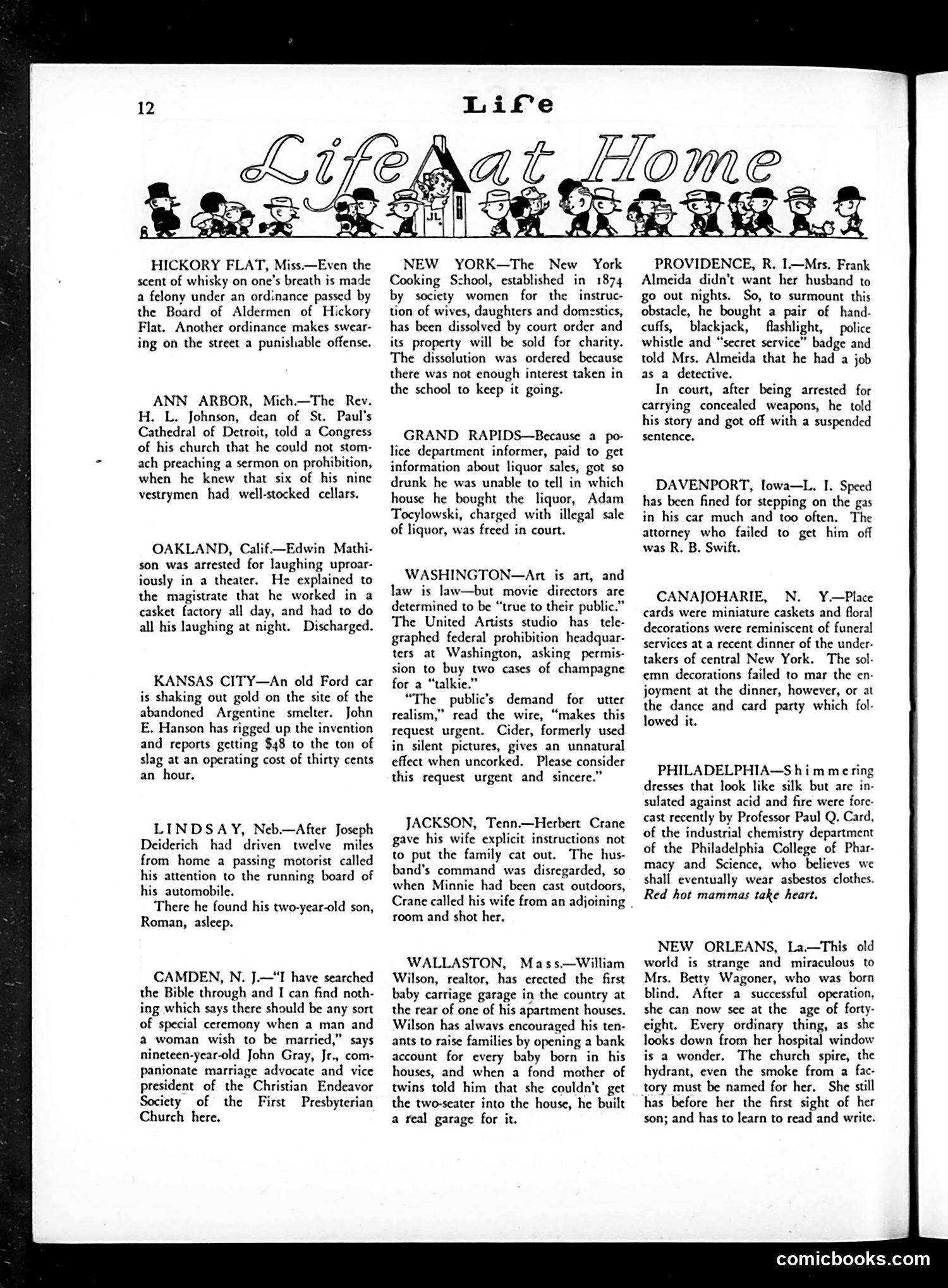
This is a "Life at Home" humor column featuring short anecdotes from various American towns. The header illustration shows a row of figures (adults and children) standing before a house, establishing a domestic theme. The brief stories mock everyday absurdities: a Michigan clergyman's hypocrisy (preaching prohibition while his vestrymen stockpile liquor), a California man arrested for excessive theater laughter, a Nebraska father finding his toddler asleep after a dangerous car ride, and a Kansas inventor monetizing salvaged gold. The column satirizes middle-class American life through situational irony and human folly. Most jokes rely on the contrast between stated values (temperance, proper conduct) and actual behavior. The tone is gently mocking rather than harsh—typical of Life's satirical approach to contemporary society during the Prohibition era.
📄 Transcribed text from this page (OCR, searchable)
Machine-transcribed from the original scan — historical spelling and the odd misread are preserved.
HICKORY FLAT, Miss.—Even the scent of whisky on one’s breath is made a felony under an ordinance passed by the Board of Aldermen of Hickory Flat. Another ordinance makes swear- ing on the street a punishable offense. ANN ARBOR, Mich.—The Rev. H. L. Johnson, dean of St. Paul's Cathedral of Detroit, told a Congress of his church that he could not stom- ach preaching a sermon on prohibition, when he knew that six of his nine vestrymen had well-stocked cellars. OAKLAND, Calif—Edwin Mathi- son was arrested for laughing uproar- iously in a theater. He explained to the magistrate that he worked in a casket factory all day, and had to do all his laughing at night. Discharged. KANSAS CITY—An old Ford car is shaking out gold on the site of the abandoned Argentine smelter. John E. Hanson has rigged up the invention and reports getting $48 to the ton of slag at an operating cost of thirty cents an hour. LINDSAY, Neb.—After Joseph Deiderich had driven twelve miles from home a passing motorist called his attention to the running board of his automobile. There he found his two-year-old son, Roman, asleep. CAMDEN, N. J.—“I have searched the Bible through and I can find noth- ing which says there should be any sort of special ceremony when a man and a woman wish to be married,” says nineteen-year-old John Gray, Jr., com- panionate marriage advocate and vice president of the Christian Endeavor Society of the First Presbyterian Church here. NEW YORK—The New York Cooking School, established in 1874 by society women for the instruc- tion of wives, daughters and domestics, has been dissolved by court order and its property will be sold for charity. The dissolution was ordered because there was not enough interest taken in the school to keep it going. GRAND RAPIDS—Because a po- lice department informer, paid to get information about liquor sales, got so drunk he was unable to tell in which house he bought the liquor, Adam Tocylowski, charged with illegal sale of liquor, was freed in court. WASHINGTON—Art is art, and law is law—but movie directors are determined to be “true to their public.” The United Artists studio has tele- graphed federal prohibition headquar- ters at Washington, asking permis- sion to buy two cases of champagne for a “talkie.” “The public's demand for utter realism,” read the wire, “makes this request urgent. Cider, formerly used in silent pictures, gives an unnatural effect when uncorked. Please consider this request urgent and sincere.” JACKSON, Tenn.—Herbert Crane gave his wife explicit instructions not to put the family cat out. The hus- band’s command was disregarded, so when Minnie had been cast outdoors, Crane called his wife from an adjoining room and shot her. WALLASTON, Mass.—William Wilson, realtor, has erected the first baby carriage garage in the country at the rear of one of his apartment houses. Wilson has always encouraged his ten- ants to raise families by opening a bank account for every baby born in his houses, and when a fond mother of twins told him that she couldn't get the two-seater into the house, he built a real garage for it. PROVIDENCE, R. I—Mrs. Frank Almeida didn’t want her husband to go out nights. So, to surmount this obstacle, he bought a pair of hand- cuffs, blackjack, flashlight, __ police whistle and “secret service” badge and told Mrs. Almeida that he had a job as a detective. In court, after being arrested for carrying concealed weapons, he told his story and got off with a suspended sentence. DAVENPORT, Iowa—L. I. Speed has been fined for stepping on the gas in his car much and too often. The attorney who failed to get him off was R. B. Swift. CANAJOHARIE, N. Y.—Place cards were miniature caskets and floral decorations were reminiscent of funeral services at a recent dinner of the under- takers of central New York. The sol- emn decorations failed to mar the en- joyment at the dinner, however, or at the dance and card party which fol- lowed it. PHILADELPHIA—S hi m me ring dresses that look like silk but are in- sulated against acid and fire were fore- cast recently by Professor Paul Q. Card, of the industrial chemistry department of the Philadelphia College of Phar- macy and Science, who believes we shall eventually wear asbestos clothes. Red hot mammas take heart. NEW ORLEANS, La.—This old world is strange and miraculous to Mrs. Betty Wagoner, who was born blind. After a successful operation, she can now see at the age of forty- eight. Every ordinary thing, as she looks down from her hospital window is a wonder. The church spire, the hydrant, even the smoke from a fac- tory must be named for her. She still has before her the first sight of her son; and has to learn to read and write. comicbooks.com