
Life, 1929-05-31 · page 9 of 36
Life — May 31, 1929 — page 9: what you’re looking at
What you’re looking at
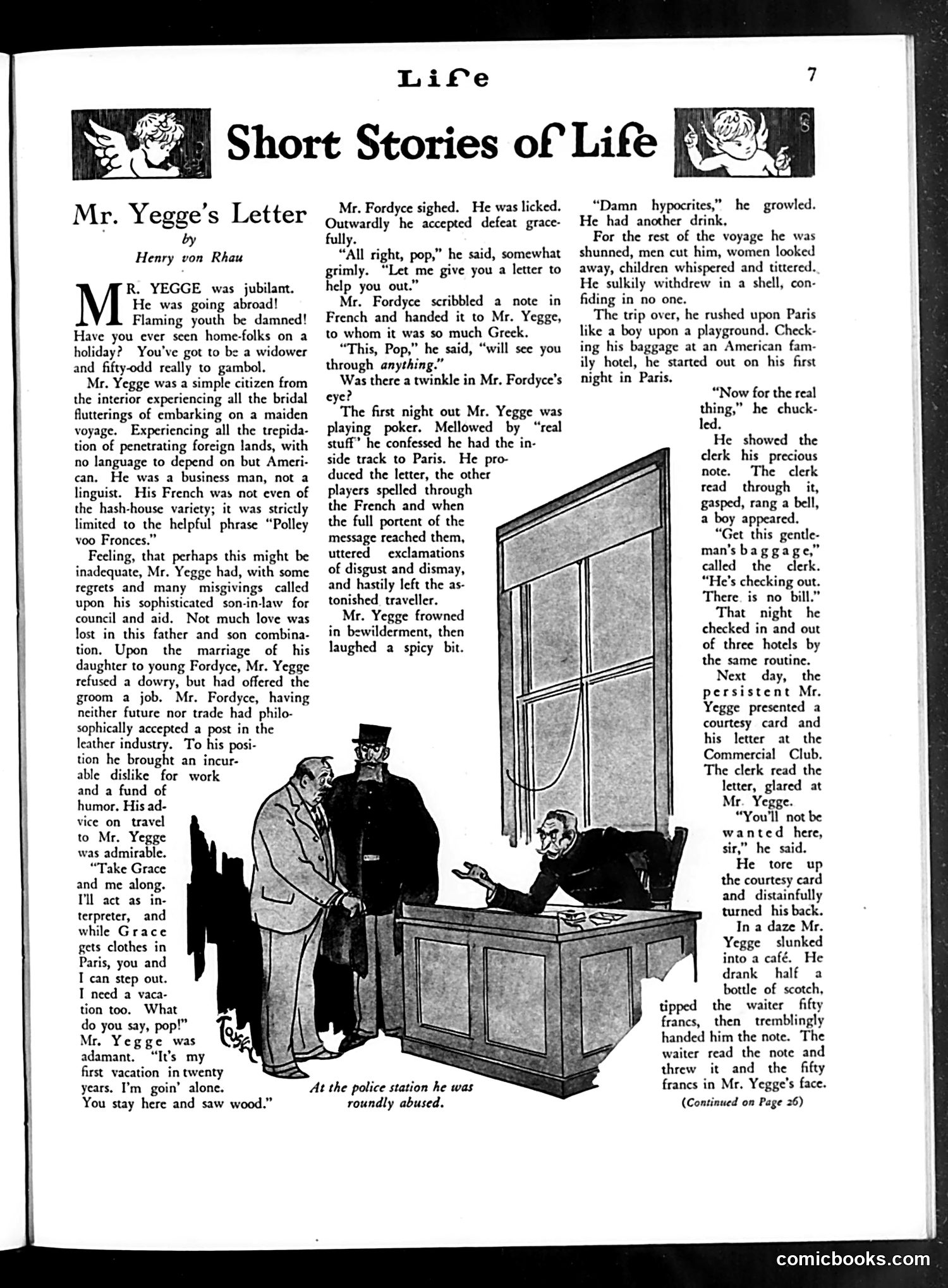
This short story satirizes a bumbling American businessman abroad. Mr. Yegge, described as "jubilant" but unsophisticated, embarks on his first vacation in twenty years. His father-in-law provides a letter of introduction to help him navigate Paris, but Yegge loses it in a poker game. The illustration shows him at a police station being "roundly abused" after the letter's loss creates complications. The satire targets American tourists of the early 20th century—men of business lacking linguistic skills or cultural refinement, prone to gambling and drinking, who bungle their way through European travel. The story mocks both Yegge's naïveté and the embarrassments he creates abroad.
📄 Transcribed text from this page (OCR, searchable)
Machine-transcribed from the original scan — historical spelling and the odd misread are preserved.
Life Short Stories of Life Mr. Yegge’s Letter by Henry von Rhau R. YEGGE was jubilant. He was going abroad! Flaming youth be damned! Have you ever seen home-folks on a holiday? You've got to be a widower and fifty-odd really to gambol. Mr. Yegge was a simple citizen from the interior experiencing all the bridal flutterings of embarking on a maiden voyage. Experiencing all the trepida- tion of penetrating foreign lands, with no language to depend on but Ameri- can. He was a business man, not a linguist. His French was not even of the hash-house variety; it was strictly limited to the helpful phrase “Polley voo Fronces.” Feeling, that perhaps this might be inadequate, Mr. Yegge had, with some regrets and many misgivings called upon his sophisticated son-in-law for council and aid. Not much love was lost in this father and son combina- tion. Upon the marriage of his daughter to young Fordyce, Mr. Yegge refused a dowry, but had offered the groom a job. Mr. Fordyce, having neither future nor trade had philo- sophically accepted a post in the leather industry. To his posi- tion he brought an incur- able dislike for work and a fund of humor. His ad- vice on travel to Mr. Yegge was admirable. “Take Grace and me along. T'll act as in- terpreter, and while Grace gets clothes in Paris, you and T can step out. T need a vaca- tion too. What do you say, pop!” Mr. Yegge was adamant. “It’s my first vacation in twenty years. I'm goin’ alone. You stay here and saw wood.” Mr. Fordyce sighed. He was licked. Outwardly he accepted defeat grace- fully. “All right, pop,” he said, somewhat grimly. “Let me give you a letter to help you out.” Mr. Fordyce scribbled a note in French and handed it to Mr. Yegge, to whom it was so much Greek. “This, Pop,” he said, “will see you through anything.” Was there a twinkle in Mr. Fordyce’s eye? The first night out Mr. Yegge was playing poker. Mellowed by “real stuff” he confessed he had the in- side track to Paris. He pro- duced the letter, the other players spelled through the French and when the full portent of the message reached them, uttered exclamations of disgust and dismay, and hastily left the as- tonished traveller. Mr. Yegge frowned in bewilderment, then laughed a spicy bit. At the police station he was roundly abused. “Damn _ hypocrites,” he growled. He had another drink, For the rest of the voyage he was shunned, men cut him, women looked away, children whispered and tittered. He sulkily withdrew in a shell, con- fiding in no one. The trip over, he rushed upon Paris like a boy upon a playground. Check- ing his baggage at an American fam- ily hotel, he started out on his first night in Paris. “Now for the real thing,” he chuck- led. He showed the clerk his precious note. The clerk read through it, gasped, rang a bell, a boy appeared. “Get this gentle- man’s baggage,” called the clerk. “He's checking out. There. is no bill.” That night he checked in and out of three hotels by the same routine. Next day, the persistent Mr. Yegge presented a courtesy card and his letter at the Commercial Club. The clerk read the letter, glared at Mr. Yegge. “You'll not be wanted here, sir,” he said. He tore up the courtesy card and distainfully turned his back. In a daze Mr. Yegge slunked into a café. He drank half a bottle of scotch, tipped the waiter fifty francs, then tremblingly handed him the note. The waiter read the note and threw it and the fifty francs in Mr. Yegge’s face. (Continued on Page 26) comicbooks.com