
Life, 1929-06-14 · page 18 of 44
Life — June 14, 1929 — page 18: what you’re looking at
What you’re looking at
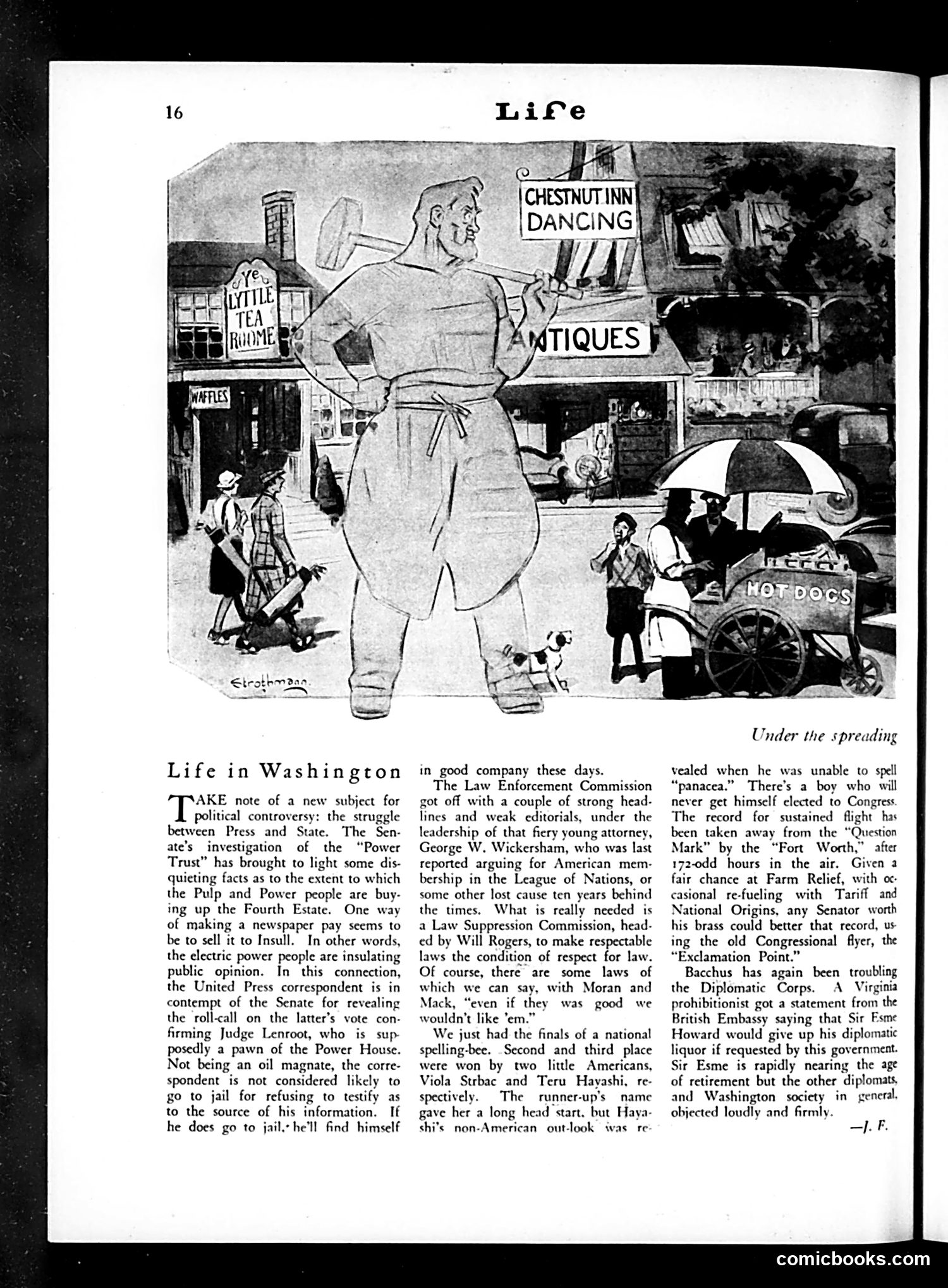
This satirical cartoon depicts a giant figure towering over Washington D.C., representing the outsized influence of the "Power Trust"—a monopolistic electric power industry that was a major political controversy of the era. The text explains the Senate is investigating this corporate power's influence on journalism and politics. The tiny figures below (including a hot dog vendor and pedestrians with an umbrella) emphasize the scale of corporate dominance over ordinary citizens. Visible storefronts reference leisure activities, contrasting everyday life against institutional corruption. The article critiques how the power companies suppress unfavorable press coverage and manipulate public opinion. It names George W. Wickersham as leading reform efforts, suggesting this reflects a real regulatory battle between corporate interests and government oversight.
📄 Transcribed text from this page (OCR, searchable)
Machine-transcribed from the original scan — historical spelling and the odd misread are preserved.
Life in Washington To note of a new subject for political controversy: the struggle between Press and State. The Sen- ate’s investigation of the “Power Trust” has brought to light some dis- quieting facts as to the extent to which the Pulp and Power people are buy- ing up the Fourth Estate. One way of making a newspaper pay seems to be to sell it to Insull. In other words, the electric power people are insulating public opinion. In this connection, the United Press correspondent is in contempt of the Senate for revealing the roll-call on the latter's vote con- firming Judge Lenroot, who is sup- posedly a pawn of the Power House. Not being an oil magnate, the corre- spondent is not considered likely to go to jail for refusing to testify as to the source of his information. If he does go to jail. he'll find himself in good company these days. The Law Enforcement Commission got off with a couple of strong head- lines and weak editorials, under the leadership of that fiery young attorney, George W. Wickersham, who was last reported arguing for American mem- bership in the League of Nations, or some other lost cause ten years behind the times. What is really needed is a Law Suppression Commission, head- ed by Will Rogers, to make respectable laws the condition of respect for law. Of course, there are some laws of which we can say, with Moran and Mack, “even if they was good we wouldn't like ‘em.” We just had the finals of a national spelling-bee. Second and third place were won by two little Americans, Viola Strbac and Teru Hayashi, re- spectively. The runner-up's name gave her a long head start. but Haya- shi’s non-American out-look was re Under the spreading vealed when he was unable to spell “panacea.” There’s a boy who will never get himself elected to Congress. The record for sustained flight has been taken away from the “Question Mark” by the “Fort Worth,” after 172-0dd hours in the air. Given a fair chance at Farm Relief, with oc- casional re-fueling with Tariff and National Origins, any Senator worth his brass could better that record, us ing the old Congressional flyer, the “Exclamation Point.” Bacchus has again been troubling the Diplomatic Corps. A Virginia prohibitionist got a statement from the British Embassy saying that Sir Esme Howard would give up his diplomatic liquor if requested by this government. Sir Esme is rapidly nearing the age of retirement but the other diplomats, and Washington society in general, objected loudly and firmly. -/.F. comicbooks.com