
Life, 1929-06-14 · page 34 of 44
Life — June 14, 1929 — page 34: what you’re looking at
What you’re looking at
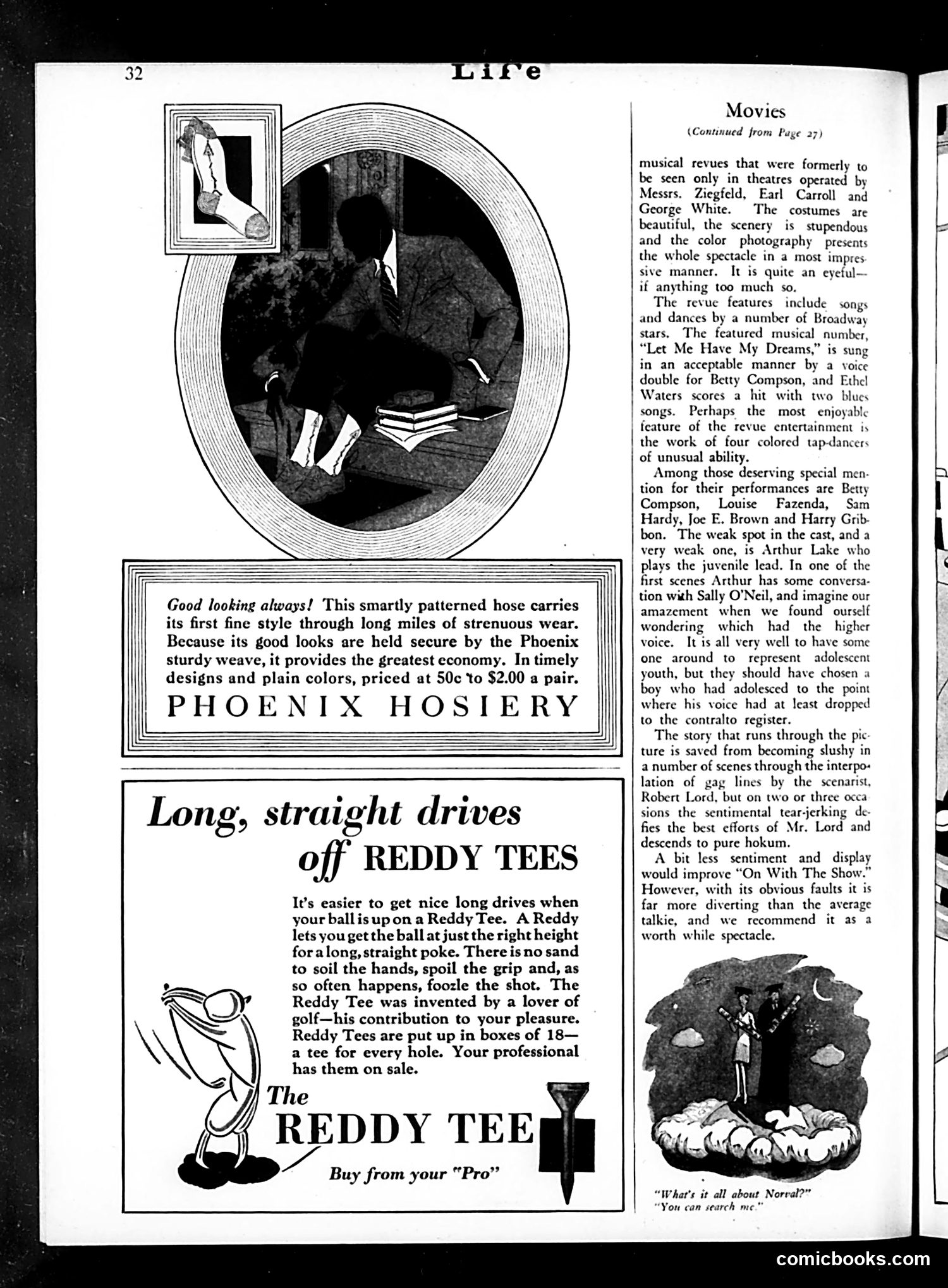
This page is primarily **advertising with a movie review**. The ads promote golf tees and women's hosiery—typical 1920s consumer goods. The small cartoon at bottom right appears to be a joke illustration accompanying the movie review of "On With The Show." The caption—"What's it all about Norval? You can search me"—suggests confusion about the film's plot, likely satirizing the reviewer's critique that the story is weak and sentimental despite entertaining musical numbers. The main movie review criticizes the talkie (early sound film) for relying too heavily on sentimentality and "pure hokum," though it praises the costumes, scenery, tap-dancers, and performances by Betty Compson and Ethel Waters. The reviewer particularly mocks Arthur Lake's casting as juvenile lead, joking his voice hadn't adequately deepened. The cartoon reinforces this satirical tone—characters literally cannot understand what the movie is about.
📄 Transcribed text from this page (OCR, searchable)
Machine-transcribed from the original scan — historical spelling and the odd misread are preserved.
Good looking always! This smartly patterned hose carries its first fine style through long miles of strenuous wear. Because its good looks are held secure by the Phoenix sturdy weave, it provides the greatest economy. In timely designs and plain colors, priced at 50c to $2.00 a pair. PHOENIX HOSIERY Long, straight drives [ off REDDY TEES It’s easier to get nice long drives when your ball is up on a Reddy Tee. A Reddy lets youget the ball at just the right height for along, straight poke. There isno sand to soil the hands, spoil the grip and, as so often happens, foozle the shot. The Reddy Tee was invented by a lover of golf—his contribution to your pleasure. Reddy Tees are put up in boxes of 18— a tee for every hole. Your professional has them on sale. The REDDY TEE Buy from your “Pro” Movies (Continued from Page 27) musical revues that were formerly to be seen only in theatres operated by Messrs. Ziegfeld, Earl Carroll and George White. The costumes are beautiful, the scenery is stupendous and the color photography presents the whole spectacle in a most impres sive manner. It is quite an eyeful— if anything too much so. The revue features include songs and dances by a number of Broadway stars. The featured musical number, “Let Me Have My Dreams,” is sung in an acceptable manner by a voice double for Betty Compson, and Ethel Waters scores a hit with vo blues songs. Perhaps the most enjoyable feature of the revue entertainment is the work of four colored tap-dancers of unusual ability. Among those deserving special men- tion for their performances are Betty Compson, Louise Fazenda, Sam Hardy, Joe E. Brown and Harry Grib- bon. The weak spot in the cast, and a very weak one, is Arthur Lake who plays the juvenile lead. In one of the first scenes Arthur has some conversa- tion with Sally O'Neil, and imagine our amazement when we found ourself wondering which had the higher voice. It is all very well to have some one around to represent adolescent youth, but they should have chosen a boy who had adolesced to the point where his voice had at least dropped to the contralto register. The story that runs through the pic ture is saved from becoming slushy in a number of scenes through the interpo- lation of gag lines by the scenarist, Robert Lord, but on two or three occa sions the sentimental tear-jerking de- fies the best efforts of Mr. Lord and descends to pure hokum. A bit less sentiment and display would improve “On With The Show.” However, with its obvious faults it is far more diverting than the average talkie, and we recommend it as a worth while spectacle. “What's it all about Norval?” “You can search me” comicbooks.com