
Life, 1929-06-28 · page 9 of 37
Life — June 28, 1929 — page 9: what you’re looking at
What you’re looking at
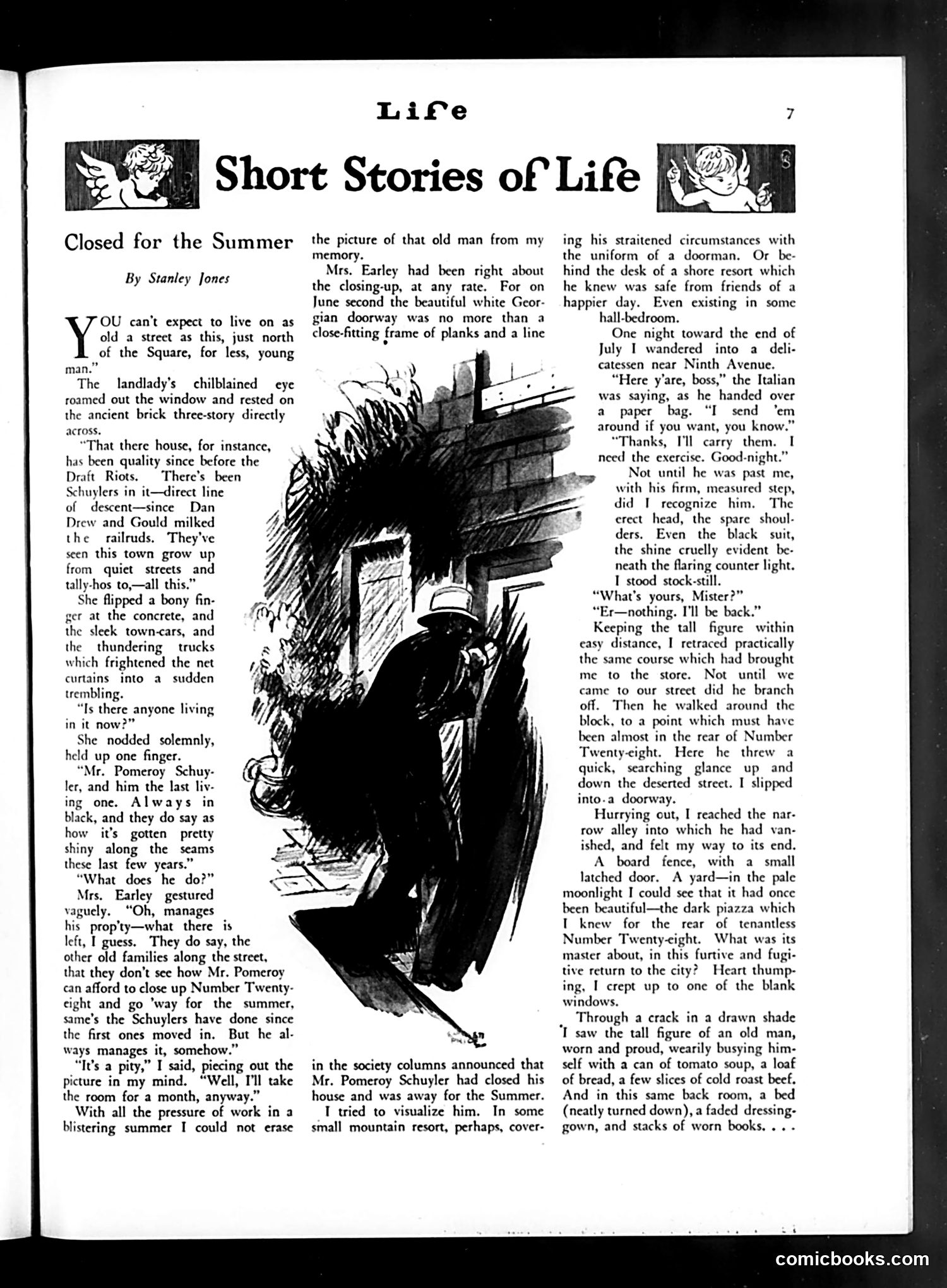
This is a short story about urban decay and social class in early 20th-century New York. The illustration shows a shabby, deteriorating tenement building—likely in a poor neighborhood north of Washington Square. The narrative centers on Mr. Pomeroy Schuyler, a wealthy man who has closed his house for summer vacation. The story explores the contrast between his seasonal absence and the permanent hardship of those living in the surrounding slums. The detailed sketch emphasizes the building's decay and abandonment, reflecting contemporary concerns about urban blight and class inequality. The piece appears to be social commentary on how the wealthy escape the city while the poor remain trapped in declining neighborhoods.
📄 Transcribed text from this page (OCR, searchable)
Machine-transcribed from the original scan — historical spelling and the odd misread are preserved.
Life Short Stories of Life Closed for the Summer By Stanley Jones 4 7 OU can’t expect to live on as old a street as this, just north of the Square, for less, young man.” The landlady’s chilblained eye roamed out the window and rested on the ancient brick three-story directly across. “That there house, for instance, has been quality since before the Draft Riots. There's been Schuylers in it—direct line of descent—since Dan Drew and Gould milked the railruds. They've seen this town grow up from quiet streets and tally-hos to,—all this.” She flipped a bony fin- ger at the concrete, and the sleek town-cars, and the thundering — trucks which frightened the net curtains into a sudden trembling. “Is there anyone living in it now?” She nodded solemnly, held up one finger. “Mr. Pomeroy Schuy- ler, and him the last liv- ing one. Always in black, and they do say as how it’s gotten pretty shiny along the seams these last few years.” “What does he do?” Mrs. Earley gestured vaguely. “Oh, manages his prop'ty—what there is left, I guess. They do say, the other old families along the street, that they don’t see how Mr. Pomeroy can afford to close up Number Twenty- eight and go ‘way for the summer, same’s the Schuylers have done since the first ones moved in. But he al- ways manages it, somehow.” “It’s a pity,” I said, piecing out the picture in my mind. “Well, I'll take the room for a month, anyway.” With all the pressure of work in a blistering summer I could not erase the picture of that old man from my memory. Mrs. Earley had been right about the closing-up, at any rate. For on June second the beautiful white Geor- gian doorway was no more than a close-fitting frame of planks and a line in the society columns announced that Mr. Pomeroy Schuyler had closed his house and was away for the Summer. T tried to visualize him. In some small mountain resort, perhaps, cover- ing his straitened circumstances with the uniform of a doorman, Or be- hind the desk of a shore resort which he knew was safe from friends of a happier day. Even existing in some hall-bedroom. One night toward the end of July I wandered into a deli- catessen near Ninth Avenue. “Here y'are, boss,” the Italian was saying, as he handed over a paper bag. “I send ‘em around if you want, you know.” “Thanks, I'll carry them. I need the exercise. Good-night.” Not until he was past me, with his firm, measured step, did I recognize him. The erect head, the spare shoul- ders. Even the black suit, the shine cruelly evident be- neath the flaring counter light. I stood stock-still. “What's yours, Mister?” “Er—nothing. I'll be back.” Keeping the tall figure within easy distance, I retraced practically the same course which had brought me to the store. Not until we came to our street did he branch off. Then he walked around the block, to a point which must have been almost in the rear of Number Twenty-eight. Here he threw a quick, searching glance up and down the deserted street. I slipped into.a doorway. Hurrying out, I reached the nar- row alley into which he had van- ished, and felt my way to its end. Aboard fence, with a small latched door. A yard—in the pale moonlight I could see that it had once been beautiful—the dark piazza which T knew for the rear of tenantless Number Twenty-cight. What was its master about, in this furtive and fugi- tive return to the city? Heart thump- ing, I crept up to one of the blank windows. Through a crack in a drawn shade ‘T saw the tall figure of an old man, worn and proud, wearily busying him- self with a can of tomato soup, a loaf of bread, a few slices of cold roast beef. And in this same back room, a bed (neatly turned down), a faded dressing- gown, and stacks of worn books... - comicbooks.com