
Life, 1929-07-05 · page 26 of 41
Life — July 5, 1929 — page 26: what you’re looking at
What you’re looking at
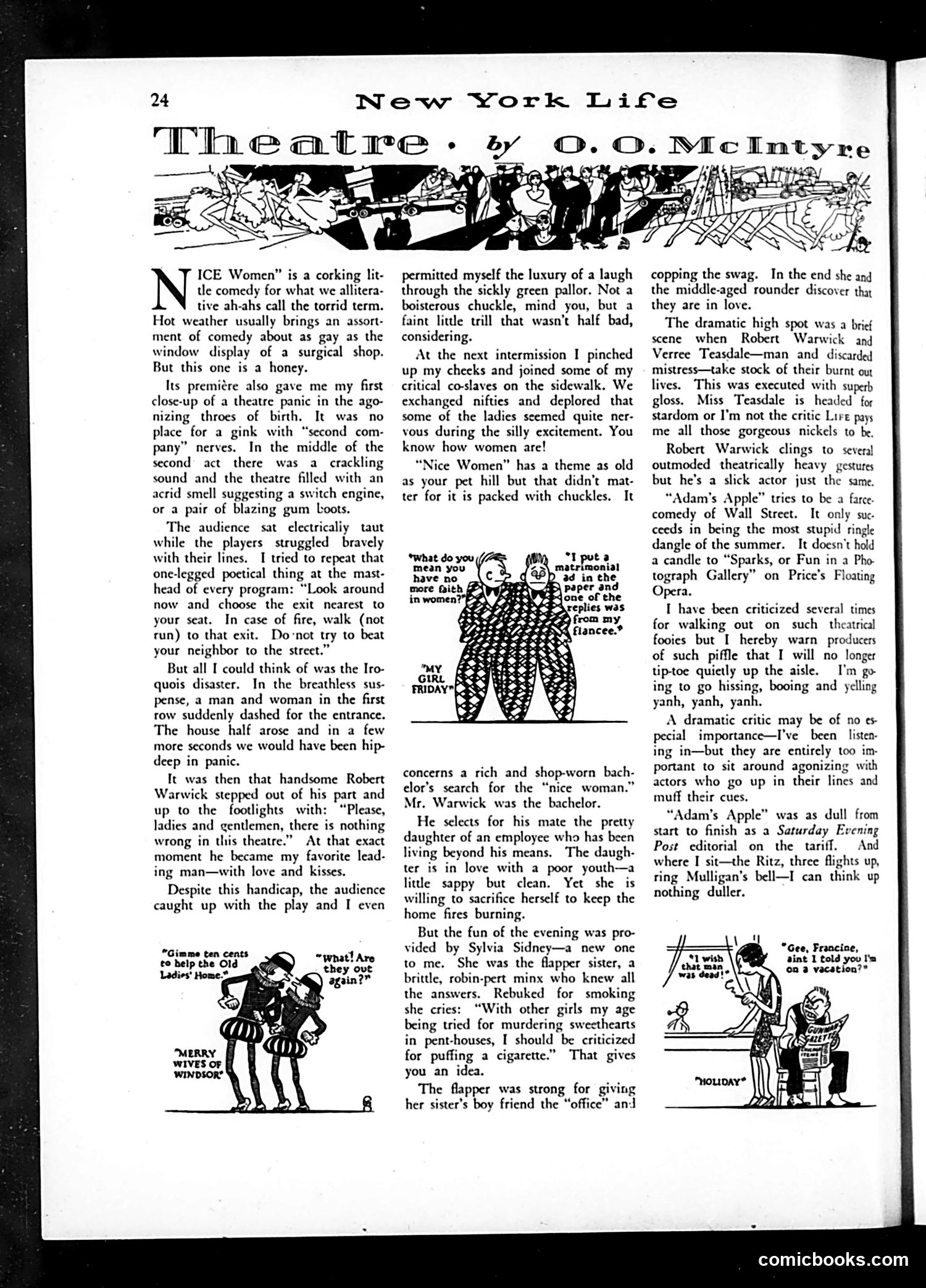
This is O.O. McIntyre's theater column reviewing two Broadway plays. The main review concerns "Nice Women," starring Robert Warwick and featuring newcomer Sylvia Sidney as a flapper character. The satire centers on the flapper archetype—a young woman who smokes, talks back, and makes witty remarks about serious topics (she jokes that murdering sweethearts in "pent-houses" is worse than her cigarette smoking). This represents 1920s anxieties about "modern" women rejecting traditional morality. The column also references a real theatrical emergency—the Iroquois Theatre disaster (a 1903 Chicago fire killing hundreds)—used to humorously illustrate the audience's panic during an unrelated backstage smell. McIntyre praises Warwick's quick thinking in calming panicked patrons. The second play reviewed, "Adam's Apple," is dismissed as worthless. The cartoons appear to illustrate flapper behavior and suburban life, supporting the contemporary anxiety theme about changing social norms.
📄 Transcribed text from this page (OCR, searchable)
Machine-transcribed from the original scan — historical spelling and the odd misread are preserved.
24 ICE Women” is a corking lit- tle comedy for what we allitera- tive ah-ahs call the torrid term. Hot weather usually brings an assort- ment of comedy about as gay as the window display of a surgical shop. But this one is a honey. Its premiére also gave me my first close-up of a theatre panic in the ago- nizing throes of birth. It was no place for a gink with “second com- pany” nerves. In the middle of the second act there was a crackling sound and the theatre filled with an acrid smell suggesting a switch engine, or a pair of blazing gum Loots. The audience sat clectricaliy taut while the players struggled bravely with their lines. I tried to repeat that one-legged poetical thing at the mast- head of every program: “Look around now and choose the exit nearest to your seat. In case of fire, walk (not run) to that exit. Do-not try to beat your neighbor to the street.” But all I could think of was the Iro- quois disaster. In the breathless sus- pense, a man and woman in the first row suddenly dashed for the entrance. The house half arose and in a few more seconds we would have been hip- deep in panic. It was then that handsome Robert Warwick stepped out of his part and up to the footlights with: “Please, ladies and gentlemen, there is nothing wrong in this theatre.” At that exact moment he became my favorite lead- ing man—with love and kisses. Despite this handicap, the audience caught up with the play and I even "Gimme ten cents to belp the Old y permitted myself the luxury of a laugh through the sickly green pallor. Not a boisterous chuckle, mind you, but a faint lite trill that wasn’t half bad, considering. At the next intermission I pinched up my cheeks and joined some of my critical co-slaves on the sidewalk. We exchanged nifties and deplored that some of the ladies seemed quite ner- vous during the silly excitement. You know how women are! “Nice Women” has a theme as old as your pet hill but that didn’t mat- ter for it is packed with chuckles, It ) “I puta matrimonial concerns a rich and shop-worn bach- clor’s search for the “nice woman.” Mr. Warwick was the bachelor. He selects for his mate the pretty daughter of an employee who has been living beyond his means. The daugh- ter is in love with a poor youth—a litle sappy but clean. Yet she is willing to sacrifice herself to keep the home fires burning. But the fun of the evening was pro- vided by Sylvia Sidney—a new one to me. She was the flapper sister, a brittle, robin-pert minx who knew all the answers. Rebuked for smoking she cries: “With other girls my age being tried for murdering sweethearts in pent-houses, I should be criticized for puffing a cigarette.” That gives you an idea. The flapper was strong for giving her sister’s boy friend the “office” and New York Life oO. oO. wae SEU y Re copping the swag. In the end she and the middle-aged rounder discover that they are in love. The dramatic high spot was a brief scene when Robert Warwick and Verree Teasdale—man and discarded mistress—take stock of their burnt out lives. This was executed with superb gloss. Miss Teasdale is headed for stardom or I'm not the critic Lire pays me all those gorgeous nickels to be. Robert Warwick clings to several outmoded theatrically heavy gestures but he’s a slick actor just the same. “Adam's Apple” tries to be a farce- comedy of Wall Street. It only suc- ceeds in being the most stupid ringle dangle of the summer. It doesn’t hold a candle to “Sparks, or Fun in a Pho tograph Gallery” on Price’s Floating Opera. T have been criticized several times for walking out on such theatrical fooies but I hereby warn producers of such piffle that I will no longer tiptoe quietly up the aisle. I'm go ing to go hissing, booing and yelling yanh, yanh, yanh. A dramatic critic may be of no es pecial importance—I’ve been _listen- ing in—but they are entirely too im- portant to sit around agonizing with actors who go up in their lines and muff their cues. “Adam's Apple” was as dull from start to finish as a Saturday Evening Post editorial on the tariff. And where I sit—the Ritz, three flights up, ring Mulligan’s bell—I can think up nothing duller. "Gee, Francine, aint 1 told you I'm on 2 vacation?* comicbooks.com