
Life, 1929-07-05 · page 41 of 41
Life — July 5, 1929 — page 41: what you’re looking at
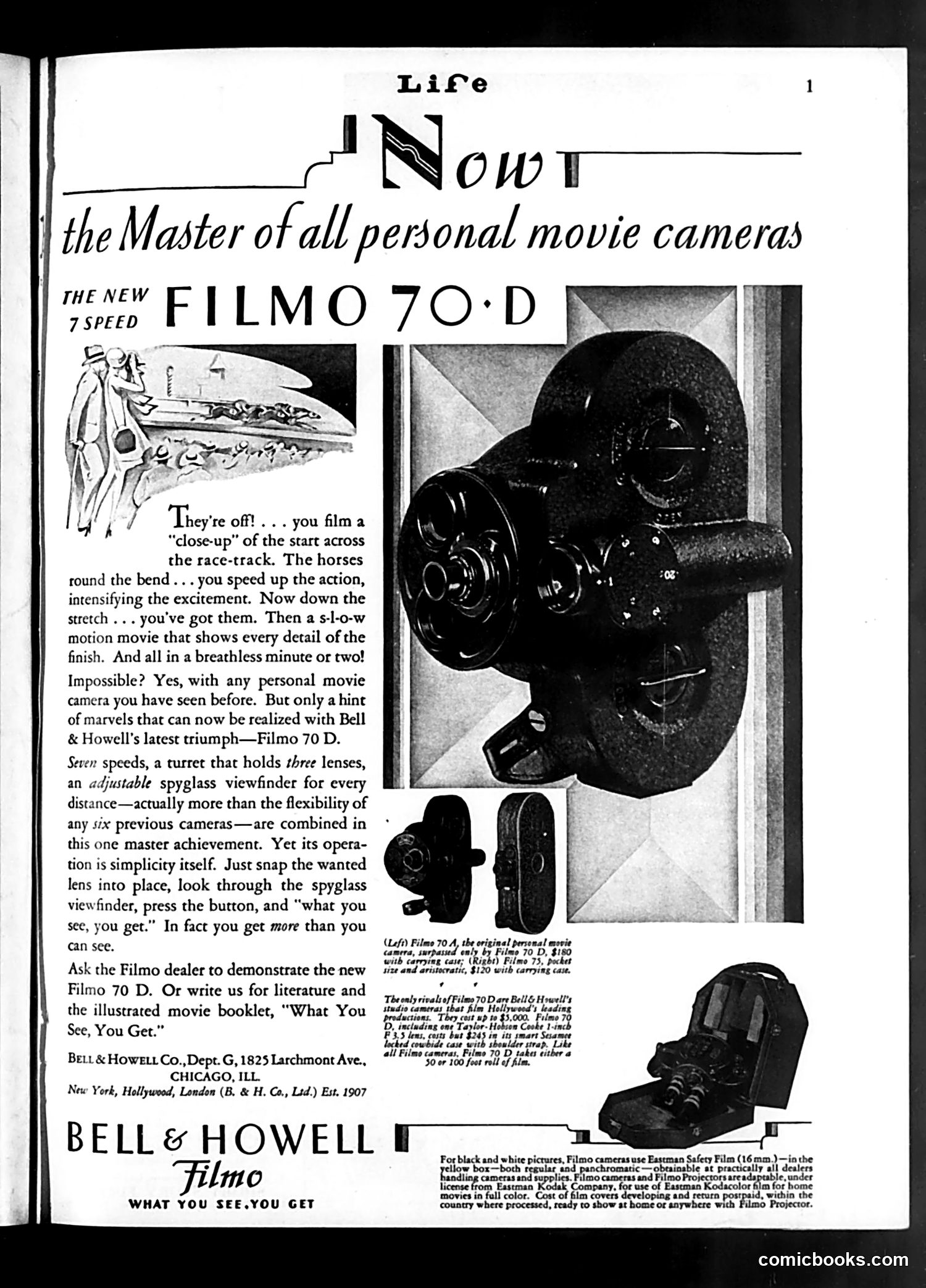
What you’re looking at
This is a **product advertisement**, not a political cartoon or satire. It promotes Bell & Howell's Filmo 70 D personal movie camera, positioned as "the Master of all personal movie cameras." # The Content The ad describes the camera's innovative features: seven variable speeds, a turret holding three interchangeable lenses, and an adjustable viewfinder. It uses a vivid example—filming a horse race with close-ups, action acceleration, slow-motion finish—to demonstrate the camera's flexibility and capabilities that earlier personal cameras supposedly lacked. The phrase "What You See, You Get" is the marketing slogan emphasizing ease of use: point, focus, shoot. # Context for Modern Readers This targets **amateur filmmakers** during the 1930s era when home movie cameras were becoming accessible consumer products. The detailed technical specs and price ($245) suggest this was marketed to serious hobbyists or semi-professionals, not casual users. The multiple photographs of the camera emphasize its sophisticated design and professional pedigree (Bell & Howell also made Hollywood studio equipment).
📄 Transcribed text from this page (OCR, searchable)
Machine-transcribed from the original scan — historical spelling and the odd misread are preserved.
ramen F LLM O Theyre off! ... you filma “close-up” of the start across the race-track. The horses round the bend .. . you speed up the action, intensifying the excitement. Now down the stretch ... you've got them. Then a s-l-o-w motion movie that shows every detail of the finish. And all in a breathless minute or two! Impossible? Yes, with any personal movie camera you have seen before. But only a hint of marvels that can now be realized with Bell & Howell's latest triumph—Filmo 70 D. Seven speeds, a turret that holds three lenses, an adjustable spyglass viewfinder for every distance—actually more than the flexibility of any six previous cameras—are combined in this one master achievement. Yet its opera- tion is simplicity itself. Just snap the wanted lens into place, look through the spyglass viewfinder, press the button, and “what you see, you get.” In fact you get more than you can see. Ask the Filmo dealer to demonstrate the new Filmo 70 D. Or write us for literature and the illustrated movie booklet, “What You See, You Get.” Bett & HOwELLCo.,Dept. G, 1825 Larchmont Ave., CHICAGO, ILL. New York, Hollywood, London (B, & H. Co,, Ltd.) Est. 1907 BELL& HOWELL ‘Filmo WHAT YOU SEE.YOU GET Life Now the Master of all pers onal movie cameras 7 O:D (Left) Filme 70 A, the ericinal personal movie camera, surpassed only by Filme 70 D, $180 with carrying case; (Right) Filmo 75, pocket size and aristocratic, $120 with carrying cast. ’ ’ To enly rivals of Films 70D are Belle Howell's studio cameras that film Hollywood's leading productions. They cast up t0 $3,000. Filme 70 D, including one Taplor- Hobson Cooks 1-nch E35 lems, costs but $245 in its smart Samet locked cowbide case with shoulder strap. Like all Filmo cameras, Pilmo 70 D takes either a 30 er 100 foot roll ef flm. For black aad ad whise pice picrares, Filmo cameras use Eastman Safety Film (16 mm.)—in the license Eastman ee edie Comat ten recs developing and return — country where processed, ready to show at home or anywhere with yee. ilar and panchromatic —obtainable st bractically ai dealers Caunerastod supolia Flo Faeeo comepes ead Vimo Pececpies covets pany, for use of East Je, under im for home id, pwichlo the filmo Proj jyector. comicbooks.com