
Life, 1929-07-12 · page 30 of 48
Life — July 12, 1929 — page 30: what you’re looking at
What you’re looking at
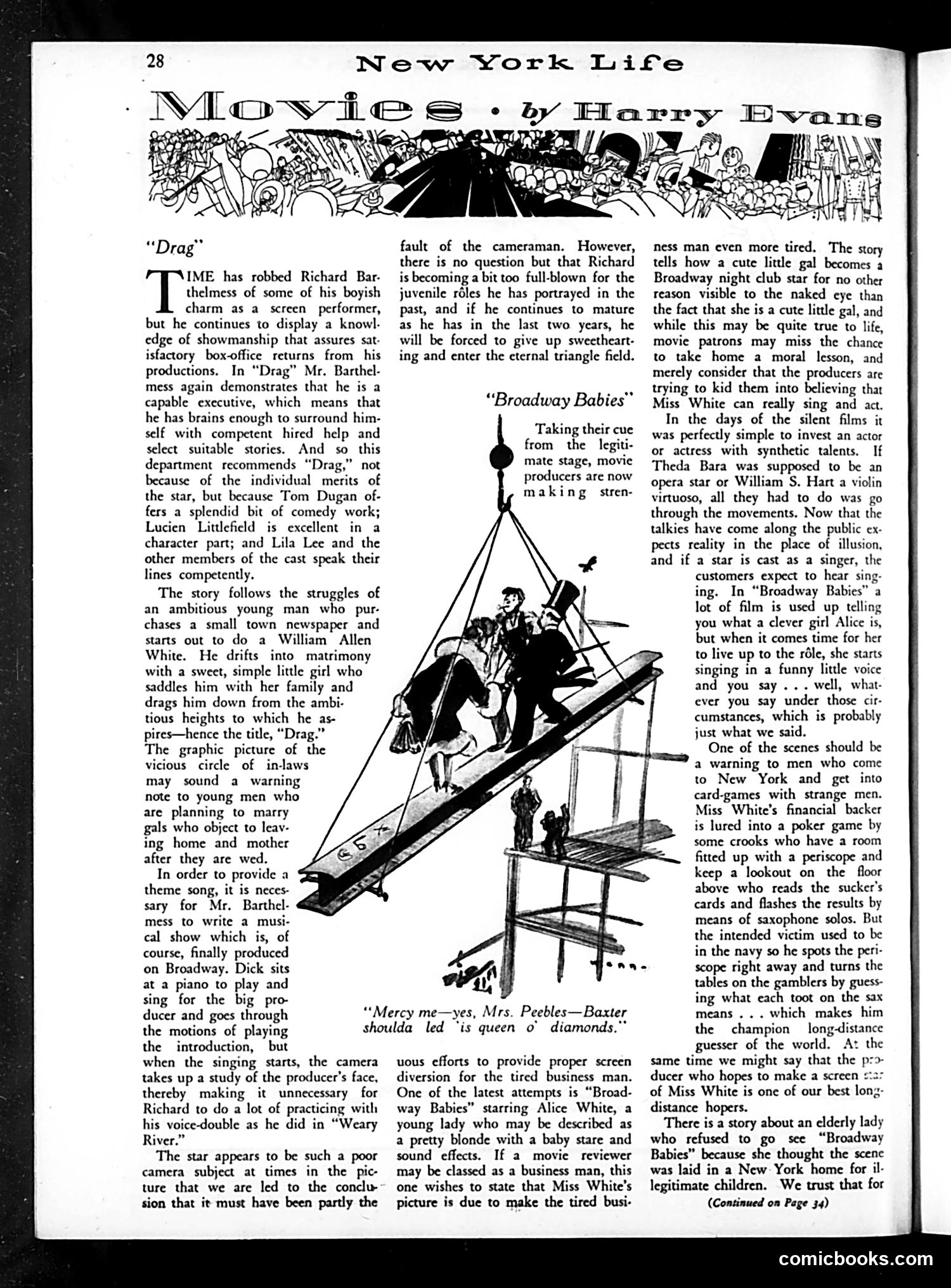
This page contains film reviews by Harry Evans for Life magazine's "Movies" column. The reviews discuss two 1920s films: **"Drag"** stars Richard Barthelmess as an ambitious young man whose wife and her family drag down his ambitions—hence the title. The reviewer praises supporting actors Tom Dugan and Lucien Littlefield but suggests Barthelmess is aging out of juvenile roles. The cartoon depicts a man weighed down by in-laws, warning young men against marrying women unwilling to leave their families. **"Broadway Babies"** stars Alice White as a nightclub performer. The reviewer critiques the film's plot as thin and White's acting as relying on her appearance rather than talent. The reviewer notes that unlike silent films, "talkies" require genuine singing ability—audiences expect to actually hear performers sing, not merely pantomime. Both reviews reflect 1920s concerns about cinema's transition to sound and evolving audience expectations.
📄 Transcribed text from this page (OCR, searchable)
Machine-transcribed from the original scan — historical spelling and the odd misread are preserved.
28 IME has robbed Richard Bar- thelmess of some of his boyish charm as a screen performer, but he continues to display a knowl- edge of showmanship that assures sat- isfactory box-office returns from his productions. In “Drag” Mr. Barthel- mess again demonstrates that he is a capable executive, which means that he has brains enough to surround him- self with competent hired help and select suitable stories. And so this department recommends “Drag,” not because of the individual merits of the star, but because Tom Dugan of- fers a splendid bit of comedy work; Lucien Littlefield is excellent in a character part; and Lila Lee and the other members of the cast speak their lines competently. The story follows the struggles of an ambitious young man who pur- chases a small town newspaper and starts out to do a William Allen White. He drifts into matrimony with a sweet, simple little girl who saddles him with her family and drags him down from the ambi- tious heights to which he as- pires—hence the tide, “Drag.” The graphic picture of the vicious circle of in-laws may sound a warning Note to young men who are planning to marry gals who object to leav- ing home and mother after they are wed. In order to provide a theme song, it is neces- sary for Mr. Barthel- mess to write a musi- cal show which is, of course, finally produced on Broadway. Dick sits at a piano to play and sing for the big pro- ducer and goes through the motions of playing the introduction, but when the singing starts, the camera takes up a study of the producer's face, thereby making it unnecessary for Richard to do a lot of practicing with his voice-double as he did in “Weary River.” The star appears to be such a poor camera subject at times in the pic- ture that we are led to the conclu sion that it must have been partly the fault of the cameraman. However, there is no question but that Richard is becoming a bit too full-blown for the juvenile réles he has portrayed in the past, and if he continues to mature as he has in the last two years, he will be forced to give up sweetheart- ing and enter the eternal triangle field. “Broadway Babies” Taking their cue from the legiti- mate stage, movie producers are now making stren- “Mercy me—yes, Mrs. Peebles— Baxter shoulda led ‘is queen o° diamonds.” uous efforts to provide proper screen diversion for the tired business man. One of the latest attempts is “Broad- way Babies” starring Alice White, a young lady who may be described as a pretty blonde with a baby stare and sound effects. If a movie reviewer may be classed as a business man, this one wishes to state that Miss White's picture is due to make the tired busi- New York Life Ness man even more tired. The story tells how a cute little gal becomes a Broadway night club star for no other reason visible to the naked eye than the fact that she is a cute little gal, and while this may be quite true to life, movie patrons may miss the chance to take home a moral lesson, and merely consider that the producers are trying to kid them into believing that Miss White can really sing and act. In the days of the silent films it was perfectly simple to invest an actor or actress with synthetic talents. If Theda Bara was supposed to be an opera star or William S. Hart a violin virtuoso, all they had to do was go through the movements. Now that the talkies have come along the public ex- pects reality in the place of illusion, and if a star is cast as a singer, the customers expect to hear sing- ing. In “Broadway Babies” a lot of film is used up telling you what a clever girl Alice is, but when it comes time for her to live up to the rdle, she starts singing in a funny little voice and you say... well, what- ever you say under those cir- cumstances, which is probably just what we said. One of the scenes should be a warning to men who come to New York and get into card-games with strange men. Miss White’s financial backer is lured into a poker game by some crooks who have a room fitted up with a periscope and keep a lookout on the floor above who reads the sucker’s cards and flashes the results by means of saxophone solos. But the intended victim used to be in the navy so he spots the peri- scope right away and turns the tables on the gamblers by guess- ing what each toot on the sax means... which makes him the champion long-distance guesser of the world. At the same time we might say that the p:- ducer who hopes to make a scree! ° of Miss White is one of our best lo: distance hopers. There is a story about an elderly lady who refused to go sce “Broadway Babies” because she thought the scene was laid in a New York home for il- legitimate children, We trust that for (Continued on Page 34) comicbooks.com