
Life, 1929-07-12 · page 40 of 48
Life — July 12, 1929 — page 40: what you’re looking at
What you’re looking at
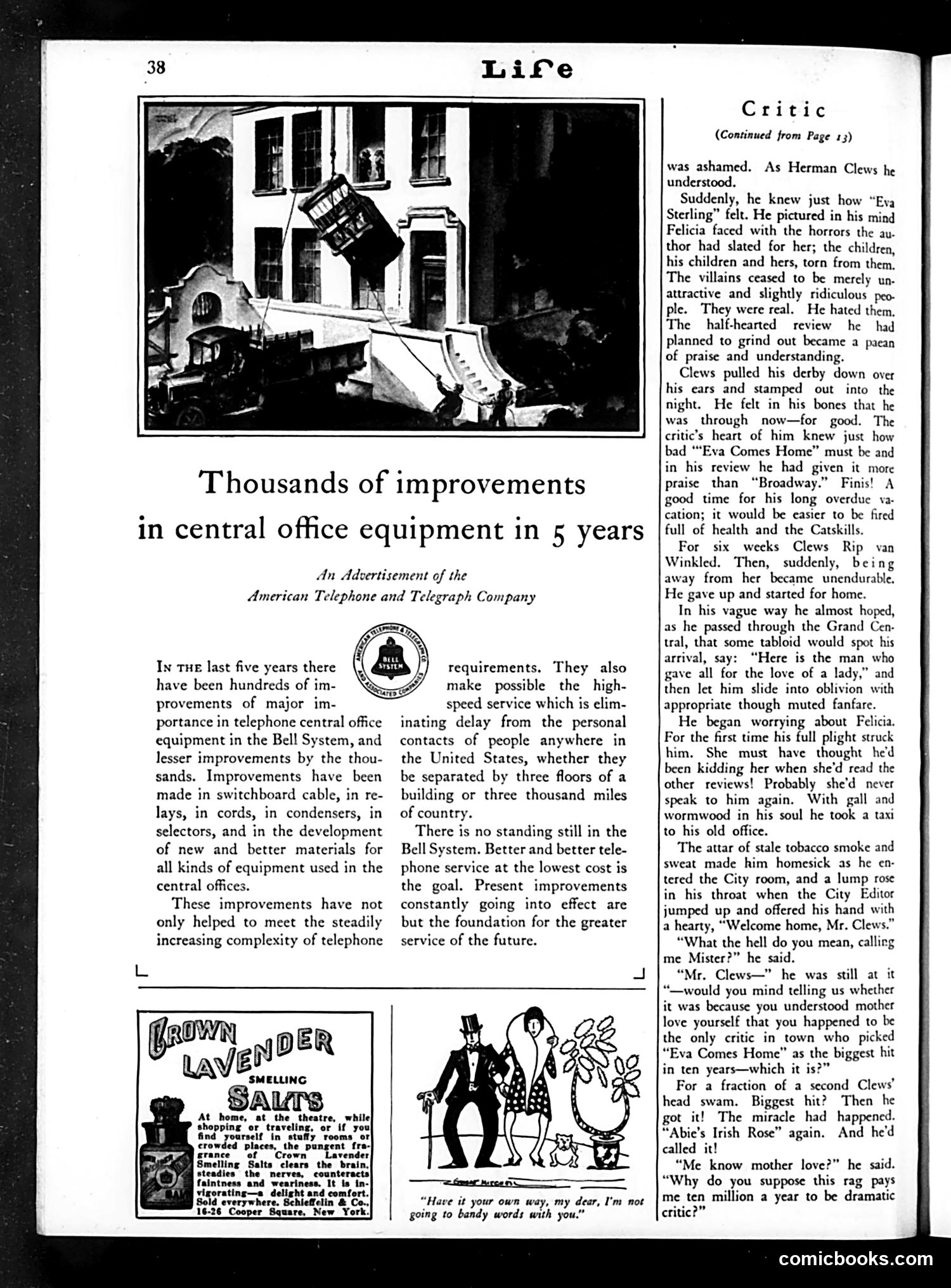
This page contains a **Bell Telephone Company advertisement** (top) promoting technical improvements in telephone infrastructure, alongside **two unrelated items**: a small ad for smelling salts and a serialized short story titled "Critic." The main advertisement emphasizes Bell System's modernization over five years—improvements in switchboard cables, relays, and equipment—enabling faster service across distances. This reflects early-20th-century corporate boosterism about technological progress. Below, a cartoon shows a formally dressed man and woman with text: "Have it your own way, my dear, I'm not going to bandy words with you"—a domestic humor joke about marital disagreement. The "Critic" story concerns a theater critic named Herman Clews who compromises his professional integrity by praising a play ("Eva Comes Home") because he sympathizes with the actress playing the lead role. The narrative explores tension between honest criticism and personal emotion, culminating when Clews returns to his newspaper office, uncertain whether the actress will forgive his inflated review.
📄 Transcribed text from this page (OCR, searchable)
Machine-transcribed from the original scan — historical spelling and the odd misread are preserved.
Thousands of improvements in central office equipment in 5 years An Advertisement of the American Telephone and Telegraph Company In THE last five years there have been hundreds of im- provements of major im- portance in telephone central office equipment in the Bell System, and lesser improvements by the thou- sands. Improvements have been made in switchboard cable, in re- lays, in cords, in condensers, in selectors, and in the development of new and better materials for all kinds of equipment used in the central offices. These improvements have not only helped to meet the steadily increasing complexity of telephone Gn DER SMELLING AUTS At home, at the theatre, while] shopping or traveling, or if you! find yourself in stuffy rooms or| wded places, the pungent fra- nce of rown vender elling Salts clears the brain, steadies the nerves, counteracts| faintness and weariness. It is in- vigorating—a delight and comfort. Sold everywhere. Sc! lin & Co..| 16-26 Cooper Square, New York. requirements. They also make possible the high- speed service which is elim- inating delay from the personal contacts of people anywhere in the United States, whether they be separated by three floors of a building or three thousand miles of country. There is no standing still in the Bell System. Better and better tele- phone service at the lowest cost is the goal. Present improvements constantly going into effect are but the foundation for the greater service of the future. “Have it your own way, my dear, I'm not going to bandy words with you.” Critic (Continued from Page 13) was ashamed. As Herman Clews he understood. Suddenly, he knew just how “Eva Sterling” felt. He pictured in his mind Felicia faced with the horrors the au- thor had slated for her; the children, his children and hers, torn from them, The villains ceased to be merely un- attractive and slightly ridiculous peo. ple. They were real. He hated them, The half-hearted review he had planned to grind out became a paean of praise and understanding. Clews pulled his derby down over his ears and stamped out into the night. He felt in his bones that he was through now—for good. The critic’s heart of him knew just how bad “Eva Comes Home” must be and in his review he had given it more praise than “Broadway.” Finis! A good time for his long overdue va- cation; it would be easier to be fired full of health and the Catskills. For six weeks Clews Rip van Winkled. Then, suddenly, being away from her became unendurable, He gave up and started for home. In his vague way he almost hoped, as he passed through the Grand Cen- tral, that some tabloid would spot his arrival, say: “Here is the man who gave all for the love of a lady,” and then let him slide into oblivion with appropriate though muted fanfare. He began worrying about Felicia. For the first time his full plight struck him. She must have thought he'd been kidding her when she'd read the other reviews! Probably she'd never speak to him again, With gall and wormwood in his soul he took a taxi to his old office. The attar of stale tobacco smoke and sweat made him homesick as he en- tered the City room, and a lump rose in his throat when the City Editor jumped up and offered his hand with a hearty, “Welcome home, Mr. Clews.” “What the hell do you mean, calling me Mister?” he said. “Mr. Clews—” he was still at it “—would you mind telling us whether it was because you understood mother love yourself that you happened to be the only critic in town who picked “Eva Comes Home” as the biggest hit in ten years—which it is?” For a fraction of a second Clews’ head swam. Biggest hit? Then he got it! The miracle had happened. “Abie’s Irish Rose” again. And he'd called it! “Me know mother love?” he said. “Why do you suppose this rag pays me ten million a year to be dramatic critic?” comicbooks.com