
Life, 1929-07-12 · page 6 of 48
Life — July 12, 1929 — page 6: what you’re looking at
What you’re looking at
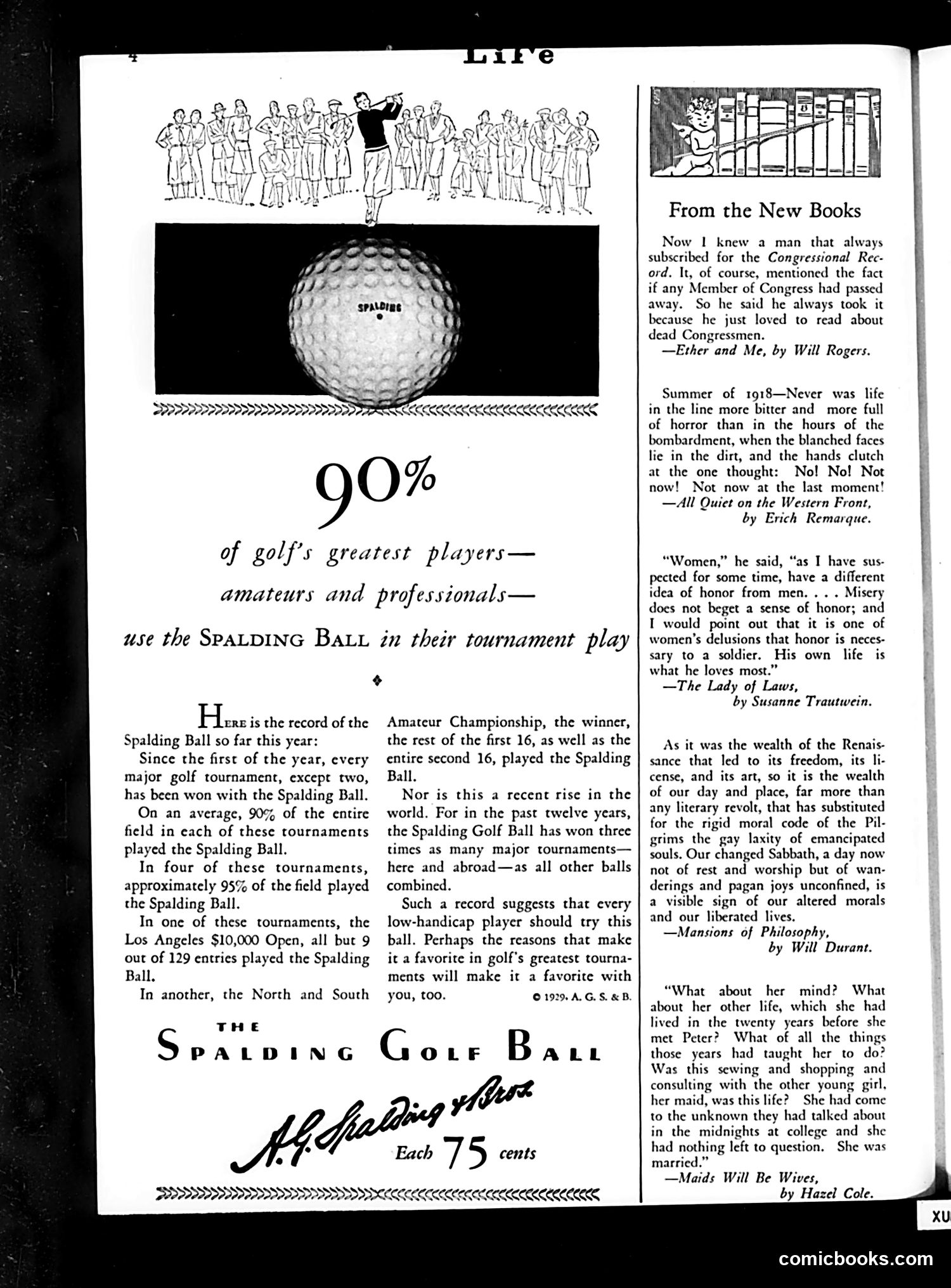
This page is primarily **advertising content**, not political satire. The main image shows a Spalding golf ball surrounded by golfers, with text claiming that "90% of golf's greatest players—amateurs and professionals—use the SPALDING BALL in their tournament play." The advertisement cites tournament records as evidence: the ball allegedly dominated major competitions including the Los Angeles $10,000 Open and the North and South Championship. The price listed is 75 cents each. The right column contains brief literary excerpts ("From the New Books") promoting various publications, unrelated to the golf advertisement. There is no political satire or social commentary visible on this page—it is a straightforward commercial promotion typical of early 20th-century magazine advertising.
📄 Transcribed text from this page (OCR, searchable)
Machine-transcribed from the original scan — historical spelling and the odd misread are preserved.
Po) >a een SEEEKEEKEEER KEKE EEK ERE gOo# of golf's greatest players— amateurs and professionals— use the SPALDING Batu in their tournament play _ is the record of the Spalding Ball so far this year: Since the first of the year, every major golf tournament, except two, has been won with the Spalding Ball. On an average, 90% of the entire field in each of these tournaments played the Spalding Ball. In four of these tournaments, approximately 95% of the field played the Spalding Ball. In one of these tournaments, the Los Angeles $10,000 Open, all but 9 out of 129 entries played the Spalding Ball. In another, the North and South THE Amateur Championship, the winner, the rest of the first 16, as well as the entire second 16, played the Spalding Ball. Nor is this a recent rise in the world. For in the past twelve years, the Spalding Golf Ball has won three times as many major tournaments— here and abroad—as all other balls combined. Such a record suggests that every low-handicap player should try this ball. Perhaps the reasons that make it a favorite in golf's greatest tourna- ments will make it a favorite with you, too. © 1929, A. G. S. & B. S patpinc Gour ae [fda POP KEELE ELEC, Each mw cents From the New Books Now | knew a man that always subscribed for the Congressional Rec- ord. It, of course, mentioned the fact if any Member of Congress had passed away. So he said he always took it because he just loved to read about dead Congressmen. —Ether and Me, by Will Rogers. Summer of 1918—Never was life in the line more bitter and more full of horror than in the hours of the bombardment, when the blanched faces lie in the dirt, and the hands clutch at the one thought: No! No! Not now! Not now at the last moment! —All Quiet on the Western Front, by Erich Remarque. “Women,” he said, “as I have sus- pected for some time, have a different idea of honor from men. . . . Misery does not beget a sense of honor; and I would point out that it is one of women’s delusions that honor is neces- sary to a soldier. His own life is what he loves most.” —The Lady of Laws, by Susanne Trautwein. As it was the wealth of the Renais- sance that led to its freedom, its li- cense, and its art, so it is the wealth of our day and place, far more than any literary revolt, that has substituted for the rigid moral code of the Pil- grims the gay laxity of emancipated souls. Our changed Sabbath, a day now not of rest and worship but of wan- derings and pagan joys unconfined, is a visible sign of our altered morals and our liberated lives. —Mansions of Philosophy, by Will Durant. “What about her mind? What about her other life, which she had lived in the twenty years before she met Peter? What of all the things those years had taught her to do? Was this sewing and shopping and consulting with the other young girl, her maid, was this life? She had come to the unknown they had talked about in the midnights at college and she had nothing left to question. She was married.” —Maids Will Be Wives, by Hazel Cole. comicbooks.com