
Penny Dreadfuls, 1800 · page 269 of 308
The Child of Waterloo, or, The Horrors of the Battle-Field — page 269: what you’re looking at
A restored page from Penny Dreadfuls, 1800. Page through the whole issue in the reader above.
📄 Transcribed text from this page (OCR, searchable)
Machine-transcribed from the original scan — historical spelling and the odd misread are preserved.
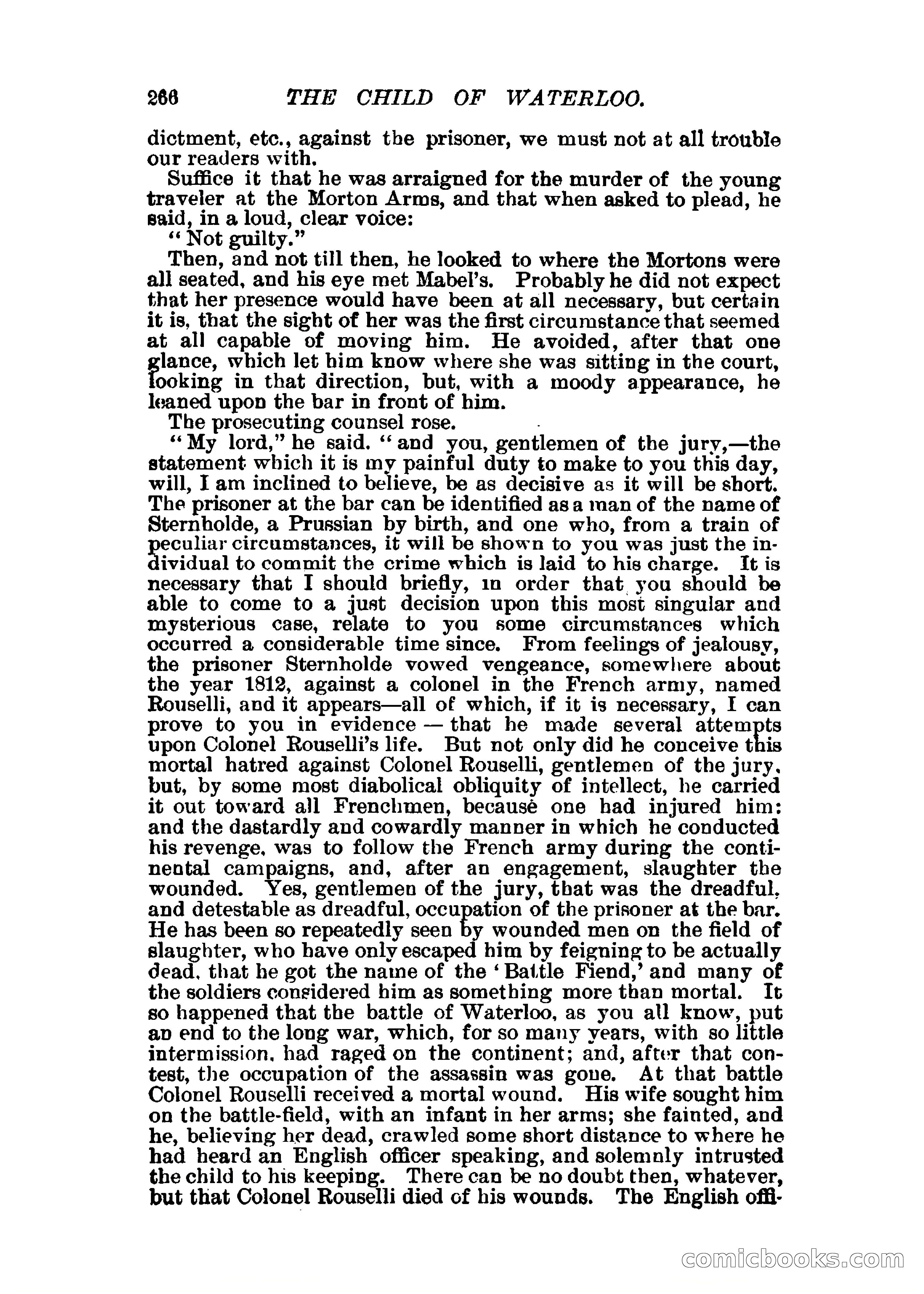
266 THE CHILD OF WATERLOO, dictment, etc., against the prisoner, we must not at all trouble our readers with. Suffice it that he was arraigned for the murder of the young traveler at the Morton Arms, and that when asked to plead, he said, in a loud, clear voice: “‘ Not guilty.” Then, and not till then, he looked to where the Mortons were all seated, and his eye met Mabel’s, Probably he did not expect that her presence would have been at all necessary, but certain it is, that the sight of her was the first circumstance that seemed at all capable of moving him. He avoided, after that one glance, which let him know where she was sitting in the court, ooking in that direction, but, with a moody appearance, he leaned upon the bar in front of him. The prosecuting counsel rose. “*My lord,” he said. ‘‘and you, gentlemen of the jury,—the statement which it is my painful duty to make to you this day, will, I am inclined to believe, be as decisive as it will be short. The prisoner at the bar can be identified asa man of the name of Sternholde, a Prussian by birth, and one who, from a train of eculiar circumstances, it will be shown to you was just the in- yividual to commit the crime which is laid to his charge. It is necessary that I should briefly, 1n order that you should be able to come to a just decision upon this most singular and mysterious case, relate to you some circumstances which occurred a considerable time since. From feelings of jealousy, the prisoner Sternholde vowed vengeance, somewhere about the year 1812, against a colonel in the French army, named Rouselli, and it appears—all of which, if it is necessary, I can prove to you in evidence — that he made several attempts upon Colonel Rouselli’s life. But not only did he conceive this mortal hatred against Colonel Rouselli, gentlemen of the jury, but, by some most diabolical obliquity of intellect, he carried it out toward ajl Frenchmen, becausé one had injured him: and the dastardly and cowardly manner in which he conducted his revenge, was to follow the French army during the conti- neotal campaigns, and, after an engagement, slaughter the wounded. Yes, gentlemen of the jury, that was the dreadful, and detestable as dreadful, occupation of the prisoner at the bar. He has been so repeatedly seen by wounded men on the field of slaughter, who have only escaped him by feigning to be actually dead. that he got the name of the ‘ Battle Fiend,’ and many of the soldiers considered him as something more than mortal. It so happened that the battle of Waterloo, as you all know, put ap end to the long war, which, for so many years, with so little intermission, had raged on the continent; and, after that con- test, the occupation of the assassin was gone. At that battle Colonel Rouselli received a mortal wound. His wife sought him on the battle-field, with an infant in her arms; she fainted, and he, believing her dead, crawled some short distance to where he had heard an English officer speaking, and solemnly intrusted the child to his keeping. There can be no doubt then, whatever, but that Colonel Rouselli died of his wounds. The English offi- comicbooks. com