
Penny Dreadfuls, 1857 · page 12 of 394
Agnes, or, Beauty and Pleasure — page 12: what you’re looking at
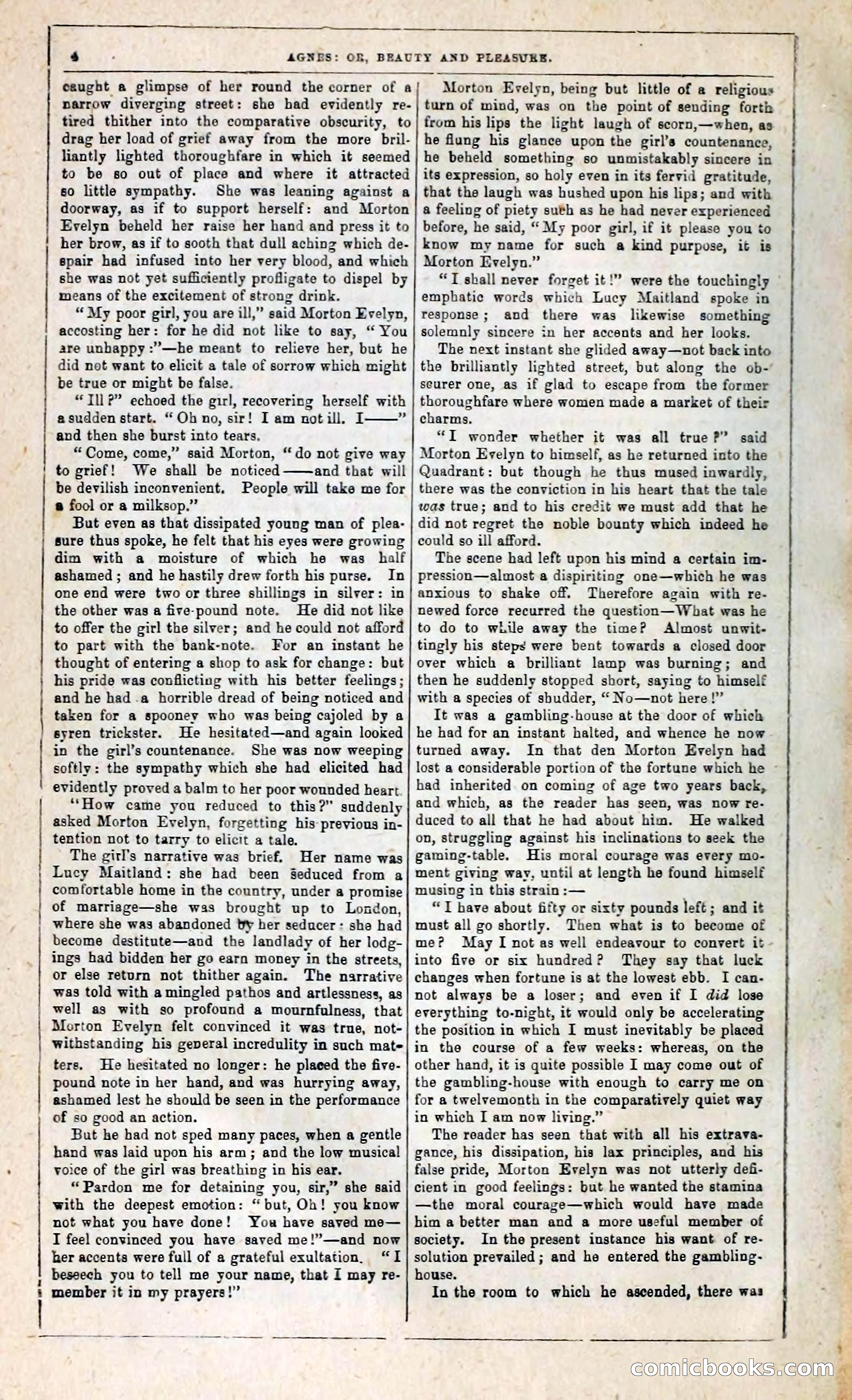
A restored page from Penny Dreadfuls, 1857. Page through the whole issue in the reader above.
📄 Transcribed text from this page (OCR, searchable)
Machine-transcribed from the original scan — historical spelling and the odd misread are preserved.
4 . AGNES: OR, BEAUTY AND PLEASURE. drag her load of grief away from the more bril- to be so out of place and where it attracted so little sympathy. doorway, as if to support herself: and Morton Evelyn beheld her raise her hand and press it to her brow, as if to sooth that dull aching which de- spair had infused into her very blood, and which she was not yet sufficiently profligate to dispel by means of the excitement of strong drink. “My poor girl, you are ill,” said Morton Evelyn, accosting her: for he did not like to say, “ You are unhappy :”’—he meant to relieve her, but he did not want to elicit a tale of sorrow which might be true or might be false. “Ill?” echoed the girl, recovering herself with a sudden start. “Ohno, sir! Iam notill, I——” and then she burst into tears. “Come, come,” said Morton, “ do not give way to grief! We shall be noticed and that will be devilish inconvenient. People will take me for @ fool or a milksop.” But even as that dissipated young man of plea- sure thus spoke, he felt that his eyes were growing dim with a moisture of which he was half ashamed ; and he hastily drew forth his purse. In one end were two or three shillings in silver: in the other was a five-pound note. He did not like to offer the girl the silver; and he could not afford to part with the bank-note. For an instant he thought of entering a shop to ask for change: but his pride was conflicting with his better feelings; and he had .a horrible dread of being noticed and taken for a spooney who was being cajoled by a syren trickster. He hesitated—and again looked in the girl’s countenance. She was now weeping softly: the sympathy which she had elicited had evidently proved a balm to her poor wounded heart. ‘“‘How came you reduced to this?” suddenly asked Morton Evelyn, forgetting his previous in- tention not to tarry to elicit a tale. The girl's narrative was brief. Her name was Lucy Maitland: she had been Seduced from a comfortable home in the country, under a promise of marriage—she was brought up to London, where she was abandoned by her seducer: she had become destitute—and the landlady of her lodg- ings had bidden her go earn money in the streets, or else return not thither again. The narrative was told with a mingled pathos and artlessness, as well as with so profound a mournfulness, that Morton Evelyn felt convinced it was true, not- withstanding his geveral incredulity in such mate He hesitated no longer: he placed the five- pound note in her hand, and was hurrying away, ashamed lest he should be seen in the performance of so good an action. But he had not sped many paces, when a gentle hand was laid upon his arm; and the low musical voice of the girl was breathing in his ear. “Pardon me for detaining you, sir,” she said with the deepest emotion: “but, Oh! you know not what you have done! You have saved me— I feel convinced you have saved me!”—and now her accents were full of a grateful exultation. “I beseech you to tell me your name, that I may re- member it in my prayers!” caught a glimpse of her round the corner of a narrow diverging street: she had evidently re- tired thither into the comparative obscurity, to liantly lighted thoroughfare in which it seemed She was leaning against a Morton Evelyn, being but little of a religious turn of mind, was on the point of sending forth from his lips the light laugh of scorn,—when, as he flung his glance upon the girl’s countenance, he beheld something so unmistakably sincere in its expression, so holy even in its fervid gratitude, that the laugh was hushed upon his lips; and with a feeling of piety suth as he had never experienced before, he said, “ My poor girl, if it please you to know my name for such a kind purpose, it is Morton Evelyn.” “T shall never forget it!” were the touchingly emphatic words which Lucy Maitland spoke in response; and there was likewise something solemnly sincere in her accents and her looks. The next instant she glided away—not back into the brilliantly lighted street, but along the ob-’ seurer one, as if glad to escape from the former thoroughfare where women made a market of their charms. “IT wonder whether it was all true ?” said Morton Evelyn to himself, as he returned into the Quadrant: but though he thus mused inwardly, there was the conviction in his heart that the tale was true; and to his credit we must add that he did not regret the noble bounty which indeed he could so ill afford. Tbe scene had left upon his mind a certain im- pression—almost a dispiriting one—which he was anxious to shake off. Therefore again with re- newed force recurred the question—What was he to do to while away the time? Almost unwit- tingly his steps were bent towards a closed door over which a brilliant lamp was burning; and then he suddenly stopped short, saying to himself with a species of shudder, ‘ No—not here!” It was a gambling-house at the door of which he had for an instant halted, and whence he now turned away. In that den Morton Evelyn had lost a considerable portion of the fortune which he ~ had inherited on coming of age two years back, and which, as the reader has seen, was now re- duced to all that he had about him. He walked on, struggling against his inclinations to seek the gaming-table. His moral courage was every mo- ment giving way, until at length he found himself musing in this strain :— “T have about fifty or sixty pounds left; and it must all go shortly. Then what is to become of me? May I not as well endeavour to convert it - into five or six hundred? They say that luck changes when fortune is at the lowest ebb. I can- not always be a loser; and even if I did lose everything to-night, it would only be accelerating the position in which I must inevitably be placed in the course of a few weeks: whereas, on the other hand, it is quite possible I may come out of the gambling-house with enough to carry me on for a twelvemonth in the comparatively quiet way in which I am now living.” The reader has seen that with all his extrava- gance, his dissipation, his lax principles, and his false pride, Morton Evelyn was not utterly defi- cient in good feelings: but he wanted the stamina —the moral courazge—which would have made him a better man and a more useful member of society. In the present instance his want of re- solution prevailed; and he entered the gambling- house. In the room to which he ascended, there was _— CoOMmicooolks