
Penny Dreadfuls, 1857 · page 136 of 394
Agnes, or, Beauty and Pleasure — page 136: what you’re looking at
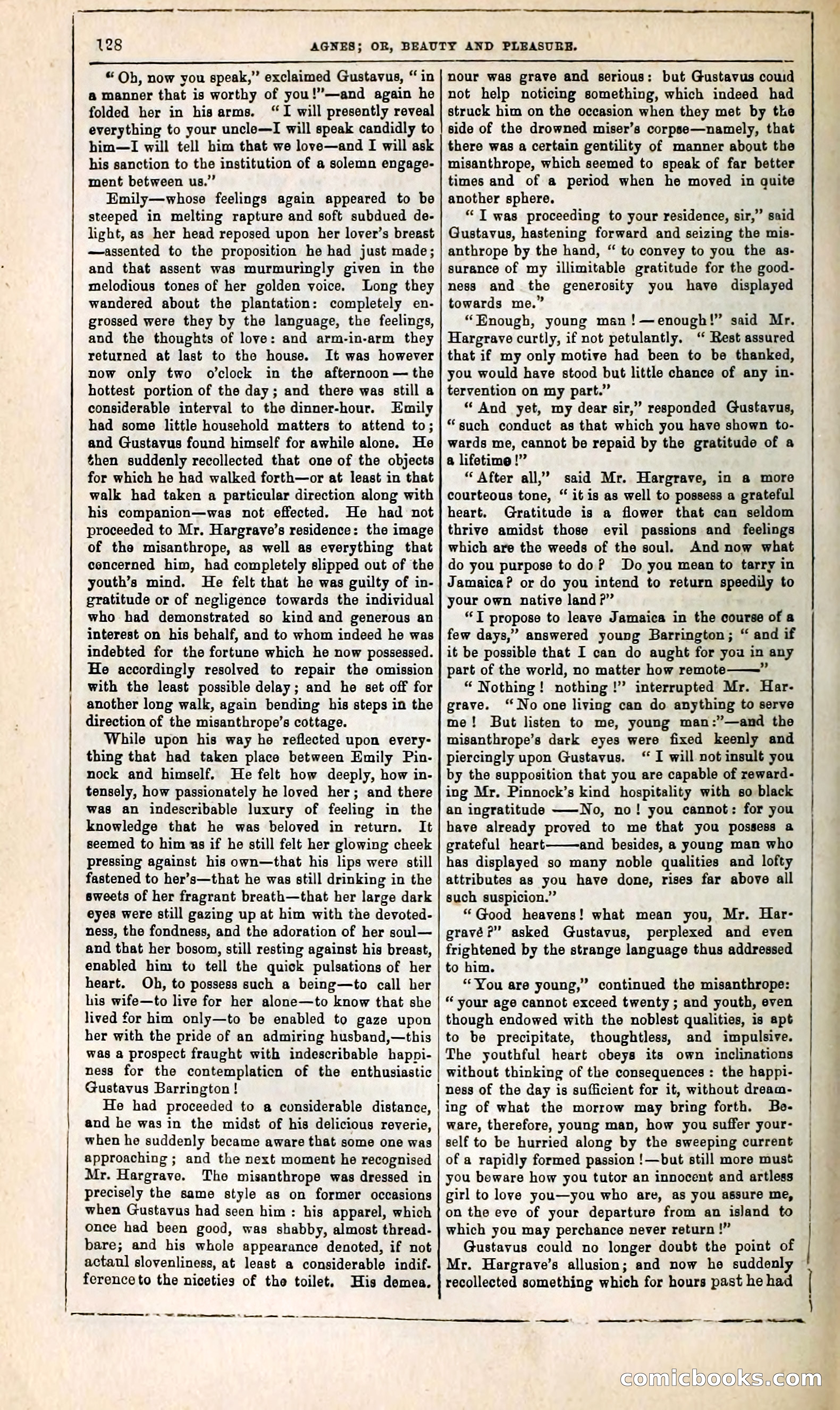
A restored page from Penny Dreadfuls, 1857. Page through the whole issue in the reader above.
📄 Transcribed text from this page (OCR, searchable)
Machine-transcribed from the original scan — historical spelling and the odd misread are preserved.
—_—=_- = ee ee 128 AGNES; OR, BEAUTY AND PLEASURE. LLL “ Oh, now you speak,” exclaimed Gustavus, “in a manner that is worthy of you!”—and again he folded her in his arms. “I will presently reveal everything to your uncle—I will speak candidly to him—I will tell bim that we love—and I will ask his sanction to the institution of a solemn engage- ment between us.” Emily—whose feelings again appeared to be steeped in melting rapture and soft subdued de- light, as her head reposed upon her lover’s breast —assented to the proposition he had just made; and that assent was murmuringly given in the melodious tones of her golden voice. Long they wandered about the plantation: completely en- grossed were they by the language, the feelings, and the thoughts of love: and arm-in-arm they returned at last to the house. It was however now only two o’clock in the afternoon — the hottest portion of the day; and there was still a considerable interval to the dinner-hour. Emily had some little household matters to attend to; and Gustavus found himself for awhile alone. He then suddenly recollected that one of the objects for which he had walked forth—or at least in that walk had taken a particular direction along with his companion—was not effected. He had not proceeded to Mr. Hargrave’s residence: the image of the misanthrope, as well as everything that concerned him, had completely slipped out of the youth’s mind. He felt that he was guilty of in- gratitude or of negligence towards the individual who had demonstrated so kind and generous an interest on his behalf, and to whom indeed he was indebted for the fortune which he now possessed. He accordingly resolved to repair the omission with the least possible delay; and he set off for another long walk, again bending his steps in the direction of the misanthrope’s cottage. While upon his way he reflected upon every- thing that had taken place between Emily Pin- nock and himself. He felt how deeply, how in- tensely, how passionately he loved her; and there was an indescribable luxury of feeling in the knowledge that he was beloved in return. It seemed to him as if he still felt her glowing cheek pressing against his own—that his lips were still fastened to her’s—that he was still drinking in the sweets of her fragrant breath—that her large dark eyes were still gazing up at him with the devoted- ness, the fondness, and the adoration of her soul— and that her boson, still resting against his breast, enabled him to tell the quick pulsations of her heart. Oh, to possess such a being—to call her his wife—to live for her alone—to know that she lived for him only—to be enabled to gaze upon her with the pride of an admiring husband,—this was a prospect fraught with indescribable happi- ness for the contemplaticn of the enthusiastic Gustavus Barrington ! He had proceeded to a considerable distance, and he was in the midst of his delicious reverie, when he suddenly became aware that some one was approaching ; and the next moment he recognised Mr. Hargrave. The misanthrope was dressed in precisely the same style as on former occasions when Gustavus had seen him: his apparel, which once had been good, was shabby, almost thread- bare; and his whole appearance denoted, if not actanl slovenliness, at least a considerable indif. ference to the niceties of the toilet. His demea. SO eet ke ee eS nour was grave and serious: but Gustavus coud not help noticing something, which indeed had struck him on the occasion when they met by the side of the drowned miser’s corpse—namely, that there was a certain gentility of manner about the misanthrope, which seemed to speak of far better times and of a period when he moved in guite another sphere. “IT was proceeding to your residence, sir,” said Gustavus, hastening forward and seizing the mis- anthrope by the hand, “ tu convey to you the as- surance of my illimitable gratitude for the good- ness and the generosity you have displayed towards me.” “Enough, young man!—enough!” said Mr. Hargrave curtly, if not petulantly. ‘“ Rest assured that if my only motive had been to be thanked, you would have stood but little chance of any in- tervention on my part.” “ And yet, my dear sir,” responded Gustavus, * such conduct as that which you have shown to- wards me, cannot be repaid by the gratitude of a a lifetime!” “ After all,’ said Mr. Hargrave, in a more courteous tone, “ it is as well to possess a grateful heart. Gratitude is a flower that can seldom thrive amidst those evil passions and feelings which are the weeds of the soul. And now what do you purpose todo? Do you mean to tarry in Jamaica? or do you intend to return speedily to your own native land?” “I propose to leave Jamaica in the course of a few days,” answered young Barrington; “ and if it be possible that I can do aught for you in any part of the world, no matter how remote “ Nothing! nothing!” interrupted Mr. Har- grave. ‘No one living can do anything to serve me! But listen to me, young man:”’—and the misanthrope’s dark eyes were fixed keenly and piercingly upon Gustavus. ‘I will not insult you by the supposition that you are capable of reward- ing Mr. Pinnock’s kind hospitality with so black an ingratitude ——No, no! you cannot: for you have already proved to me that you possess a grateful heart and besides, a young man who has displayed so many noble qualities and lofty attributes as you have done, rises far above all such suspicion.” “Good heavens! what mean you, Mr. Har- gravé?” asked Gustavus, perplexed and even frightened by the strange language thus addressed to him. ‘You are young,” continued the misanthrope: * your age cannot exceed twenty ; and youth, even though endowed with the noblest qualities, is apt to be precipitate, thoughtless, and impulsive. The youthful heart obeys its own inclinations without thinking of the consequences: the happi- ness of the day is sufficient for it, without dream- ing of what the morrow may bring forth. Be- ware, therefore, young man, how you suffer your- self to be hurried along by the sweeping current of a rapidly formed passion !—but still more must you beware how you tutor an innocent and artless girl to love you—you who are, as you assure me, on the eve of your departure from an island to which you may perchance never return !” Gustavus could no longer doubt the point of Mr. Hargrave’s allusion; and now he suddenly recollected something which for hours past he had a GComichbooks;com ———— | ; | enna, SOU: