
Penny Dreadfuls, 1857 · page 160 of 394
Agnes, or, Beauty and Pleasure — page 160: what you’re looking at
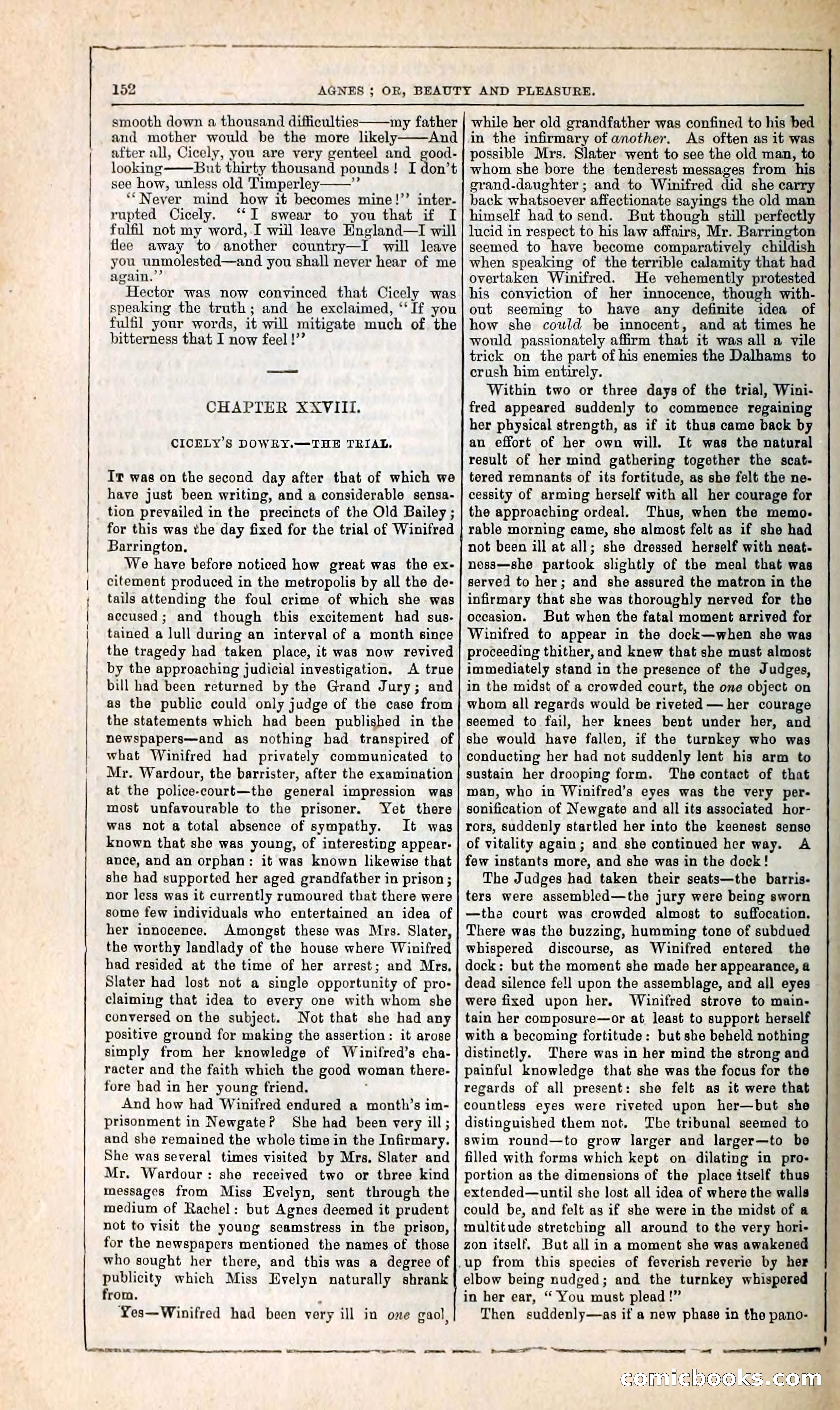
A restored page from Penny Dreadfuls, 1857. Page through the whole issue in the reader above.
📄 Transcribed text from this page (OCR, searchable)
Machine-transcribed from the original scan — historical spelling and the odd misread are preserved.
152 AGNES ; OR, BEAUTY AND PLEASURE. smooth down a thousand difficulties my father and mother would be the more likely——And after all, Cicely, you are very genteel and good- looking ——But thirty thousand pounds! I don’t see how, unless old Timperley ——’’ ‘** Never mind how it becomes mine!’’ inter- rupted Cicely. ‘‘I swear to you that if I fulfil not my word, I will leave Hnegland—I will flee away to another country—I will leave you unmolested—and you shall never hear of me again.’ “Hector was now convinced that Cicely was speaking the truth; and he exclaimed, ‘‘If you fulfil your words, it will mitigate much of ‘the bitterness that I now feel !’’ —— CHAPTER XXVIII. CICELY’S DOWRY.—THE TRIAL, Ir was on the second day after that of which we have just been writing, and a considerable sensa- tion prevailed in the precincts of the Old Bailey ; for this was the day fixed for the trial of Winifred Barrington, We have before noticed how great was the ex- citement produced in the metropolis by all the de- tails attending the foul crime of which she was accused; and though this excitement had sus- tained a lull during an interval of a month since | —~_— the tragedy had taken place, it was now revived by the approaching judicial investigation, A true bill had been returned by the Grand Jury; and as the public could only judge of the case from the statements which had been published in the newspapers—and as nothing had transpired of what Winifred had privately communicated to Mr. Wardour, the barrister, after the examination at the police-court—the general impression was most unfavourable to the prisoner. Yet there was not a total absence of sympathy. It was known that she was young, of interesting appear- ance, and an orphan: it was known likewise that she had supported her aged grandfather in prison ; nor less was it currently rumoured that there were some few individuals who entertained an idea of her innocence. Amongst these was Mrs. Slater, the worthy landlady of the house where Winifred had resided at the time of her arrest; and Mrs, Slater had lost not a single opportunity of pro- claiming that idea to every one with whom she conversed on the subject. Not that she had any positive ground for making the assertion: it arose simply from her knowledge of Winifred’s cha- racter and the faith which the good w woman there- fore bad in her young friend. And how had Winifred endured a month’s im- prisonment in Newgate? She had been very ill; and she remained the whole time in the Infirmary. She was several times visited by Mrs, Slater and Mr. Wardour: she received two or three kind messages from Miss Evelyn, sent through the medium of Rachel: but Agnes deemed it prudent not to visit the young seamstress in the prison, for the newspapers mentioned the names of those who sought her there, and this was a degree of publicity which Miss Evelyn naturally shrank from. ° Yes—Winifred had been very ill in one gaol, 7. .up from this species of feverish reverie by her Se while her old grandfather was confined to his bed in the infirmary of another. As often as it was possible Mrs. Slater went to see the old man, to whom she bore the tenderest messages from his grand-daughter ; and to Winifred did she carry back whatsoever affectionate sayings the old man himself had to send. But though still perfectly lucid in respect to his law affairs, Mr. Barrington seemed to have become comparatively childish when speaking of the terrible calamity that had overtaken Winifred. He vehemently protested his conviction of her innocence, though with- out seeming to have any definite idea of how she could be innocent, and at times he would passionately affirm that it was all a vile trick on the part of his enemies the Dalhams to crush him entirely. Within two or three days of the trial, Wini- fred appeared suddenly to commence regaining her physical strength, as if it thus came back by an effort of her own will. It was the natural result of her mind gathering together the scat- tered remnants of its fortitude, as she felt the ne- cessity of arming herself with all her courage for the approaching ordeal. Thus, when the memo- rable morning came, she almost felt as if she had not been ill at all; she dressed herself with neat- ness—she partook slightly of the meal that was served to her; and she assured the matron in the infirmary that she was thoroughly nerved for the occasion. But when the fatal moment arrived for Winifred to appear in the dock—when she was proceeding thither, and knew that she must almost immediately stand in the presence of the Judges, in the midst of a crowded court, the one object on whom all regards would be riveted — her courage seemed to fail, her knees bent under her, and she would have fallen, if the turnkey who was conducting her had not suddenly lent his arm to sustain her drooping form. The contact of that man, who in Winifred’s eyes was the very per- sonification of Newgate and all its associated hor- rors, suddenly startled her into the keenest sense of vitality again; and she continued her way. A few instants more, and she was in the dock! The Judges had taken their seats—the barris- ters were assembled—the jury were being sworn —the court was crowded almost to suffocation. There was the buzzing, humming tone of subdued whispered discourse, as Winifred entered the dock: but the moment she made her appearance, @ dead silence fe!l upon the assemblage, and all eyes were fixed upon her. Winifred strove to main- tain her composure—or at least to support herself with a becoming fortitude: but she beheld nothing distinctly. There was in her mind the strong and painful knowledge that she was the focus for the regards of all present: she felt as it were that countless eyes were riveted upon her—but she distinguished them not. The tribunal seemed to swim round—to grow larger and larger—to be filled with forms which kept on dilating in pro- portion as the dimensions of the place itself thus extended—until she lost all idea of where the walla could be, and felt as if she were in the midst of a multitude stretching all around to the very hori- zon itself. But all in a moment she was awakened elbow being nudged; and the turnkey whispered in her ear, ‘“ You must plead !” Then suddenly—as if a new phase in the pano- a ll COMIC OOKSASolie