
Penny Dreadfuls, 1857 · page 176 of 394
Agnes, or, Beauty and Pleasure — page 176: what you’re looking at
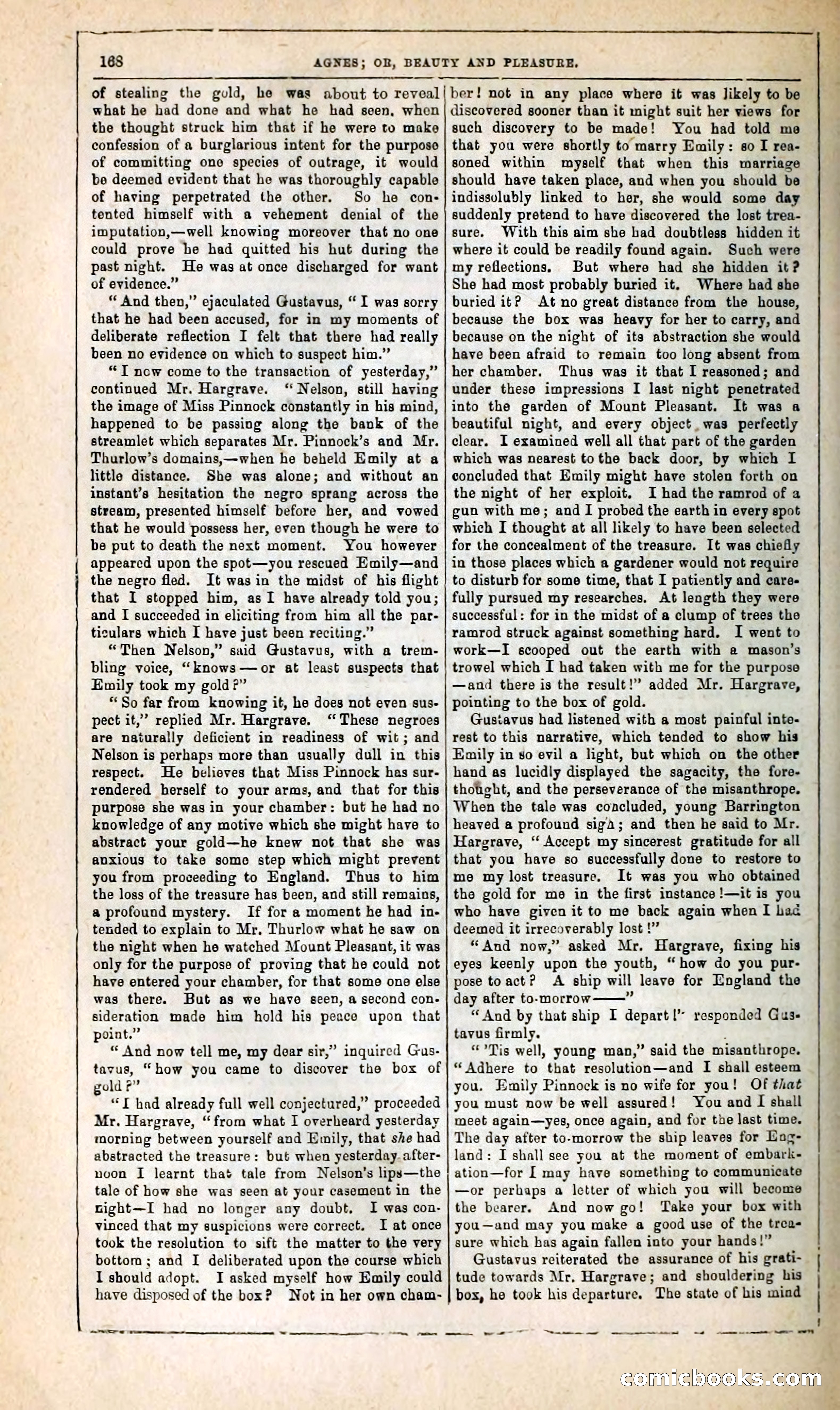
A restored page from Penny Dreadfuls, 1857. Page through the whole issue in the reader above.
📄 Transcribed text from this page (OCR, searchable)
Machine-transcribed from the original scan — historical spelling and the odd misread are preserved.
168 of stealing the guld, he was about to reveal what he had done and what he had seen, when the thought struck him that if he were to make confession of a burglarious intent for the purpose of committing one species of outrage, it would be deemed evident that he was thoroughly capable of having perpetrated the other. So he con- tented himself with a vehement denial of the imputation,—well knowing moreover that no one could prove he had quitted his hut during the past night. He was at once discharged for want of evidence.” “ And then,” ejaculated Gustavus, “ I was sorry that he had been accused, for in my moments of deliberate reflection I felt that there had really been no evidence on which to suspect him.” “T now come to the transaction of yesterday,” continued Mr. Hargrave. ‘‘ Nelson, still having the image of Miss Pinnock constantly in his mind, happened to be passing along the bank of the streamlet which separates Mr. Pinnock’s and Mr. Thurlow’s domains,—when he beheld Emily at a little distance. She was alone; and without an instant’s hesitation the negro sprang across the stream, presented himself before her, and vowed that he would possess her, even though he were to be put to death the next moment. You however { appeared upon the spot—you rescued Emily—and the negro fled. It wasin the midst of his flight that I stopped him, as I have already told you; and I succeeded in eliciting from him all the par- ticulars which I have just been reciting.” “Then Nelson,” said Gustavus, with a trem- bling voice, “knows—or at least suspects that Emily took my gold?” “So far from knowing it, he does not even sus- pect it,” replied Mr. Hargrave. “These negroes are naturally deficient in readiness of wit; and Nelson is perhaps more than usually dull in this respect. He believes that Miss Pinnock has sur- rendered herself to your arms, and that for this purpose she was in your chamber: but he had no knowledge of any motive which she might have to abstract your gold—he knew not that she was anxious to take some step which might prevent you from proceeding to England. Thus to him the loss of the treasure has been, and still remains, a profound mystery. If for a moment he had in- tended to explain to Mr, Thurlow what he saw on the night when he watched Mount Pleasant, it was only for the purpose of proving that he could not have entered your chamber, for that some one else was there. But as we have seen, a second con- sideration made him hold his peace upon that point.” “ And now tell me, my dear sir,” inquired Gus- tavus, “how you came to discover the box of gold ?” “I had already full well conjectured,” proceeded Mr. Hargrave, “from what I overheard yesterday morning between yourself and Emily, that she had abstracted the treasure: but when yesterday. after- noon I learnt that tale from Nelson’s lips—the tale of how she was seen at your casement in the might—I had no longer any doubt. I was con- vinced that my suspicions were correct. I at once took the resolution to sift the matter to the very bottom ; and I deliberated upon the course which I should adopt. I asked myself how Emily could have disposed of the box? Not in her own cham- _—— Oo 8 eee AGNES; OR, BEAUTY AND PLEASURE, ber! not in any place where it was Jikely to be discovered sooner than it might suit her views for such discovery to be made! You had told mea that you were shortly to marry Emily: so I rea- soned within myself that when this marriage should have taken place, and when you should be indissulubly linked to her, she would some day suddenly pretend to have discovered the lost trea- sure. With this aim she had doubtless hidden it where it could be readily found again. Such were my reflections, But where had she hidden it? She had most probably buried it. Where had she buried it? At no great distance from the house, because the box was heavy for her to carry, and because on the night of its abstraction she would have been afraid to remain too long absent from her chamber. Thus was it that I reasoned; and under these impressions I last night penetrated into the garden of Mount Pleasant. It was a beautiful night, and every object. was perfectly clear. I examined well all that part of the garden which was nearest tothe back door, by which I concluded that Emily might have stolen forth on the night of her exploit. I had the ramrod of a gun with me; and I probed the earth in every spot which I thought at all likely to have been selected for the concealment of the treasure. It was chiefly in those places which a gardener would not require to disturb for some time, that I patiently and care- fully pursued my researches. At length they were successful: for in the midst of a clump of trees the ramrod struck against something hard. I went to work—I scooped out the earth with a mason’s trowel which I had taken with me for the purpose —and there is the result!” added Mr. Hargrave, pointing to the box of gold. Gustavus had listened with a most painful inte- rest to this narrative, which tended to show his Emily in so evil a light, but which on the other hand as lucidly displayed the sagacity, the fore- thotght, and the perseverance of the misanthrope. When the tale was concluded, young Barrington heaved a profound siga; and then he said to Mr. Hargrave, ‘‘ Accept my sincerest gratitude for all that you have so successfully done to restore to me my lost treasure. It was you who obtained the gold for me in the first instance !—it is you who have given it to me back again when I had deemed it irrecoverably lost !” “And now,” asked Mr. Hargrave, fixing his eyes keenly upon the youth, “how do you pur- pose toact? A ship will leave for England the day after to-morrow i “ And by that ship I depart!’ responded Gus- tavus firmly. . “Tis well, young man,” said the misanthrope. * Adhere to that resolution—and I shall esteem you. Emily Pinnock is no wife for you! Of that you must now be well assured! You and I shall meet again—yes, once again, and for the last time. The day after to-morrow the ship leaves for Eag- land: I shall see you at the moment of embark- ation—for [ may have something to communicate —or perhaps a letter of which you will become the bearer. And now go! ‘Take your box with you—and may you make a good use of the trea- sure which has again fallen into your hands!” Gustavus reiterated the assurance of his grati- tude towards Mr, Hargrave; and shouldering his box, he took his departure. The state of his mind COMmicooolx<s le el ‘ 4 pe