
Penny Dreadfuls, 1857 · page 199 of 394
Agnes, or, Beauty and Pleasure — page 199: what you’re looking at
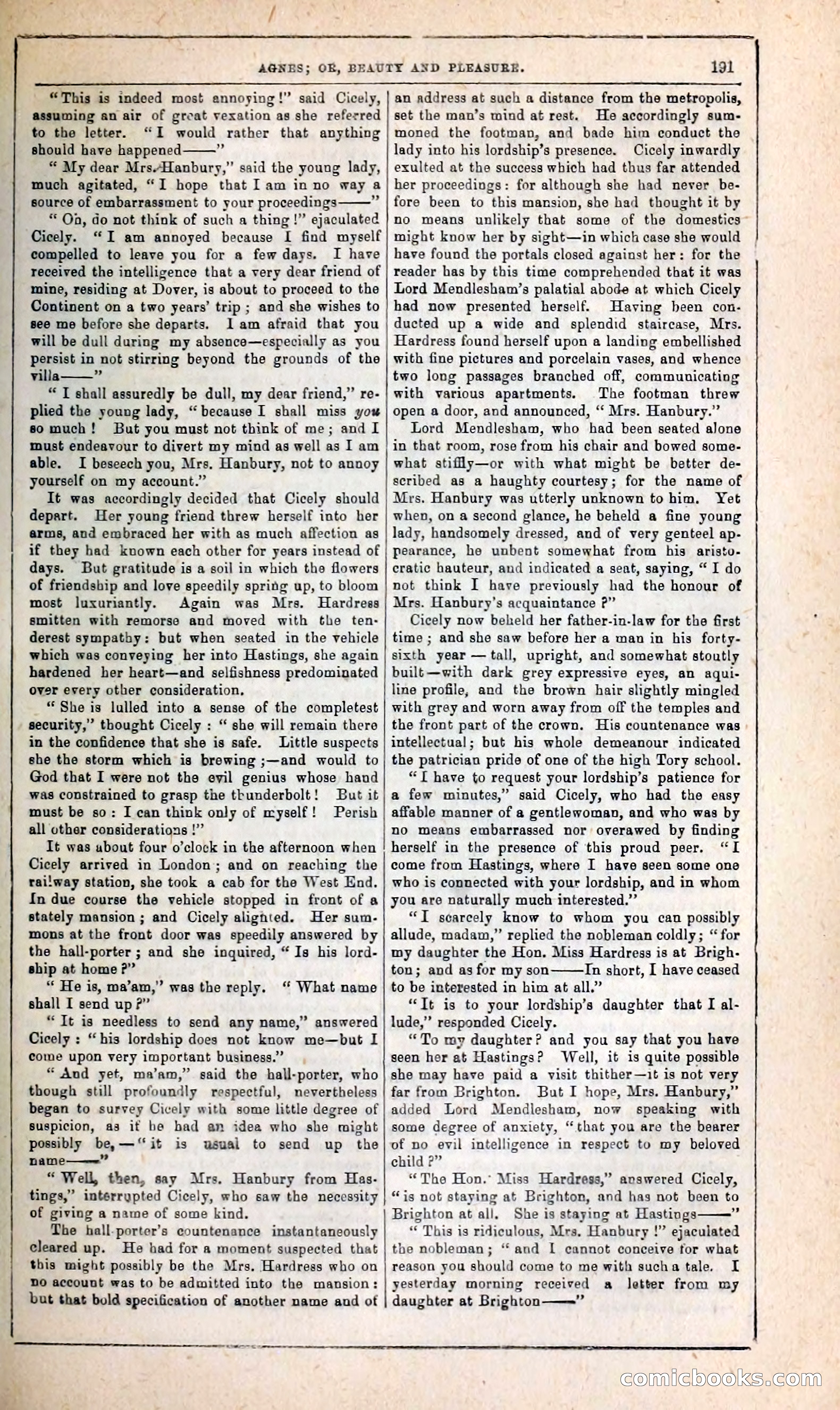
A restored page from Penny Dreadfuls, 1857. Page through the whole issue in the reader above.
📄 Transcribed text from this page (OCR, searchable)
Machine-transcribed from the original scan — historical spelling and the odd misread are preserved.
AGNES; OR, BEAUTY AND PLEASURE. 191 “This is indeed most ennoying!” said Cicely, assuming an air of great vexation as she referred to the letter. “I would rather that anything should have happened 4 My dear Mrs.Hanbury,” said the young lady, much agitated, “I hope that Iam inno way a source of embarrassment to your proceedings a * On, do not think of such a thing!” ejaculated Cicely. “I am annoyed because [ find myself compelled to leave you for a few days. I have received the intelligence that a very dear friend of mine, residing at Dover, is about to proceed to the Continent on a two years’ trip ; and she wishes to see me before she departs. lam afraid that you will be dull during my absence—especially as you persist in not stirring beyond the grounds of the villa Ps “I shall assuredly be dull, my dear friend,” re- plied the young lady, “because I shall miss you somuch! But you must not think of me; and I must endeavour to divert my mind as well as I am able. I beseech you, Mrs. Hanbury, not to annoy yourself on my account.” It was accordingly decided that Cicely should depart. Her young friend threw herself into her arms, and embraced her with as much affection as if they had kuown each other for years instead of days. But gratitude is a soil in which the flowers of friendship and love speedily spring up, to bloom most luxuriantly. Again was Mrs. Hardress smitten with remorse and moved with the ten- derest sympathy: but when seated in the vehicle which was conveying her into Hastings, she again hardened her heart—and selfishness predominated over every other consideration, “She is lulled into a sense of the completest security,” thought Cicely : “ she will remain there in the confidence that she is safe. Little suspects she the storm which is brewing ;—and would to God that I were not the evil genius whose hand was constrained to grasp the thunderbolt! But it must be so: I can think only of myself! Perish all other considerations !” It was about four o’clock in the afternoon when Cicely arrived in London; and on reaching the railway station, she took a cab for the West End. {In due course the vehicle stopped in front of a stately mansion ; and Cicely alighted. Her sum- mons at the front door was speedily answered by the hall-porter ; and she inquired, “ Is his lord- ship at home ?” “* He is, ma’am,” was the reply. shall I send up ?” “It is needless to send any name,” answered Cicely : “his lordship does not know me—but I come upon very important business.” “ And yet, ma’am,” said the hall-porter, who though still profoundly respectful, nevertheless began to survey Cicely with some little degree of suspicion, as it be had an idea who she might possibly be,—‘‘it is usual to send up the name——~” “ Well, then, say Mrs. Hanbury from Has- tings,” interrypted Cicely, who saw the necessity of giving a name of some kind. The hall-porter’s countenance instantaneously eleared up. He had for a moment suspected that this might possibly be the Mrs. Hardress who on no account was to be admitted into the mansion: but that bold specification of another name and of ‘“ What name cS —_—- sam am mn mem aa Ra cc Oe an address at such a distance from the metropolis, set the man’s mind at rest. He accordingly sum- moned the footman, and bade him conduct the lady into his lordship’s presence. Cicely inwardly exulted at the success which had thus far attended her proceedings: for although she had never be- fore been to this mansion, she had thought it by no means unlikely that some of the domestics~ might know her by sight—in which case she would have found the portals closed against her: for the reader has by this time comprehended that it was Lord Mendlesham’s palatial abode at which Cicely had now presented herself. Having been con- ducted up a wide and splendid staircase, Mrs. Hardress found herself upon a landing embellished with fine pictures and porcelain vases, and whence two long passages branched off, communicating with various apartments. The footman threw open a door, and announced, “‘ Mrs. Hanbury.” Lord Mendlesham, who had been seated alone in that room, rose from his chair and bowed some- what stifly—or with what might be better de- scribed as a haughty courtesy; for the name of Mrs. Hanbury was utterly unknown to him. Yet when, on a second glance, he beheld a fine young lady, handsomely dressed, and of very genteel ap- pearance, he unbent somewhat from his aristo- cratic hauteur, and indicated a seat, saying, “ I do not think I have previously had the honour of Mrs. Hanbury’s acquaintance ?” Cicely now beheld her father-in-law for the first time ; and she saw before her a man in his forty- sixth year — tall, upright, and somewhat stoutly built—with dark grey expressive eyes, an aqui- line profile, and the brown hair slightly mingled with gray and worn away from off the temples and the front part of the crown. His countenance was intellectual; but his whole demeanour indicated the patrician pride of one of the high Tory school. “[ have to request your lordship’s patience for a few minutes,” said Cicely, who had the easy affable manner of a gentlewoman, and who was by no means embarrassed nor overawed by finding herself in the presence of this proud peer. “I come from Hastings, where I have seen some one who is connected with your lordship, and in whom you are naturally much interested.” “TI scarcely know to whom you can possibly allude, madam,” replied the nobleman coldly; “for my daughter the Hon. Miss Hardress is at Brigh- ton; and as for my son In short, I have ceased to be interested in him at all.” “Tt is to your lordship’s daughter that I al- lude,” responded Cicely. “To my daughter? and you say that you have seen her at Hastings? Well, it is quite possible she may have paid a visit thither—it is not very far from Brighton. But I hope, Mrs. Hanbury,” added Lord Mendlesham, now speaking with some degree of anxiety, “that you are the bearer of no evil intelligence in respect to my beloved child ?” “The Hon. Miss Hardress,” answered Cicely, “is not staying at Brighton, and has not been to Brighton at all, She is staying at Hastings ~ “ This is ridiculous, Mrs, Hanbury !” ejaculated the nobleman; “‘ and [| cannot conceive tor what reason you should come to me with sucha tale. I yesterday morning received a letter from my daughter at Brighton——~” CoMmiclooolks Olin