
Penny Dreadfuls, 1857 · page 223 of 394
Agnes, or, Beauty and Pleasure — page 223: what you’re looking at
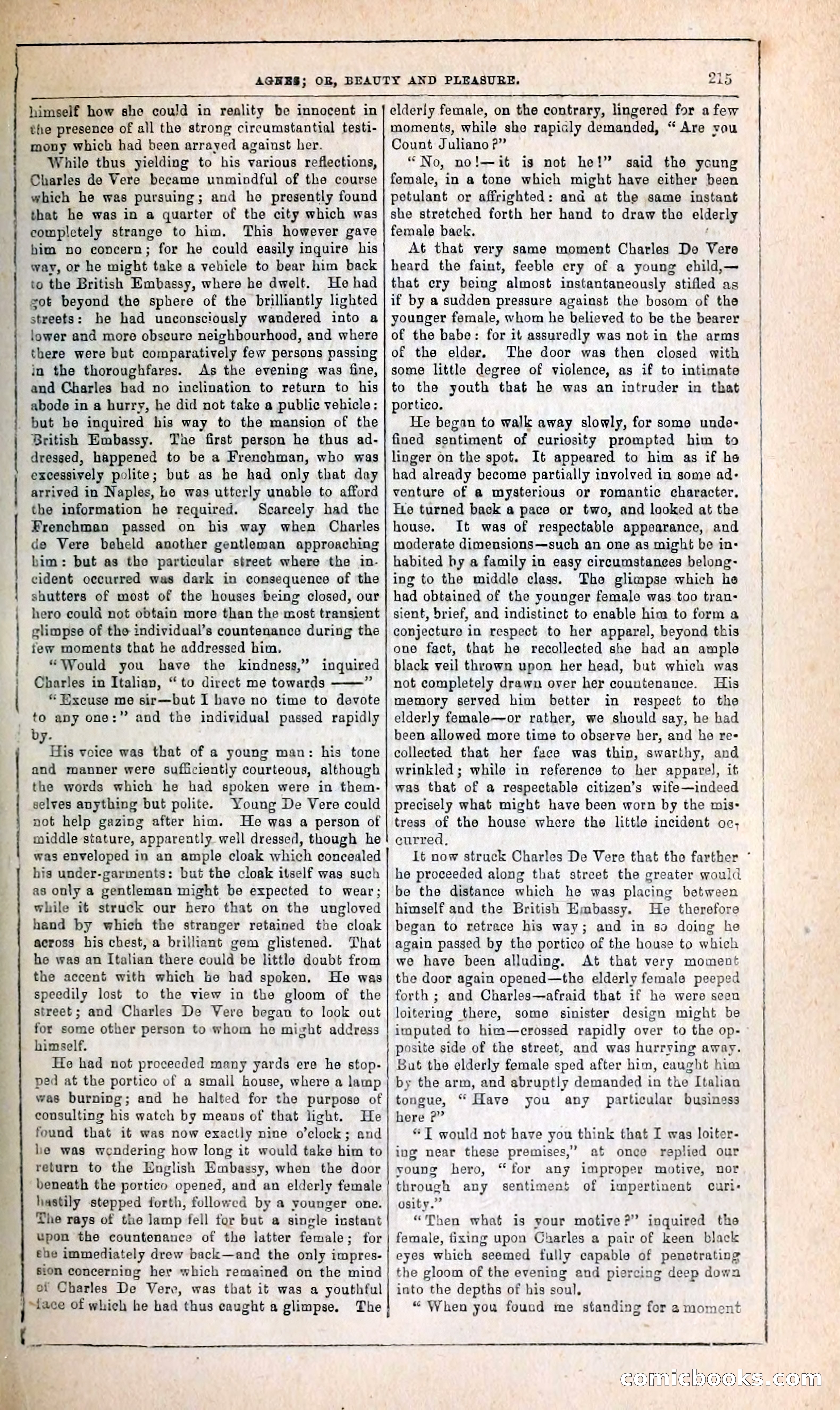
A restored page from Penny Dreadfuls, 1857. Page through the whole issue in the reader above.
📄 Transcribed text from this page (OCR, searchable)
Machine-transcribed from the original scan — historical spelling and the odd misread are preserved.
AGNES; OR, BEAUTY AND PLEASURE. himself how she could in reality be innocent in the presence of all the strong circumstantial testi- mony which had been arrayed against her. While thus yielding to his various reflections, Charles de Vere became unmindful of the course which he was pursuing; and he presently found that he was in a quarter of the city which was completely strange to him. This however gave him no concern; for he could easily inquire his way, or he might take a vebicle to bear him back to the British Embassy, where he dwelt. He had sot beyond the sphere of the brilliantly lighted streets: he had unconsciously wandered into a lower and more obscure neighbourhood, and where there were but comparatively few persons passing in the thoroughfares. As the evening was fine, and Charles had no inclination to return to his abode in a hurry, he did not take a public vehicle: but be inquired his way to the mansion of the British Embassy. The first person he thus ad- dressed, happened to be a Frenchman, who was excessively polite; but as he had only that day arrived in Naples, he was utterly unable to afford the information he required. Scareely had the Frenchman passed on his way when Charles de Vere beheld another gentleman approaching bim: but as the particular street where the in- cident occurred was dark in consequence of the shutters of most of the houses being closed, our hero could not obtain more than the most transient glimpse of the individual’s countenance during the few moments that he addressed him. “Would you have the kindness,” inquired Charles in Italian, “ to direct me towards * Excuse me sir—but I have no time to devote to any one:” and the individual passed rapidly ' by. His voice was that of a young man: his tone and manner were sufficiently courteous, although the words which he had spoken were in them- selves anything but polite. Young De Vere could not help gazing after him. He was a person of middle stature, apparently well dressed, though he was enveloped in an ample cloak which concealed his under-garments: but the cloak itself was such as only a gentleman might be expected to wear; while it struck our hero that on the ungloved hand by which the stranger retained the cloak across his chest, a brilliant gem elistened. That he was an Italian there could be little doubt from the accent with which he had spoken. He was speedily lost to the view in the gloom of the street; and Charles De Vere began to look out for some other person to whom he mizht address himself. He had not proceeded many yards ere he stop- ped at the portico of a small house, where a lamp was burning; and he halted for the purpose of consulting his watch by means of that light. He found that it was now exactly nine o’clock; and he was wondering how long it would take him to return to the English Embassy, when the door beneath the portico opened, and an elderly female hastily stepped forth, followed by a younger one. The rays of the lamp fell for but a sinele instant upon the countenance of the latter female ; for ebe immediately drew back—and the only impres- sion concerning her which remained on the mind of Charles De Vere, was that it was a youthful | ~iace of which he had thus caught a glimpse. The Orr eid elderly female, on the contrary, lingered for afew moments, while she rapicly demanded, “ Are vou Count Juliano ?” “No, no!—it is not he!” said the young female, in a tone which might have either been petulant or affrighted: and at the same instant she stretched forth her hand to draw the eldondg female back. At that very same moment Charles De Vere heard the faint, feeble ery of a young child,— that cry being almost instantaneously stifled as if by a sudden pressure against the bosom of the younger female, whom he believed to be the bearer of the babe: for it assuredly was not in the arms of the elder, The door was then closed with some little degree of violence, as if to intimate to the youth that he was an intruder in that portico. He began to walk away slowly, for some unde- fined sentiment of curiosity prompted him to linger on the spot. It appeared to him as if he had already become partially involved in some ad- venture of @ mysterious or romantic character. Ete turned back a pace or two, and looked at the house. It was of respectable appearance, and moderate dimensions—such an one as might be in: habited by a family in easy circumstances belong- ing to the middle class. Tho glimpse which he had obtained of the younger female was too tran- sient, brief, and indistinct to enable him to form a conjecture in respect to her apparel, beyond this one fact, that he recollected she had an ample black veil thrown upon her head, but which was not completely drawn over her countenance. His memory served him better in respect to the elderly female—or rather, we should say, he had been allowed more time to observe her, and he res collected that her face was thin, swarthy, and wrinkled; while in reference to her apparel, it was that of a respectable citizen’s wife—indeed precisely what might have been worn by the wis- tress of the house where the little incident oc; eurred, It now struck Charles De Vere that tho farther ° he proceeded along that street the greater would be the distance which he was placing between himself and the British Embassy. He therefore began to retrace his way; and in sa doing he again passed by the portico of the house to which we have been alluding. At that very moment the door again opened—the elderly female peeped forth; and Charles—afraid that if he were seen loitering there, some sinister design might be imputed to him—crossed rapidly over to the op- posite side of the street, and was hurrying away. But the elderly female sped after him, caught him by the arm, and abruptly demanded in the Italian tongue, “ Have you any particular business here P” * T would not have you think that I was loiter- ing near these premises,’ at once replied our young hero, “for any improper motive, nor through any sentiment of impertinent curi- osity.” “Phen what is your motive?” inquired the female, fixing upon Charles a pair of keen black eyes which seemed fully capable of penetrating the gloom of the evening and piercing deep down into the depths of his soul, “ When you found me standing for a moment CoMmiclooolkks a A AE <a pment tt i LL —_—--