
Penny Dreadfuls, 1857 · page 234 of 394
Agnes, or, Beauty and Pleasure — page 234: what you’re looking at
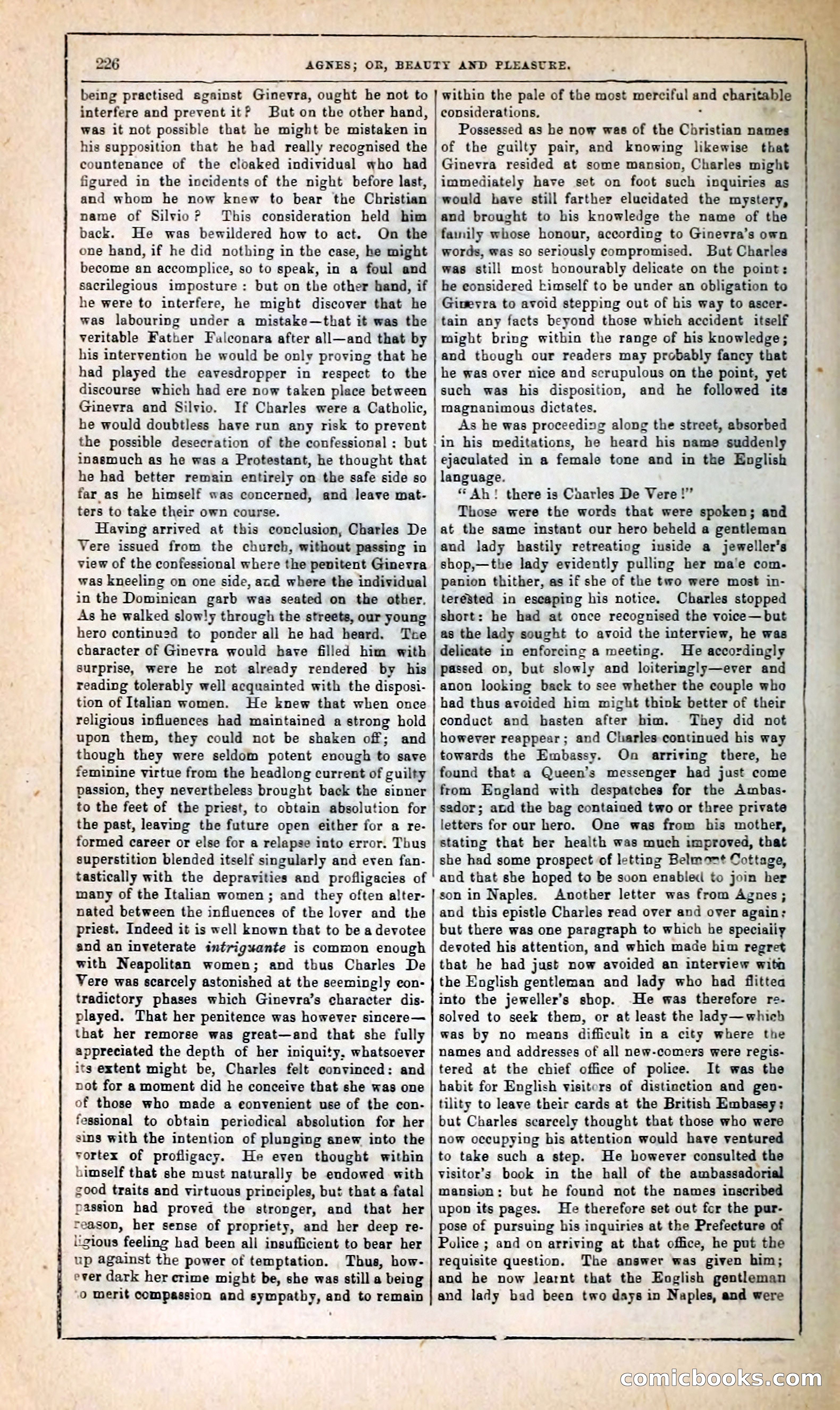
A restored page from Penny Dreadfuls, 1857. Page through the whole issue in the reader above.
📄 Transcribed text from this page (OCR, searchable)
Machine-transcribed from the original scan — historical spelling and the odd misread are preserved.
226 being practised against Ginevra, ought he not to interfere and prevent it? But on the other hand, was it not possible that he might be mistaken in his supposition that he bad really recognised the countenance of the cloaked individual who had figured in the incidents of the night before last, and whom he now knew to bear the Christian name of Silvio? This consideration held him back. He was bewildered how to act. On the one hand, if he did nothing in the case, he might become an accomplice, so to speak, in a foul and sacrilegious imposture : but on the other hand, if he were to interfere, he might discover that he was labouring under a mistake—that it was the veritable Father Falconara after all—and that by his intervention he would be only proving that he had played the eavesdropper in respect to the discourse which had ere now taken place between Ginevra and Silvio. If Charles were a Catholic, he would doubtless have run any risk to prevent the possible desecration of the confessional : but inasmuch as he was a Protestant, he thought that he had better remain entirely on the safe side so far as he himself was concerned, and leave mat- ters to take their own course. Having arrived at this conclusion, Charles De Vere issued from the church, without passing in view of the confessional where the penitent Ginevra was kneeling on one side, acd where the individual in the Dominican garb waa seated on the other. As he walked slowly through the streets, our young hero continued to ponder all he had heard. Tre character of Ginevra would have filled him with surprise, were he rot already rendered by his reading tolerably well acquainted with the disposi- tion of Italian women. He knew that when once religious influences had maintained a strong hold upon them, they could not be shaken off; and though they were seldom potent enough to save feminine virtue from the headlong current of guilty passion, they nevertheless brought back the sinner to the feet of the priest, to obtain absolution for the past, leaving the future open either for a re- formed career or else for a relapse into error. Thus superstition blended itself singularly and even fan- tastically with the depravities and profligacies of many of the Italian women; and they often alter- nated between the influences of the lover and the priest. Indeed it is well known that to be a devotee and an inveterate intriguante is common enough with Neapolitan women; and thus Charles De Vere was scarcely astonished at the seemingly con- tradictory phases which Ginevra’s character dis- played. That her penitence was however sincere— that her remoree was great—and that she fully appreciated the depth of her iniquity, whatsoever its extent might be, Charles felt convinced: and not for a moment did he conceive that she was one of those who made a eonvenient use of the con- fessional to obtain periodical absolution for her sins with the intention of plunging anew into the vortex of profligacy. He even thought within himself that she must naturally be endowed with good traits and virtuous principles, but that a fatal passion had proved the stronger, and that her reasop, her sense of propriety, and her deep re- ligious feeling had been all insuflicient to bear her up against the power of temptation. Thus, how- ever dark her crime might be, she was still a being (0 merit compassion and sympatby, and to remain AGNES; OR, BEAUTY AND PLEASURE, within the pale of the most merciful and charitable considerations. Possessed as he now was of the Ohemten names — of the guilty pair, and knowing likewise that Ginevra resided at some mansion, Charles might immediately have set on foot such inquiries as would have still farther elucidated the mystery, and brought to his knowledge the name of the fainily whose honour, according to Ginevra’s own words, was so seriously compromised. But Charles was still most honourably delicate on the point: he considered kimself to be under an obligation to Givevyra to avoid stepping out of bis way to ascer- tain any facts beyond those which accident itself might bring within the range of his knowledge; and though our readers may probably fancy that he was over nice and scrupulous on the point, yet such was his disposition, and he followed its magnanimous dictates. As he was proceeding along the street, absorbed in his meditations, he heard his name suddenly ejaculated in a female tone and in the English language. “Ah! there is Caarles De Vere !” Those were the words that were spoken; and at the same instant our hero beheld a gentleman aud Jady hastily retreating inside a jeweller’s shop,—tbe lady evidently pulling her ma‘e com. panion thither, as if she of the two were most in- terested in escaping his notice. Charles stopped short: he had at once recognised the voice—but as the lady sought to avoid the interview, he was delicate in enforcing a meeting. He accordingly passed on, but slowly and loiterimgly—ever and anon looking back to see whether the couple whe had thus avoided him might think better of their conduct and hasten after bim. They did not however reappear; and Cliarles continued his way towards the Embassy. On arriving there, he found that a Queen’s messenger had just come from England with despatches for the Ambas- sador; aud the bag contained two or three private letters for our hero. One was from his mother, stating that ber health was much improved, that she had some prospect of letting Belmont Cottage, and that she hoped to be soon enabled to join her son in Naples. Another letter was from Agnes; and this epistle Charles read over and over again; but there was one paragraph to which he speciaiiy devoted his attention, and which made him regret that he had just now avoided an interview witn the English gentleman and lady who had flittea ito the jeweller’s shop. He was therefore re. solved to seek them, or at least the lady—whieh was by no means difficult in a city where the names and addresses of all new-comers were regis- tered at the chief office of police. It was the habit for English visitors of distinction and gen- tility to leave their cards at the British Embasay: but Charles scarcely thought that those who were now occupying bis attention would have ventured to take such a step. He however consulted the visitor’s book in the hall of the ambassadorial mansion: but he found not the names inscribed upon its pages. He therefore set out for the pur- pose of pursuing bis inquiries at the Prefecture of Police ; and on arriving at that office, he put the requisite question. The answer was given him; and he now learnt that the English gentleman and lady bad been two days in Naples, and were Comicbooks ' —_ he te ee —