
Penny Dreadfuls, 1857 · page 243 of 394
Agnes, or, Beauty and Pleasure — page 243: what you’re looking at
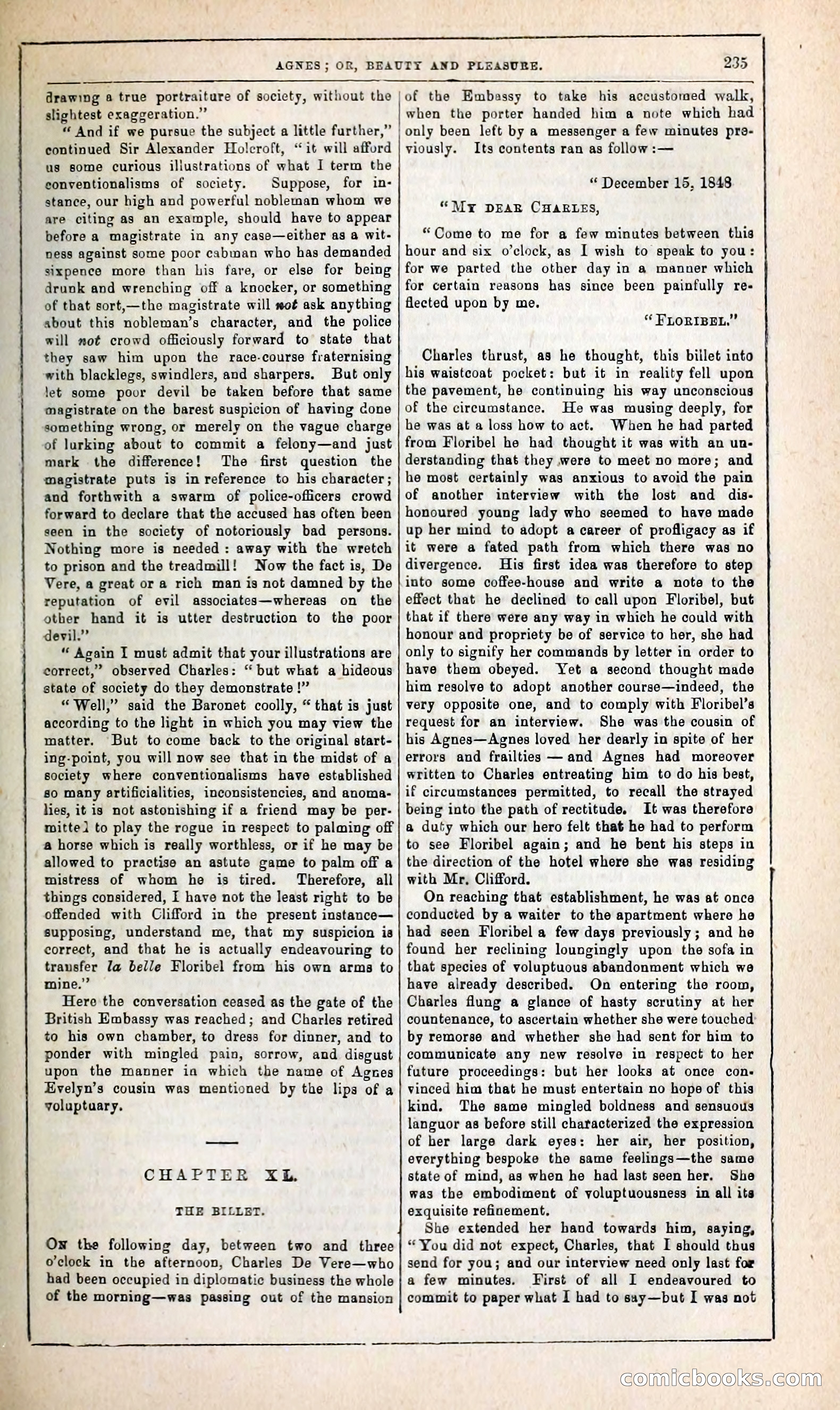
A restored page from Penny Dreadfuls, 1857. Page through the whole issue in the reader above.
📄 Transcribed text from this page (OCR, searchable)
Machine-transcribed from the original scan — historical spelling and the odd misread are preserved.
j as AGNES; OR, BEAUTY AND PLEASURE. 235 drawing a true portraiture of society, without the jof the Embassy to take his accustomed walk, slightest exaggeration.” when the porter handed him a note which had “ And if we pursue the subject a little further,” only been left by a messenger a few minutes pre- continued Sir Alexander Holcroft, “it will afford us some curious illustrations of what I term the conventionalisms of society. Suppose, for in- stance, our high and powerful nobleman whom we are citing as an example, should have to appear before a magistrate in any case—either as a wit- ness against some poor cabman who has demanded sixpence more than his fare, or else for being drunk and wrenching off a knocker, or something of that sort,—the magistrate will woé ask anything about this nobleman’s character, and the police will mot crowd officiously forward to state that they saw him upon the race-course fraternising with blacklegs, swindlers, and sharpers. But only let some poor devil be taken before that same magistrate on the barest suspicion of having cone something wrong, or merely on the vague charge of lurking about to commit a felony—and just mark the difference! The first question the magistrate puts is in reference to his character; and forthwith a swarm of police-officers crowd forward to declare that the accused has often been seen in the society of notoriously bad persons. Nothing more is needed: away with the wretch to prison and the treadmill! Now the fact is, De Vere, a great or a rich man is not damned by the reputation of evil associates—whereas on the other hand it is utter destruction to the poor devil.” “ Acain I must admit that your illustrations are correct,” observed Charles: “but what a hideous state of society do they demonstrate !” “Well,” said the Baronet coolly, “ that is just according to the light in which you may view the matter. But to come back to the original start- ing-point, you will now see that in the midst of a society where conventionalisms have established so many artificialities, inconsistencies, and anoma- lies, it is not astonishing if a friend may be per- mittel to play the rogue in respect to palming off a horse which is really worthless, or if he may be allowed to practise an astute game to palm off a mistress of whom he is tired. Therefore, all things considered, I have not the least right to be offended with Clifford in the present instance— supposing, understand me, that my suspicion is correct, and that he is actually endeavouring to transfer la belle Floribel from his own arms to mine.” Here the conversation ceased as the gate of the British Embassy was reached; and Charles retired to his own chamber, to dress for dinner, and to ponder with mingled pain, sorrow, and disgust upon the manner in which the name of Agnes Eivelyn’s cousin was mentioned by the lips of a vyoluptuary, CHAPTER Xk. THE BILLET. Ow the following day, between two and three o’clock in the afternoon, Charles De Vere—who had been occupied in diplomatic business the whole of the morning—was passing out of the mansion viously. Its contents ran as follow :— “ December 15, 1848 “My DEAR CHARLES, “Come to me for a few minutes between this hour and six o’clock, as I wish to speak to you: for we parted the other day in a manner which for certain reasons has since been painfully re- flected upon by me. “ FLORIBEL,” Charles thrust, as he thought, this billet into his waistcoat pocket: but it in reality fell upon the pavement, he continuing his way unconscious of the circumstance. He was musing deeply, for he was at a loss how to act. When he had parted from Floribel he had thought it was with an un- derstanding that they were to meet no more; and he most certainly was anxious to avoid the pain of another interview with the lost and dis- honoured young lady who seemed to have made up her mind to adopt a career of profligacy as if it were a fated path from which there was no divergence. His first idea was therefore to step into some coffee-house and write a note to the effect that he declined to call upon Floribel, but that if there were any way in which he could with honour and propriety be of service to her, she had only to signify her commands by letter in order to have them obeyed. Yet a second thought made him resolve to adopt another course—indeed, the very opposite one, and to comply with Floribel’s request for an interview. She was the cousin of his Agnes—Agnes loved her dearly in spite of her errors and frailties — and Agnes had moreover written to Charles entreating him to do his best, if circumstances permitted, to recall the strayed being into the path of rectitude. It was therefore a duty which our hero felt that he had to perform to see Floribel again; and he bent his steps in the direction of the hotel where she was residing with Mr, Clifford. On reaching that establishment, he was at once conducted by a waiter to the apartment where he had seen Floribel a few days previously; and he found her reclining loungingly upon the sofa in that species of voluptuous abandonment which we have already described. On entering the room, Charles flung a glance of hasty scrutiny at her countenance, to ascertain whether she were touched by remorse and whether she had sent for him to communicate any new resolve in respect to her future proceedings: but her looks at once cons vinced him that he must entertain no hope of this kind. The same mingled boldness and sensuous languor as before still chatacterized the expression of her large dark eyes: her air, her position, everything bespoke the same feelings—the same state of mind, as when he had last seen her. She was the embodiment of yoluptuousness in all its exquisite refinement, She extended her hand towards him, saying, “You did not expect, Charles, that I should thus send for you; and our interview need only last for a few minutes. First of all I endeavoured to commit to paper what I had to say—but I was not COMmiclhooolkks OimM