
Penny Dreadfuls, 1857 · page 251 of 394
Agnes, or, Beauty and Pleasure — page 251: what you’re looking at
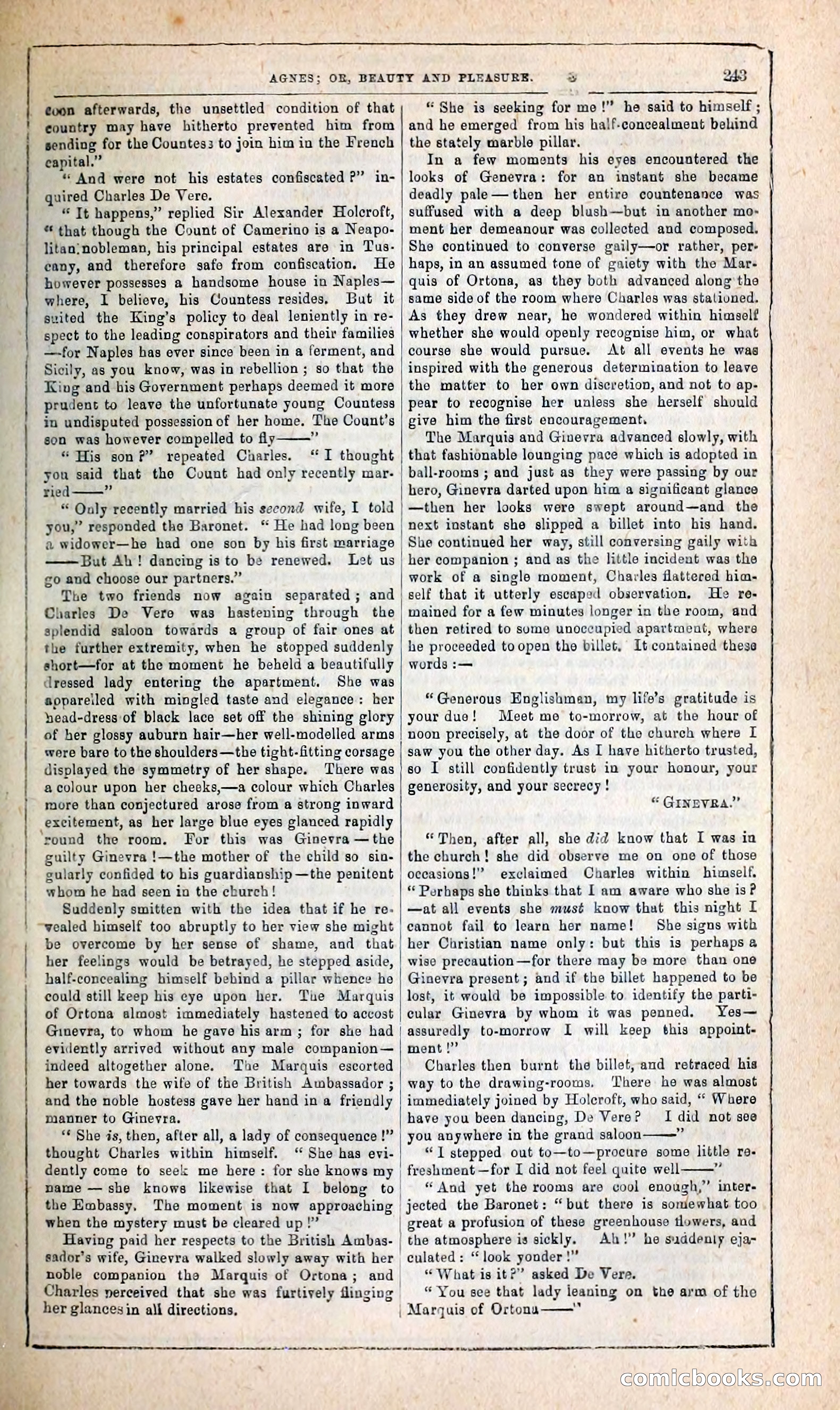
A restored page from Penny Dreadfuls, 1857. Page through the whole issue in the reader above.
📄 Transcribed text from this page (OCR, searchable)
Machine-transcribed from the original scan — historical spelling and the odd misread are preserved.
‘ round the room. von afterwards, the unsettled condition of that country may have hitherto prevented him from sending for the Countes3 to join him in the French capital.” * And were not his estates confiscated P” in- guired Charles De Vere. * Tt happens,” replied Sir Alexander Holcroft, * that though the Count of Camerino is a Neapo- litan;nobleman, his principal estates are in Tus- eany, and therefore safe from confiscation. He however possesses a handsome house in Naples— where, I believe, his Countess resides, But it suited the King’s policy to deal leniently in re- spect to the leading conspirators and their families —- for Naples has ever since been in a ferment, and Sicily, as you know, was in rebellion ; so that the King and bis Government perhaps deemed it more prudent to leave the unfortunate young Countess in undisputed possession of her home. The Count’s son was however compelled to fly eo “ His son?” repeated Charles. “I thought you said that the Count had only recently mar- ried a * Only recently married his second wife, I told you,” responded the Baronet. “ He had long been a widower—he had one son by his first marriage But Ah! dancing is to be renewed. Let us go and choose our partners.” The two friends now again separated; and Charles De Vere was hastening through the splendid saloon towards a group of fair ones at the further extremity, when he stopped suddenly short—for at the moment he beheld a beautifully dressed lady entering the apartment. She was sopareiled with mingled taste and elegance: her hnead-dress of black lace set off the shining glory of her glossy auburn hair—her well-modelled arms were bare to the shoulders—the tight-fitting corsage displayed the symmetry of her shape. ‘There was a colour upon her cheeks,—a colour which Charles more than conjectured arose from a strong inward excitement, as her large blue eyes glanced rapidly For this was Ginevra — the guilty Ginevra !—the mother of the child so sia- gularly confided to his guardianship —the penitent whom he had seen in the church! Suddenly smitten with the idea that if he re- “vealed himself too abruptly to her view she might be overcome by her sense of shame, and that her feelings would be betrayed, he stepped aside, half-concealing himself behind a pillar whence he could still keep his eye upon her. Tue Marquis of Ortona almost immediately hastened to accost Ginevra, to whom he gave his arm ; for she had evidently arrived without any male companion— indeed altogether alone. The Marquis escorted her towards the wife of the British Ambassador ; and the noble hostess gave her hand in a friendly manner to Ginevra. ‘* She is, then, after all, a lady of consequence !” thought Charles within himself. ‘ She has evi- dently come to seek me here: for she knows my name — she knows likewise that I belong to the Embassy, The moment is now approaching when the mystery must be cleared up !” Having paid her respects to the British Ambas- | sador’s wife, Ginevra walked slowly away with her noble companion the Marquis of Ortona; and Charles perceived that she was furtively flinging her glancesin ali directions, . ree ee ee ne LS OE ES A LS TTT Conmiclooolks AGNES; OB, BEAUTY AND PLEASURE. 2 OTT TP ae ee ee PAS “She is seeking for me!” he said to himself ; and he emerged from his half-concealment behind the stately marble pillar. In a few moments his eyes encountered the looks of Genevra: for an instant she became deadly pale—then her entire countenance was suffused with a deep blush—but in another mo- ment her demeanour was collected and composed. She continued to converse gaily—or rather, per- haps, in an assumed tone of gaiety with the Mar- quis of Ortona, as they both advanced along the same side of the room where Charles was stationed. As they drew near, he wondered within himself whether she would openly recognise him, or what course she would pursue. At all events he was inspired with the generous determination to leave the matter to her own discretion, and not to ap- pear to recognise her unless she herself should give him the first encouragement. The Marquis and Ginevra advanced slowly, with that fashionable lounging pace which is adopted in ball-rooms ; and just as they were passing by our hero, Ginevra darted upon him a significant glance —then her looks were swept around—and the next instant she slipped a billet into his hand. | She continued her way, still conversing gaily with her companion ; and as the little incident was the work of a single moment, Charles flattered him- self that it utterly escaped observation. He re- mained for a few minutes longer in the room, and then retired to sume unoccupied apartment, where he proceeded to open tho billet, It contained these words :— “Generous Englishman, my life’s gratitude is your due! Meet me to-morrow, at the hour of noon precisely, at the door of tho chureh where I saw you the other day. As I have hitherto trusted, so I still confidently trust in your honour, your generosity, and your secrecy! “ GINEVRA.” “Then, after all, she did know that I was in the church! she did observe me on one of those occasions!” exclaimed Charles within himself. Porhaps she thinks that I am aware who she is?P —at all events she musé¢ know that this night L cannot fail to learn her name! She signs with her Christian name only: but this is perhaps a wise precaution—for there may be more than one Ginevra present; and if the billet happened to be lost, it would be impossible to identify the parti- cular Ginevra by whom it was penned. Yes— assuredly to-morrow I will keep this appoint. ment !” Charles then burnt the billet, and retraced his way to the drawing-rooms. ‘There he was almost immediately joined by Holecroft, who said, * Where have you been dancing, De Vere? I did not see you anywhere in the grand saloon ss “TI stepped out to—to—procure some little ra- freshment —for I did not feel quite well a “And yet the rooms are cool enough,” inter- jected the Baronet: “but there is somewhat too | great a profusion of these greenhouse tlowers, and the atmosphere is sickly. Ah!” he suddenty eja- culated: “ look yonder !” “What is it?” asked De Vere. “ You see that lady leaning on the arm of the | Marquis of Ortona 7 ”