
Penny Dreadfuls, 1857 · page 271 of 394
Agnes, or, Beauty and Pleasure — page 271: what you’re looking at
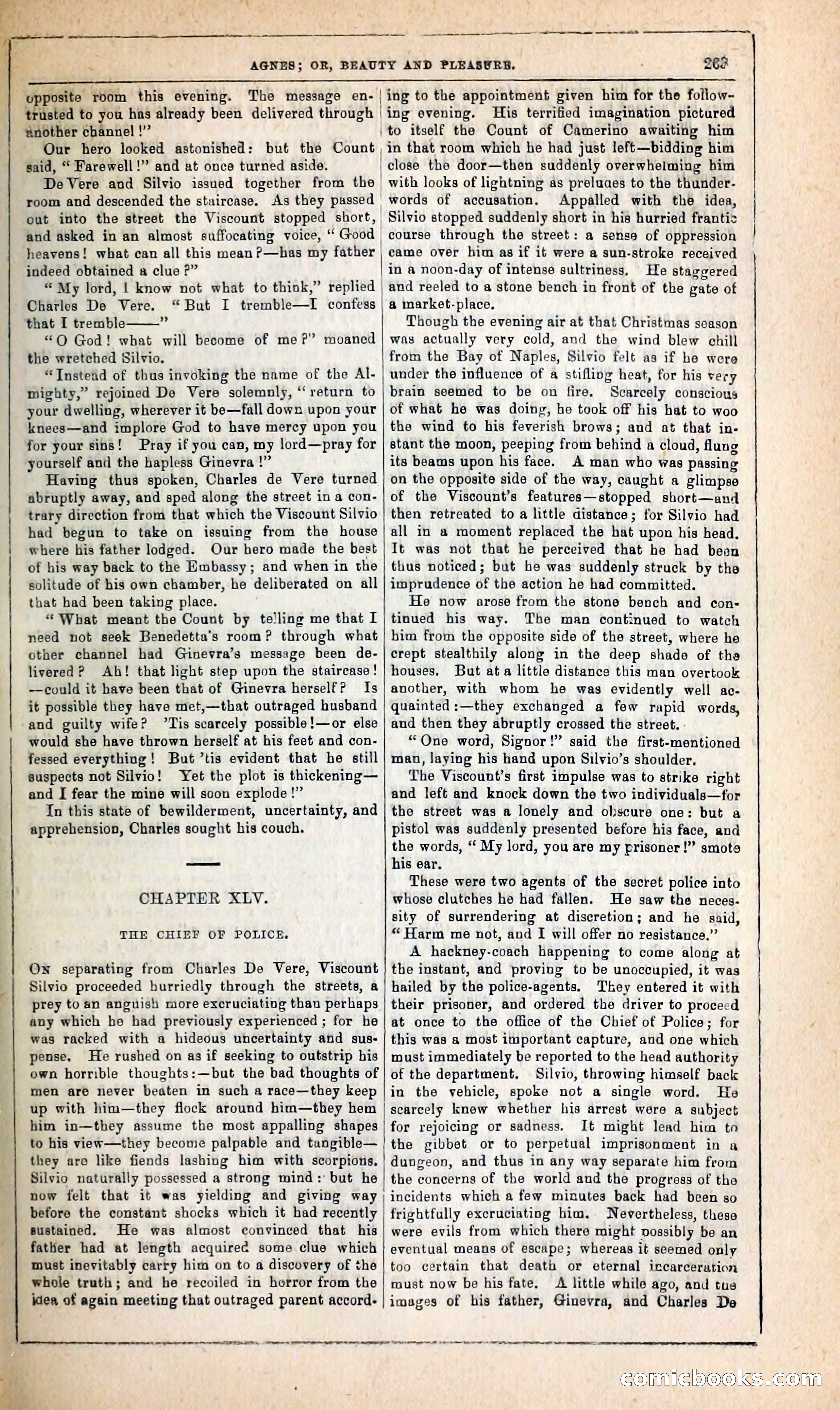
A restored page from Penny Dreadfuls, 1857. Page through the whole issue in the reader above.
📄 Transcribed text from this page (OCR, searchable)
Machine-transcribed from the original scan — historical spelling and the odd misread are preserved.
1 a ys aut a a | eae to another channel !” -and guilty wife? posite room this evening. The message en- | you has already been delivered through Our hero looked astonished: but the Count said, “ Farewell!” and at once turned aside. | DeVere and Silvio issued together from the room and descended the staircase. As they passed | out into the street the Viscount stopped short, and asked in an almost suffocating voice, “ Good | heavens! what can all this mean P—has my father indeed obtained a clue ?” “ My lord, | know not what to think,” replied Charles De Vere. “But I tremble—I confess that I tremble “OQ God! what will become of me?” moaned the wretched Silvio. “Instead of thus invoking the name of the Al- mighty,” rejoined De Vere solemnly, ‘return to your dwelling, wherever it be—fall down upon your knees—and implore God to have merey upon you for your sins! Pray if you can, my lord—pray for yourself and the hapless Ginevra !” Having thus spoken, Charles de Vere turned abruptly away, and sped along the street in a con- trary direction from that which the Viscount Silvio had begun to take on issuing from the house where his father lodged. Our hero made the best of his way back to the Embassy; and when in the solitude of his own chamber, he deliberated on all that had been taking place. “What meant the Count by telling me that I need not seek Benedetta’s room? through what other channel had Ginevra’s message been de- livered? Ah! that light step upon the staircase! —could it have been that of Ginevra herself? Is it possible they have met,—that outraged husband Tis scarcely possible!—or else would she have thrown herself at his feet and con- fessed everything! But ’tis evident that he still suspects not Silvio! Yet the plot is thickening— and [ fear the mine will soon explode!” In this state of bewilderment, uncertainty, and apprehension, Charles sought his couch. CHAPTER XLV. THE CHIEF OF POLICE. On separating from Charles De Vere, Viscount Silvio proceeded hurriedly through the streets, a prey to an anguish more excruciating than perhaps any which he had previously experienced ; for he was racked with a hideous uncertainty and sus- pense. He rushed on as if seeking to outstrip his own horrible thoughts:—but the bad thoughts of men are never beaten in such a race—they keep up with him—they flock around him—they hem him in—they assume the most appalling shapes to his view—they become palpable and tangible— they are like fiends lashing him with scorpions. Silvio naturally possessed a strong mind: but he now felt that it was yielding and giving way before the constant shocks which it had recently Bustained. He was almost convinced that his father had at length acquirec some clue which must inevitably carry him on to a discovery of the whole truth; and he recoiled in horror from the idea of again meeting that outraged parent accord- AGNES; OR, BEAUTY AND PLEASURB. en ee ee ree mee ne TT 268 ing to the appointment given him for the follow- ing evening. His terrified imagination pictured ito itself the Count of Camerino awaiting him in that room which he had just left—bidding him close the door—then suddenly overwhelming bim with looks of lightning as preluaes to the thunder- words of accusation. Appalled with the idea, Silvio stopped suddenly short in his hurried frantic course through the street: a sense of oppression came over him as if it were a sun-stroke received in a noon-day of intense sultriness. He staggered and reeled to a stone bench in front of the gate of a market-place. Though the evening air at that Christmas soason was actually very cold, and the wind blew chill from the Bay of Naples, Silvio felt as if he were under the influence of a stifling heat, for his very brain seemed to be on fire. Scarcely conscious of what he was doing, he took off his hat to woo the wind to his feverish brows; and at that in- stant the moon, peeping from behind a cloud, flung its beams upon his face. A man who was passing on the opposite side of the way, caught a glimpse of the Viscount’s features—stopped short—and then retreated to a little distance; for Silvio had all in a moment replaced the hat upon his head, It was not that he perceived that he had beon thus noticed; but he was suddenly struck by the imprudence of the action he had committed. He now arose from the stone bench and con- tinued his way. The man continued to watch him from the opposite side of the street, where he crept stealthily along in the deep shade of the houses. But ata little distance this man overtook another, with whom he was evidently well ac- quainted:—they exchanged a few rapid words, aud then they abruptly crossed the street. “One word, Signor!” said the first-mentioned man, laying his hand upon Silvio’s shoulder, The Viscount’s first impulse was to strike right and left and knock down the two individuals—for the street was a lonely and obscure one: but a pistol was suddenly presented before his face, and the words, “ My lord, you are my prisoner!” smota his ear. These were two agents of the secret police into whose clutches he had fallen. He saw the neces- sity of surrendering at discretion; and he said, “ Harm me not, and I will offer no resistance.” A hackney-coach happening to come along at the instant, and proving to be unoccupied, it was hailed by the police-agents. They entered it with their prisoner, and ordered the driver to proceed at once to the office of the Chief of Police; for this was a most important capture, and one which must immediately be reported to the head authority of the department. Silvio, throwing himself back in the vehicle, spoke not a single word. He scarcely knew whether his arrest were a subject for rejoicing or sadness. It might lead him ta the gibbet or to perpetual imprisonment in a dungeon, and thus in any way separate him from the concerns of the world and the progress of the incidents which a few minutes back had been so frightfully excruciating him. Nevertheless, these were evils from which there might possibly be an eventual means of escape; whereas it seemed only too certain that death or eternal incarceration must now be his fate. <A little while ago, and tue images of his father, Ginevra, and Charles De es et wen eee COMmnicooolks Om