
Penny Dreadfuls, 1857 · page 288 of 394
Agnes, or, Beauty and Pleasure — page 288: what you’re looking at
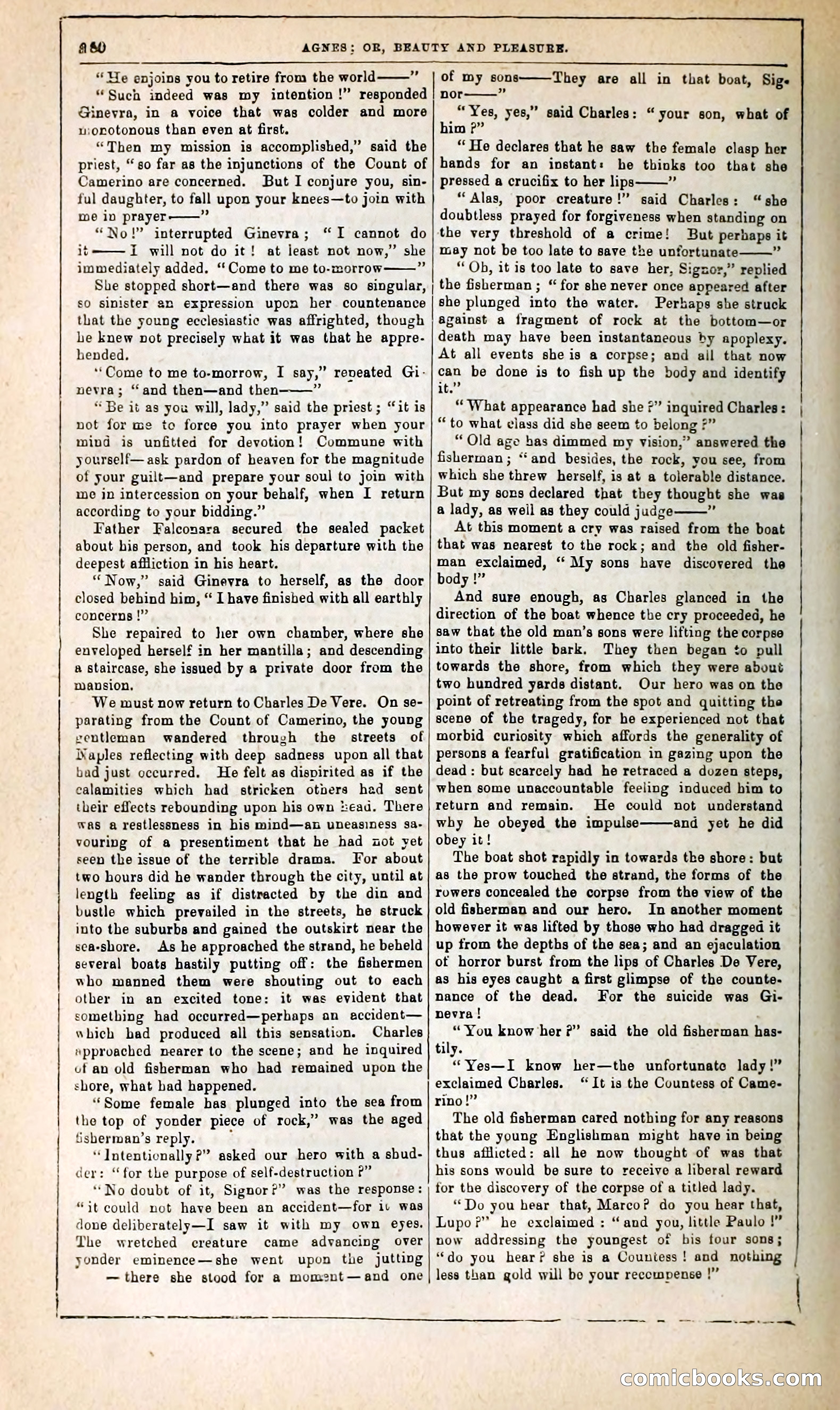
A restored page from Penny Dreadfuls, 1857. Page through the whole issue in the reader above.
📄 Transcribed text from this page (OCR, searchable)
Machine-transcribed from the original scan — historical spelling and the odd misread are preserved.
Ago AGNES: OR, BEAUTY AND PLEASURE. _—.e ” We enjoins you to retire from the world “Such indeed was my intention !” responded | nor Ginevyra, in a voice that was colder and more uiorotonous than even at first. “Then my mission is accomplished,” said the priest, “so far as the injunctions of the Count of Camerino are concerned. But I conjure you, sin- ful daughter, to fall upon your knees—to join with me ip prayer-——”’ “No!” interrupted Ginevra ; it i will not do it! at least not now, immediately added. ‘‘Come to me to-morrow “T cannot do ” she ) She stopped short—and there was so singular, | sO sinister an expression upon her countenance that the young ecclesiastic was affrighted, though he knew not precisely what it was that he appre- hended. ‘Come to me to-morrow, I say,’ nevra; “and then—and then a “Be it as you will, lady,” said the priest ; “it is not for me to force you into prayer when your mind is unfitted for devotion! Commune with yourself—ask pardon of heaven for the magnitude of your guilt—and prepare your soul to join with me jn intercession on your behalf, when I return according to your bidding.” Father Falconara secured the sealed packet about his person, and took his departure with the deepest affliction in his heart. * Now,” said Gineyra to herself, as the door closed behind him, “ I have finished with all earthly concerns !” She repaired to her own chamber, where she enveloped herself in her mantilla; and descending a staircase, she issued by a private door from the mansion. We wust now return to Charles De Vere. On se- parating from the Count of Camerino, the young gentleman wandered through the streets of Naples reflecting with deep sadness upon all that bad just occurred. He felt as dispirited as if the calamities which had stricken otbers had sent their effects rebounding upon his own =ead. There was a restlessness in his mind—an uneasiness sa- vouring of a presentiment that he had aot vet seen the issue of the terrible drama. Tor about two hours did he wander through the city, until at length feeling as if distracted by the din and bustle which prevailed in the streets, he struck into the suburbs and gained the outskirt near the sea-shore. As he approached the strand, he beheld several boats hastily putting off: the fishermen who manned them were shouting out to each other in an excited tone: it was evident that something had occurred—perbaps an accident— which bad produced all this sensation. Charles approached nearer to the scene; and he inquired cf an old fisherman who had remained upon the shore, what bad happened. ‘Some female has plunged into the sea from the top of yonder piece of rock,’ was the aged tisherman’s reply. : “Intentionally?” asked our hero with a sbud- der: “for the purpose of self-destruction P” ‘No doubt of it, Signor?” was the response: “it could not have been an accident—for iv was done deliberately—I saw it with my own eyes. The wretched creature came advancing over yonder eminence—she went upon the jutting — there she stood for a moment—and one ’ reveated Gi- of my sons They are all in that boat, Sige “Yes, yes,” said Charles: “your son, what of him P” “He declares that he saw the female clasp her hands for an instant: he thinks too that she pressed a crucifix to her lips ” “Alas, poor creature!” said Charles: “she doubtless prayed for forgiveness when standing on the very threshold of a crime! But perhaps it may not be too late to save the unfortunate dg “Ob, it is too late to save her, Sigzor,” replied the fisherman ; “ for she never once appeared after she plunged into the water. Perhaps she struck against a fragment of rock at the bottom—or death may have been instantaneous by apoplexy. At all events she is a corpse; and all that now can be done is to fish up the body and identify it.” “What appearance had she ?” inquired Charles: “to what ciass did she seem to belong ?” “Old age has dimmed my vision,” answered the fisherman ; “and besides, the rock, you see, from which she threw herself, is at a tolerable distance. But my sors declared that they thought she was & lady, as weil as they could judge 2 At this moment a cry was raised from the boat that was nearest to the rock; and the old fisher- man exclaimed, “ My sons have discovered the body !” And sure enough, as Charles glanced in the direction of the boat whence the cry proceeded, he saw that the old man’s sons were lifting the corpse into their little bark. They then began ¢o pull towards the shore, from which they were about two hundred yards distant. Our hero was on the point of retreating from the spot and quitting the scene of the tragedy, for he experienced not that morbid curiosity which affords the generality of persons a fearful gratification in gazing upon the dead : but scarcely had he retraced a dozen steps, when some unaccountable feeling induced him to return and remain. He could not understand why he obeyed the impulse and yet he did obey it! The boat shot rapidly in towards the shore: but as the prow touched the atrand, the forms of the rowers concealed the corpse from the view of the old fisherman and our hero. In another moment however it was lifted by those who had dragged it up from the depths of the sea; and an ejaculation ot horror burst from the lips of Charles De Vere, as his eyes caught a first glimpse of the counte- nance of the dead. Jor the suicide was Gi- nevra! “You know her ?” said the old fisherman has- tily. ““Yes—I know her—the unfortunate lady!” exclaimed Charles. “It is the Countess of Came- rino!” The old fisherman cared nothing for any reasons that the young Englishman might have in being thus afflicted: all he now thought of was that his sons would be sure to receive a liberal reward for the discovery of the corpse of a titled lady. “Do you hear that, Marco? do you hear that, Lupo?” he exclaimed : “and you, little Paulo !” now addressing the youngest or his four sons; “do you hear? she is a Countess! and nothing less than gold will bo your reccmpense |” GComicbooks