
Penny Dreadfuls, 1857 · page 302 of 394
Agnes, or, Beauty and Pleasure — page 302: what you’re looking at
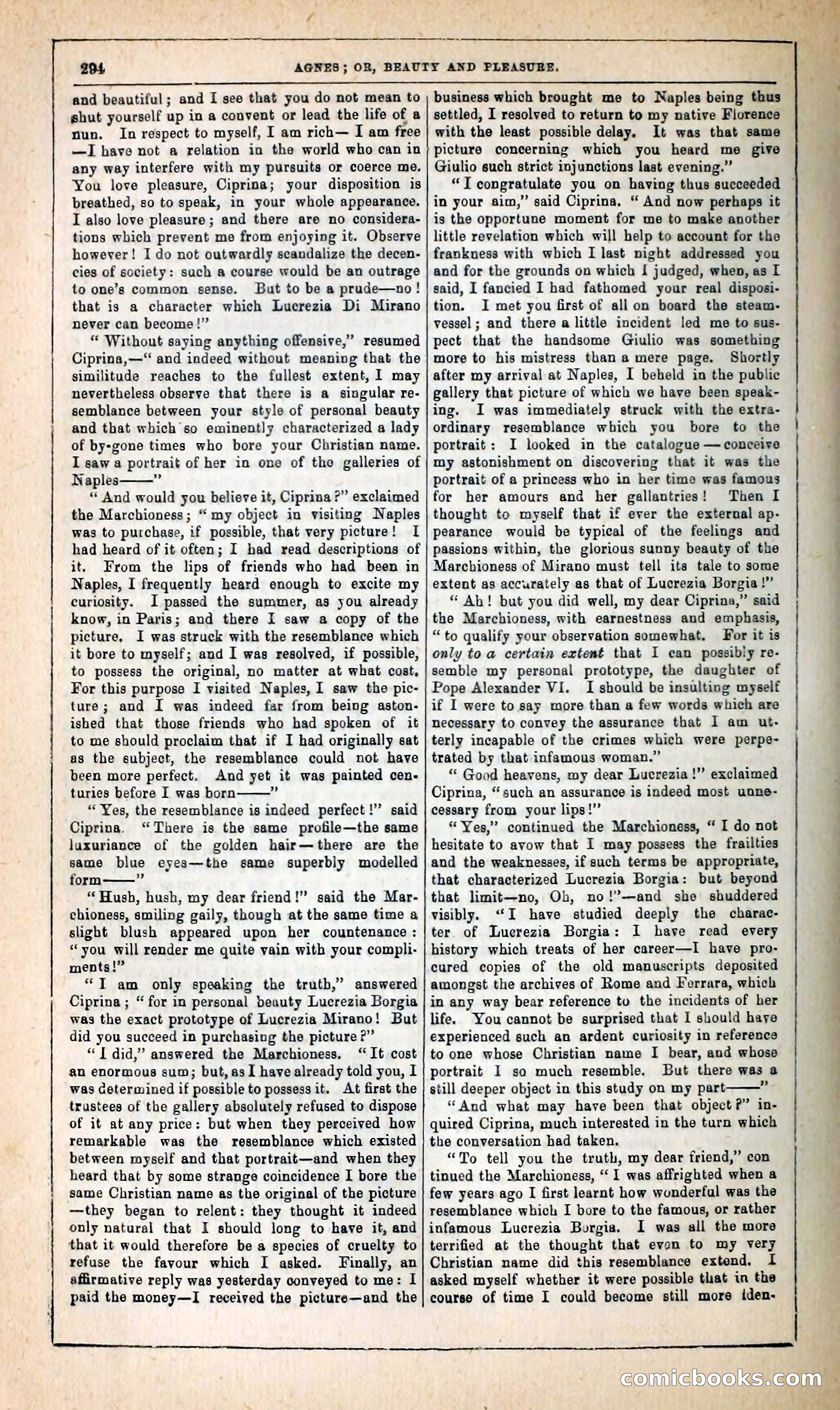
A restored page from Penny Dreadfuls, 1857. Page through the whole issue in the reader above.
📄 Transcribed text from this page (OCR, searchable)
Machine-transcribed from the original scan — historical spelling and the odd misread are preserved.
294 and beautiful; and I see that you do not mean to shut yourself up in a convent or lead the life of a nun. In respect to myself, I am rich— I am free —I have not a relation in the world who can in any way interfere with my pursuits or coerce me. You love pleasure, Ciprina; your disposition is breathed, so to speak, in your whole appearance. I also love pleasure; and there are no considera- tions which prevent me from enjoying it. Observe however! I do not outwardly scandalize the decen- cies of society: such a course would be an outrage to one’s common sense. But to be a prude—no! that is a character which Lucrezia Di Mirano never can become!” * Without saying anything offensive,” resumed Ciprina,—‘ and indeed without meaning that the similitude reaches to the fullest extent, 1 may nevertheless observe that there is a singular re- semblance between your style of personal beauty and that which so eminently characterized a lady of by-gone times who bore your Christian name. I saw a portrait of her in one of tho galleries of Naples th * And would you believe it, Ciprina ?” exclaimed the Marchioness; “ my object in visiting Naples was to purchase, if possible, that very picture! I had heard of it often; I had read descriptions of it. From the lips of friends who had been in Naples, I frequently heard enough to excite my curiosity. I passed the summer, as you already know, in Paris; and there I saw a copy of the picture, I was struck with the resemblance which it bore to myself; and I was resolved, if possible, to possess the original, no matter at what cost. For this purpose I visited Naples, 1 saw the pic- ture; and I was indeed far from being aston- ished that those friends who had spoken of it to me should proclaim that if I had originally sat as the subject, the resemblance could not have been more perfect. And yet it was painted cen- turies before I was born ‘ ‘Yes, the resemblance is indeed perfect!” said Ciprina. “There is the same profile—the same luxuriance of the golden hair—there are the same blue eyes—the same superbly modelled form——” “Hush, hush, my dear friend!” said the Mar- chioness, smiling gaily, though at the same time a slight blush appeared upon her countenance : “you will render me quite vain with your compli- ments!” “IT am only speaking the truth,” answered Ciprina ; “ for in personal beauty Lucrezia Borgia was the exact prototype of Lucrezia Mirano! But did you succeed in purchasing the picture?” “I did,” answered the Marchioness. “It cost an enormous sum; but,asI have already told you, 1 was Getermined if possible to possess it. At first the trustees of the gallery absolutely refused to dispose of it at any price: but when they perceived how remarkable was the resemblance which existed between myself and that portrait—and when they heard that by some strange coincidence I bore the same Christian name as the original of the picture —they began to relent: they thought it indeed only natural that I should long to have it, and that it would therefore be a species of cruelty to refuse the favour which I asked. Finally, an affirmative reply was yesterday conveyed to me: I paid the money—I received the picture—and the AGNES; OR, BEAUTY AND PLEASURE. business which brought me to Naples being thus settled, I resolved to return to my native Florence with the least possible delay. It was that same picture concerning which you heard me give Giulio such strict injunctions last evening.” “T congratulate you on having thus succeeded ~ in your aim,” said Ciprina. “ And now perhaps it is the opportune moment for me to make another little revelation which will help to account for the frankness with which I last night addressed you and for the grounds on which I judged, when, as I said, I fancied I had fathomed your real disposi- tion. I met you first of all on board the steam- vessel ; and there a little incident led me to sus- pect that the handsome Giulio was something more to his mistress than a mere page. Shortly after my arrival at Naples, I beheld in the public gallery that picture of which we have been speak- ing. I was immediately struck with the extra- ordinary resemblance which you bore to the portrait: I looked in the catalogue — conceive my astonishment on discovering that it was the portrait of a princess who in her time was famous for her amours and her gallantries! Then I thought to myself that if ever the external ap- pearance would be typical of the feelings and passions within, the glorious sunny beauty of the Marchioness of Mirano must tell its tale to some extent as accurately as that of Lucrezia Borgia!” “ Ab! but you did well, my dear Ciprina,” said the Marchioness, with earnestness and emphasis, “to qualify your observation somewhat. For it is only toa certain extent that I ean possibly re- semble my personal prototype, the daughter of Pope Alexander VI. I should be insulting myself if I were to say more than a few words which are necessary to convey the assurance that I am ut- terly incapable of the crimes which were perpe- trated by that infamous woman.” “ Good heavens, my dear Lucrezia!” exclaimed Ciprina, “such an assurance is indeed most unne- cessary from your lips!’ “Yes,” continued the Marchioness, “ I do not hesitate to avow that I may possess the frailties and the weaknesses, if such terms be appropriate, that characterized Lucrezia Borgia: but beyond that limit—no, Ob, no!”—and she shuddered visibly. ‘I have studied deeply the charac- ter of Luerezia Borgia: I have read every history which treats of her career—I have pro- cured copies of the old manuscripts deposited amongst the archives of Rome and Ferrara, which in any way bear reference tou the incidents of her life. You cannot be surprised that I sould haye experienced such an ardent curiosity in reference to one whose Christian name I bear, and whose portrait 1 so much resemble. But there was a still deeper object in this study on my part ” “And what may have been that object P” in- quired Ciprina, much interested in the turn which the conversation had taken. “To tell you the truth, my dear friend,” con tinued the Marchioness, ‘1 was affrighted when a few years ago I first learnt how wonderful was the resemblance which I bore to the famous, or rather infamous Lucrezia Borgia. I was all the more terrified at the thought that even to my very Christian name did this resemblance extend. 1 asked myself whether it were possible that in the course of time I could become still more iden- GComichbooks