
Penny Dreadfuls, 1857 · page 306 of 394
Agnes, or, Beauty and Pleasure — page 306: what you’re looking at
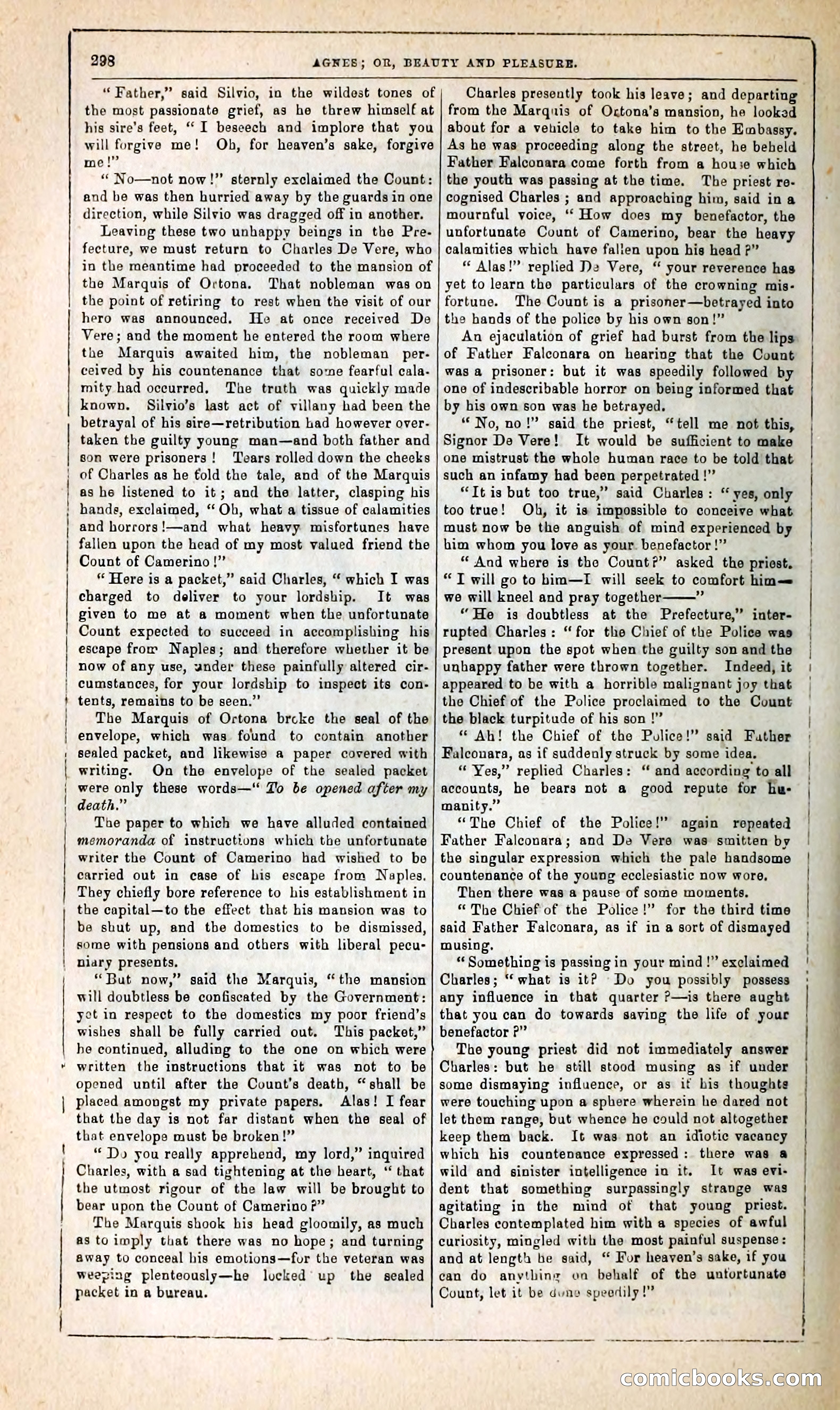
A restored page from Penny Dreadfuls, 1857. Page through the whole issue in the reader above.
📄 Transcribed text from this page (OCR, searchable)
Machine-transcribed from the original scan — historical spelling and the odd misread are preserved.
Se ert eee a Sl a nr bopper spue en — er re , —- — tt ——— ne 298 AGRES; OR, BEAUTY AND PLEASURE. ‘‘ Father,” said Silvio, in the wildest tones of the most passionate grief, as he threw himself at his sire’s feet, ‘‘ I beseech and implore that you will forgive me! Oh, for heaven’s sake, forgive me!” “* No—not now!”’ sternly exclaimed the Count: and be was then hurried away by the guards in one direction, while Silvio was dragged off in another. Leaving these two unhappy beings in the Pre- fecture, we must return to Charles De Vere, who in the meantime had proceeded to the mansion of the Marquis of Ortona. That nobleman was on the point of retiring to rest when the visit of our hero was announced. He at once received De Vere; and the moment he entered the room where the Marquis awaited him, the nobleman per- ceived by his countenance that some fearful cala- mity had oceurred. The truth was quickly made known. Silvio’s last act of villany had been the betrayal of his sire—retribution had however over- taken the guilty young man—and both father and son were prisoners! Tears rolled down the cheeks of Charles as he fold the tale, and of the Marquis as he listened to it; and the latter, clasping his hands, exclaimed, “Oh, what a tissue of calamities and horrors!—and what heavy misfortunes have fallen upon the head of my most valued friend the Count of Camerino!”’ Here is a packet,” said Charles, “ which I was charged to deliver to your lordship. It was given to me at a moment when the unfortunate Count expected to succeed in accomplishing his escape from Naples; and therefore whether it be now of any use, ander these painfully altered cir- cumstances, for your lordship to inspect its con- tents, remains to be seen.” The Marquis of Ortona brcke the seal of the envelope, which was found to contain another sealed packet, and likewise a paper covered with writing. On the envelope of the sealed packet were only these words—‘ Zo be opened after my death,” The paper to which we have alluded contained memoranda of instructions which the unfortunate writer the Count of Camerino had wished to be carried out in case of his escape from Naples. They chiefly bore reference to his establishment in the capital—to the effect that his mansion was to be shut up, and tbe domestics to be dismissed, some with pensions and others with liberal pecu- Diary presents. “But now,” said the Marquis, “the mansion will doubtless be confiscated by the Government: yet in respect to the domestics my poor friend’s wishes shall be fully carried out. This packet,” he continued, alluding to the one on which were written the instructions that it was not to be opened until after the Count’s death, “shall be placed amongst my private papers. Alas! I fear that the day is not far distant when the seal of that envelope must be broken!” “Do you really apprebend, my lord,” inquired Charles, with a sad tightening at the heart, “ that the utmost rigour of the law will be brought to bear upon the Count of Camerino ?” The Marquis shook his head gloomily, as much as to imply that there was no hope; and turning away to conceal his emotions—for the veteran was Weeping plenteously—he lucked up the sealed packet in a bureau. Charles presently took his leave; and departing from the Marquis of Oxtona’s mansion, he lookad about for a vehicle to take him to the Embassy, As he was proceeding along the street, he beheld Father Falconara come forth from a hou;e which the youth was passing at the time. The priest re- cognised Charles ; and approaching him, said in a mournful voice, ‘‘ How does my benefactor, the unfortunate Count of Camerino, bear the heavy calamities which have falien upon his head ?” * Alas!” replied De Vere, “ your reverence has yet to learn the particulars of the crowning mis- fortune. The Count is a prisoner—betrayed into the hands of the police by his own son!” An ejaculation of grief had burst from the lips of Father Falconara on hearing that the Count was a prisoner: but it was speedily followed by one of indescribable horror on being informed that by his own son was he betrayed, ** No, no!” said the priest, “tell me not this, Signor De Vere! It would be sufficient to make one mistrust the whole human race to be told that such an infamy had been perpetrated !” “It is but too true,” said Charles: “ yes, only too true! Ob, it is impossible to conceive what must now be the anguish of mind experienced by him whom you love as your. benefactor!” “And where is the Count?” asked the priest. *T will go to bim—I will seek to comfort himn— we will kneel and pray together _ “He is doubtless at the Prefecture,” inter- rupted Charles: “for the Chief of the Police was present upon the spot when the guilty son and the unhappy father were thrown together. Indeed, it appeared to be with a horrible malignant joy that the Chief of the Police proclaimed to the Count the black turpitude of his son !” * Ah! the Chief of the Police!” said Futher Palcouara, as if suddenly struck by some idea. “ Yes,” replied Charles: “ and according to all accounts, he bears not a good repute for hu- manity.” “The Chief of the Police!” again repeated Father Falconara; and De Vere was smitten by the singular expression which the pale handsome countenance of the young ecclesiastic now wore, Then there was a pause of some moments. * The Chief of the Police!” for the third time said Father Falconara, as if in a sort of dismayed musing. ‘Something is passing in your mind !” exclaimed Charles; “what is it? Do you possibly possess any influence in that quarter P—is there aught that you can do towards saving the life of your benefactor P” | The young priest did not immediately answer Charles: but he still stood musing as if under some dismaying influence, or as if his thoughts were touching upon a sphere wherein he dared not let them range, but whence he could not altogether keep them back. It was not an idiotic vacancy which his countenance expressed: there was & wild and sinister intelligence in it, It was evi- dent that something surpassingly strange was agitating in the mind of that young priest. Charles contemplated him with a species of awful curiosity, mingled with the most painful suspense : and at length be said, “ For heaven’s sake, if you can do anything on behalf of the untortunate Count, let it be dune speedily!” Comicbooks