
Penny Dreadfuls, 1857 · page 312 of 394
Agnes, or, Beauty and Pleasure — page 312: what you’re looking at
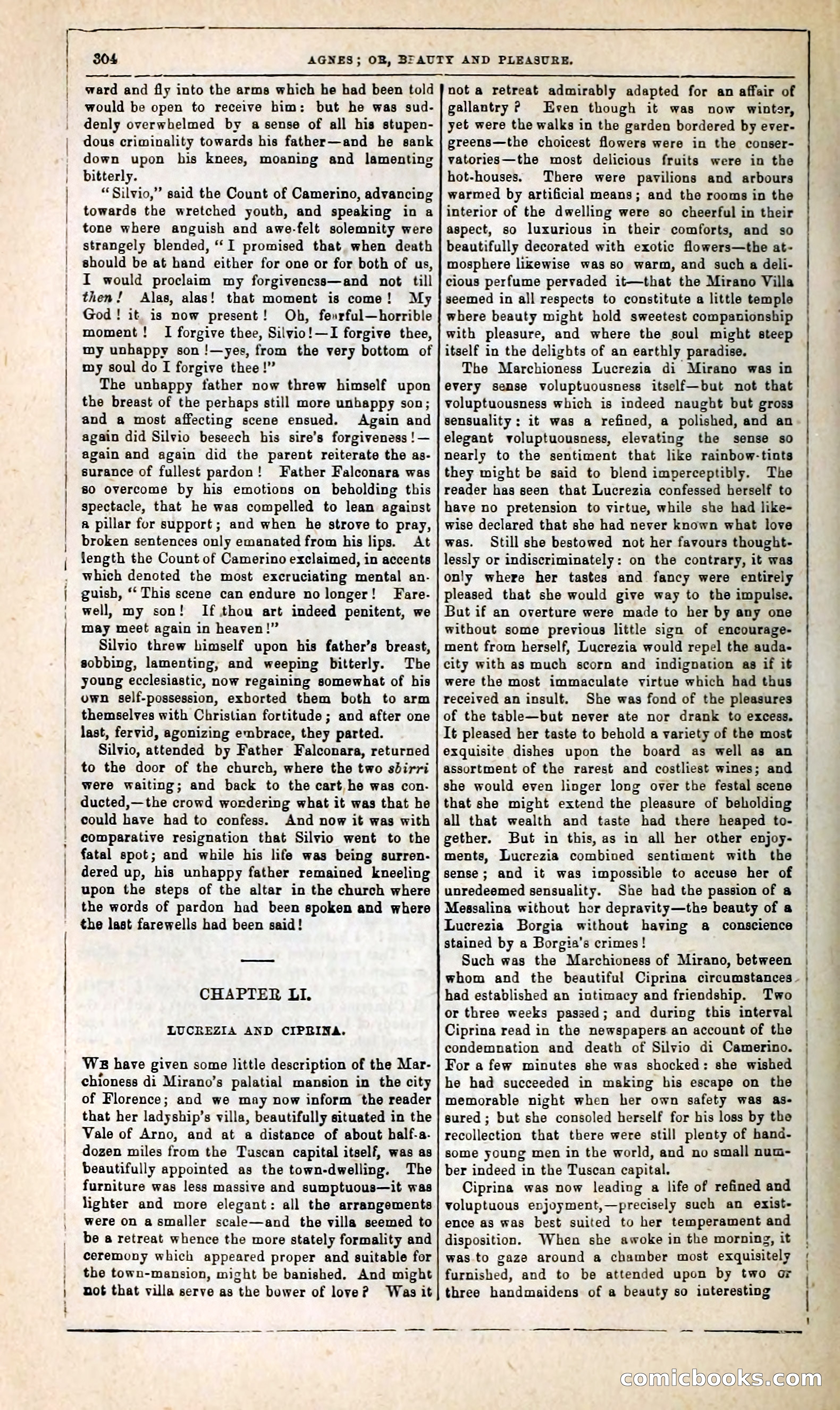
A restored page from Penny Dreadfuls, 1857. Page through the whole issue in the reader above.
📄 Transcribed text from this page (OCR, searchable)
Machine-transcribed from the original scan — historical spelling and the odd misread are preserved.
— el 304 —— = ee would be open to receive him: but he was sud- denly overwhelmed by a sense of all his stupen- dous criminality towards his father—and he sank down upon his knees, moaning and lamenting bitterly. “Silvio,” said the Count of Camerino, advancing towards the wretched youth, and speaking in a tone where anguish and awe-felt solemnity were strangely blended, “‘I promised that when death | should be at hand either for one or for both of us, I would proclaim my forgivencss—and not till then! Alas, alas! that moment is come! My | God! it is now present! Ob, fe»rful—horrible | moment! I forgive thee, Silvio!—I forgive thee, my unhappy son !—yes, from the very bottom of my soul do I forgive thee!” The unhappy father now threw himself upon the breast of the perhaps still more unbappy son; and a most affecting scene ensued. Again and | again did Silvio beseech his sire’s forgiveness ! — | again and again did the parent reiterate the as- | surance of fullest pardon! Father Falconara was | | 80 overcome by his emotions on beholding this spectacle, that he was compelled to lean against a pillar for support; and when he strove to pray, broken sentences only emanated from his lips. At length the Count of Camerino exclaimed, in accents which denoted the most excruciating mental an- | guish, ‘‘ This scene can endure no longer! Fare- | well, my son! If thou art indeed penitent, we may meet again in heaven!” | Silvio threw himself upon his father’s breast, | sobbing, lamenting, and weeping bitterly. The | young ecclesiastic, now regaining somewhat of his _ own self-possession, exhorted them both to arm | themselves with Christian fortitude; and after one last, fervid, agonizing embrace, they parted. | Silvio, attended by Father Falconara, returned | to the door of the church, where the two sbirri | were waiting; and back to the cart he was con- | ducted,—the crowd wordering what it was that he | Could have had to confess. And now it was with | comparative resignation that Silvio went to the | fatal spot; and while his life was being surren- | dered up, his unhappy father remained kneeling | upon the steps of the altar in the church where | the words of pardon had been spoken and where the last farewells had been said! CHAPTER LI. LUCREZIA AND CIPRINA. WB have given some little description of the Mar- chioness di Mirano’s palatial mansion in the city of Florence; and we may now inform the reader that her ladyship’s villa, beautifully situated in the Vale of Arno, and at a distance of about half-a- dozen miles from the Tuscan capital itself, was as beautifully appointed as the town-dwelling. The furniture was less massive and sumptuous—it was lighter and more elegant: all the arrangements , Were on asmaller scale—and the villa seemed to _ bea retreat whence the more stately formality and | ¢ceremony which appeared proper and suitable for the town-mansion, might be banished. And might not that villa serve as the bower of love? Was it pe ee ward and fly into the arms which he had been told AGNES; OB, BFAUTY AND PLEASURE. not a retreat admirably adapted for an affair of gallantry ? Even though it was now winter, yet were the walks in the garden bordered by ever- greens—the choicest flowers were in the conser- vatories—the most delicious fruits were in the hot-houses. There were pavilions and arbours warmed by artificial means; and the rooms in the interior of the dwelling were so cheerful in their aspect, so luxurious in their comforts, and so beautifully decorated with exotic flowers—the at- mosphere likewise was so warm, and such a deli- cious perfume pervaded it—that the Mirano Villa seemed in all respects to constitute a little temple where beauty might hold sweetest companionship with pleasure, and where the soul might steep itself in the delights of an earthly paradise. The Marchioness Lucrezia di Mirano was in every sense voluptuousness itself—but not that voluptuousness which is indeed naught but gross sensuality: it was a refined, a polished, and an elegant voluptuousness, elevating the sense so nearly to the sentiment that like rainbow-tints they might be said to blend imperceptibly. The reader has seen that Lucrezia confessed herself to have no pretension to virtue, while she had like- wise declared that she had never known what love was. Still she bestowed not her favours thought- lessly or indiscriminately: on the contrary, it was only where her tastes and fancy were entirely pleased that she would give way to the impulse. But if an overture were made to her by any one without some previous little sign of encourage- ment from herself, Lucrezia would repel the auda- city with as much scorn and indignation as if it were the most immaculate virtue which had thus received an insult. She was fond of the pleasures of the table—but never ate nor drank to excess. It pleased her taste to behold a variety of the most exquisite dishes upon the board as well as an assortment of the rarest and costliest wines; and she would even linger long over the festal scene that she might extend the pleasure of beholding all that wealth and taste had there heaped to- gether. But in this, as in all her other enjoy- ments, Lucrezia combined sentiment with the sense; and it was impossible to aceuse her of unredeemed sensuality. She had the passion of a Messalina without hor depravity—the beauty of a Lucrezia Borgia without having a conscience stained by a Borgia’s crimes! Such was the Marchioness of Mirano, between whom and the beautiful Ciprina circumstances - had established an intimacy and friendship. Two or three weeks passed; and during this interval Ciprina read in the newspapers an account of the condemnation and death of Silvio di Camerino. For a few minutes she was shocked: she wished he had succeeded in making his escape on the memorable night when her own safety was as- sured ; but she consoled herself for his loss by the recollection that there were still plenty of hand- some young men in the world, and no small num- ber indeed in the Tuscan capital. Ciprina was now leading a life of refined and voluptuous epjoyment,—precisely such an exist- ence as was best suited to her temperament and disposition. When she awoke in the morning, it was to gaze around a chamber most exquisitely furnished, and to be attended upon by two or three handmaidens of a beauty so interesting see ee ee ee ee oe. ee oe - e memes nn i ee ee se Comicbooks a (©) =}