
Penny Dreadfuls, 1857 · page 32 of 394
Agnes, or, Beauty and Pleasure — page 32: what you’re looking at
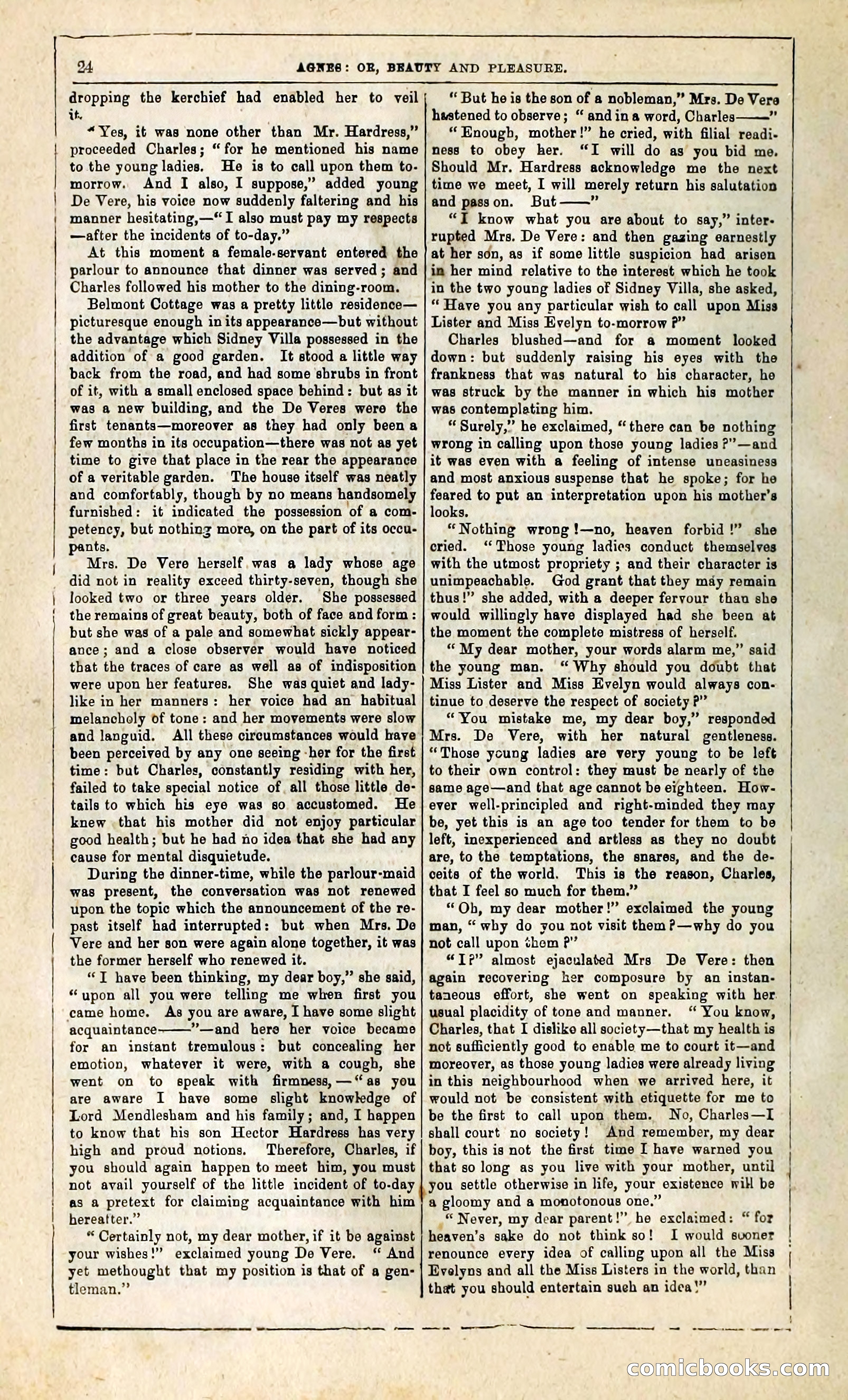
A restored page from Penny Dreadfuls, 1857. Page through the whole issue in the reader above.
📄 Transcribed text from this page (OCR, searchable)
Machine-transcribed from the original scan — historical spelling and the odd misread are preserved.
eo err —a se 24 AGNES: OR, BEAUTY AND PLEASURE. dropping the kerchief had enabled her to veil it, “Yes, tt was none other than Mr. Hardress,” proceeded Charles; “for he mentioned his name to the young ladies. He is to call upon them to- morrow. And I also, I suppose,” added young De Vere, his voice now suddenly faltering and his manner hesitating,—“ I also must pay my respects —after the incidents of to-day.” At this moment a female-servant entered the parlour to announce that dinner was served; and Charles followed his mother to the dining-room. Belmont Cottage was a pretty little residence— picturesque enough in its appearance—but without the advantage which Sidney Villa possessed in the addition of a good garden. It stood a little way back from the road, and had some shrubs in front of it, with a small enclosed space behind: but as it was a new building, and the De Veres were the first tenants—moreover as they had only beena few months in its occupation—there was not as yet time to give that place in the rear the appearance of a veritable garden. The house itself was neatly and comfortably, though by no means handsomely furnished: it indicated the possession of a com- petency, but nothing more, on the part of its occu- pants. Mrs. De Vere herself. was a lady whose age did not in reality exceed thirty-seven, though she looked two or three years older. She possessed the remains of great beauty, both of face and form: but she was of a pale and somewhat sickly appear- ance; and a close observer would have noticed that the traces of care as well as of indisposition were upon her features. She was quiet and lady- like in her manners: her voice had an habitual melancholy of tone: and her movements were slow and languid. All these circumstances would have been perceived by any one seeing -her for the first time: but Charles, constantly residing with her, failed to take special notice of all those little de- tails to which his eye was so accustomed. He knew that his mother did not enjoy particular good health; but he had no idea that she had any cause for mental disquietude. During the dinner-time, while the parlour-maid was present, the conversation was not renewed upon the topic which the announcement of the re- past itself had interrupted: but when Mrs. De Vere and her son were again alone together, it was the former herself who renewed it. “T have been thinking, my dear boy,” she said, “upon all you were telling me when first you came home. As you are aware, I have some slight acquaintance ”*—and here her voice became for an instant tremulous: but concealing her emotion, whatever it were, with a cough, she went on to speak with firmness, —‘“‘as you are aware I have some slight knowkdge of Lord Mendlesham and his family; and, I happen to know that his son Hector Hardress has very high and proud notions. Therefore, Charles, if you should again happen to meet him, you must not avail yourself of the little incident of to-day as a pretext for claiming acquaintance with him hereafter.” “ Certainly not, my dear mother, if it be against your wishes!’ exclaimed young De Vere. ‘“ And yet methought that my position is that of a gen- tleman.”’ (Weert we eee eee ** But he is the son of a nobleman,” Mrs. De Vera hastened to observe; “ andina word, Charles ng “Knougb, mother!” he cried, with filial readi- ness to obey her. “I will do as you bid me. Should Mr. Hardress acknowledge me the next time we meet, I will merely return his salutation and passon. But dd “JT know what you are about to say,” inter- rupted Mrs. De Vere: and then gazing earnestly at her son, as if some little suspicion had arisen in her mind relative to the interest which he took in the two young ladies of Sidney Villa, she asked, ‘Have you any particular wish to call upon Miss Lister and Miss Evelyn to-morrow P” Charles blushed—and for a moment looked down: but suddenly raising his eyes with the frankness that was natural to his character, he was struck by the manner in which his mother was contemplating him. “ Surely,” he exclaimed, “there can be nothing wrong in calling upon those young ladies ?’—and it was even with a feeling of intense uneasiness and most anxious suspense that he spoke; for he feared to put an interpretation upon his mother’s looks. “Nothing wrong!—no, heaven forbid !” she cried. ‘Those young ladies conduct themselves with the utmost propriety ; and their character is unimpeachable. God grant that they mdy remain thus!” she added, with a deeper fervour thau she would willingly have displayed had she been at the moment the complete mistress of herself. “My dear mother, your words alarm me,” said the young man. “ Why should you doubt that Miss Lister and Miss Evelyn would always con- tinue to deserve the respect of society P” “You mistake me, my dear boy,” responded Mrs. De Vere, with her natural gentleness. “‘Those young ladies are very young to be left to their own control: they must be nearly of the same age—and that age cannot be eighteen. How- ever well-principled and right-minded they may be, yet this is an age too tender for them to be left, inexperienced and artless as they no doubt are, to the temptations, the snares, and the de- ceits of the world. This is the reason, Charles, that I feel so much for them.” “Oh, my dear mother!” exclaimed the young man, “why do you not visit them ?—why do you not call upon them ?” “TP” almost ejaculated Mrs De Vere: then again recovering her composure by an instan- taneous effort, she went on speaking with her. usual placidity of tone and manner. “ You know, Charles, that I dislike all society—that my health is not sufficiently good to enable me to court it—and moreover, as those young ladies were already living in this neighbourhood when we arrived here, it would not be consistent with etiquette for me to be the first to call upon them. No, Charles—I shall court no society! And remember, my dear boy, this is not the first time I have warned you that so long as you live with your mother, until you settle otherwise in life, your existence will be a gloomy and a monotonous one.” _© Never, my dear parent!” he exclaimed: “ for heaven’s sake do not think so! I would svoner renounce every idea of calling upon all the Miss Evelyns and all the Miss Listers in the world, than that you should entertain sueh an idea!” seg gana aamsecneenapstunnasennng COMmiclooolkx<s } | : | | | i ee eer ie (EC)