
Penny Dreadfuls, 1857 · page 351 of 394
Agnes, or, Beauty and Pleasure — page 351: what you’re looking at
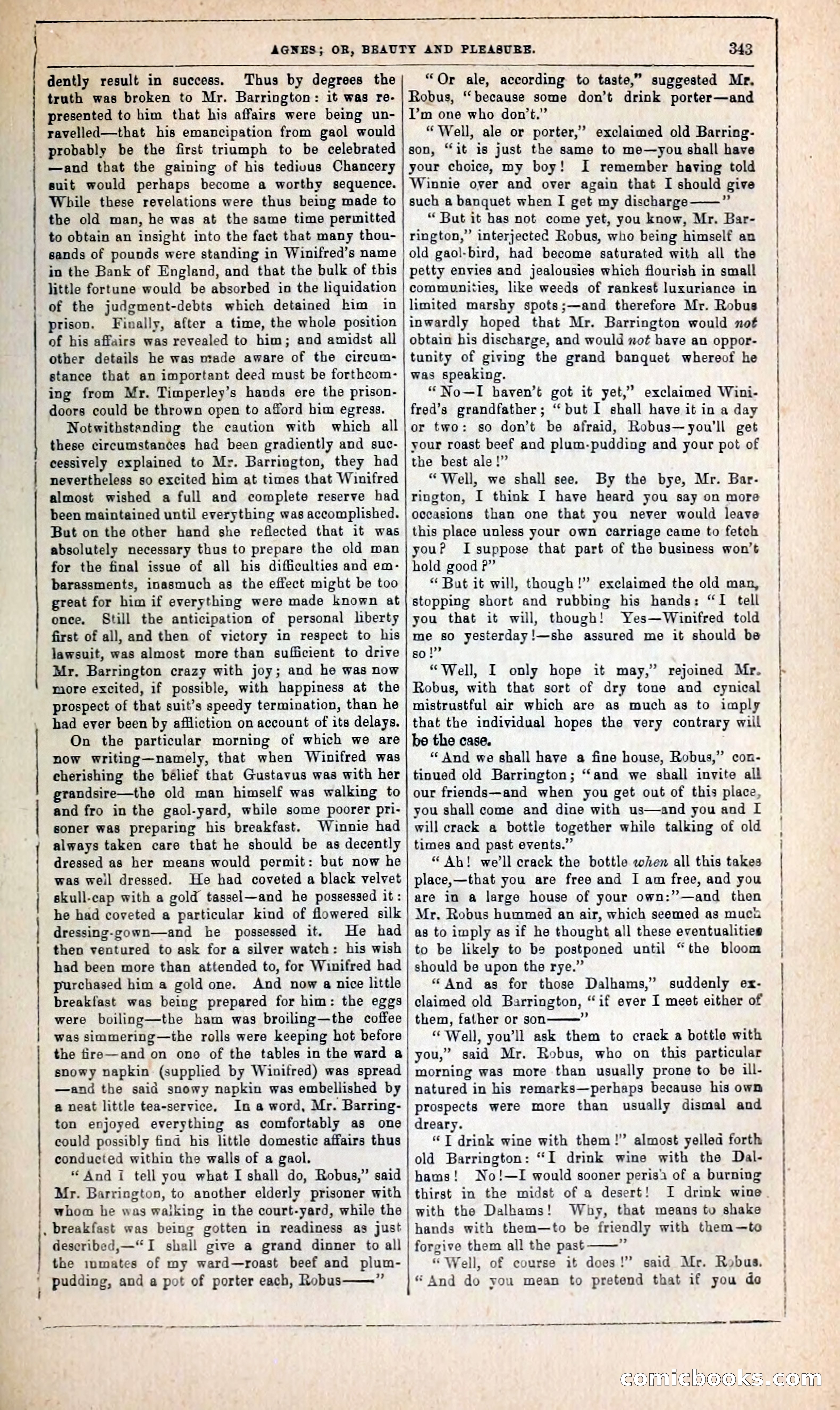
A restored page from Penny Dreadfuls, 1857. Page through the whole issue in the reader above.
📄 Transcribed text from this page (OCR, searchable)
Machine-transcribed from the original scan — historical spelling and the odd misread are preserved.
ST St i dently result in success. Thus by degrees the truth was broken to Mr. Barrington: it was re- presented to him that his affairs were being un- ravelled—that his emancipation from gaol would probably be the first triumph to be celebrated —and that the gaining of his tedious Chancery suit would perhaps become a worthy sequence. While these revelations were thus being made to the old man, he was at the same time permitted to obtain an insight into the fact that many thou- sands of pounds were standing in Winifred’s name in the Bank of Englend, and that the bulk of tbis little fortune would be absorbed in the liquidation of the judgment-debts which detained him in prison. Finally, after a time, the whole position of his affairs was revealed to him; and amidst all other details he was utade aware of the circum- stance that an important deed must be forthcom- ing from Mr. Timperley’s hands ere the prison- doors could be thrown open to afford him egress. Notwithstanding the caution with which all these circumstances had been gradiently and suc- cessively explained to Mr. Barrington, they had nevertheless so excited him at times that Winifred almost wished a full and complete reserve had been maintained until everything was accomplished. But on the other hand she reflected that it was absolutely necessary thus to prepare the old man for the final issue of all his difficulties and em- barassments, inasmuch as the effect might be too great for him if everything were made known at once. Still the anticipation of personal liberty first of all, and then of victory in respect to his lawsuit, was almost more than sufficient to drive Mr. Barrington crazy with joy; and he was now more excited, if possible, with happiness at the prospect of that suit’s speedy termination, than he had ever been by affliction on account of its delays. On the particular morning of which we are now writing—namely, that when Winifred was eherishing the bélief that Gustavus was with her grandsire—the old man himself was walking to and fro in the gaol-yard, while some poorer pri- soner was preparing his breakfast. Winnie had | always taken care that he should be as decently dressed as her means would permit: but now he was weil dressed. He had coveted a black velvet skull-cap with a gold tassel—and he possessed it: he had coveted a particular kind of flowered silk dressing-sown—and he possessed it. He had then ventured to ask for a silver watch: his wish had been more than attended to, for Winifred had purchased him a gold one. And now a nice little breakfast was being prepared for him: the eggs were boiling—the ham was broiling—the coffee was simmering—the rolls were keeping hot before the fire—and on ono of the tables in the ward a snowy napkin (supplied by Winifred) was spread —and the said snowy napkin was embellished by a neat little tea-service. In a word, Mr. Barring- ton enjoyed everything as comfortably as one could possibly find his little domestic affairs thus conducted within the walls of a gaol. “Andi tell you what I shall do, Robus,” said Mr. Barrington, to another elderly prisoner with whom he was walking in the court-yard, while the . breakfast was being gotten in readiness as just deseribed,—“‘I shall give a grand dinner to all } the inmates of my ward—roast beef and plum- pudding, and a pot of porter each, Robus a ’ —_—_—_—_——n ee eee ne ee me ee AGNES; OR, BEAUTY AND PLEASURE. —- = 343 “Or ale, according to taste,” suggested Mr, Robus, “because some don’t drink porter—and I’m one who don’t.” “Well, ale or porter,” exclaimed old Barring- son, “it is just the same to me—you shall have your choice, my boy! I remember having told Winnie over and over again that I should give such a banquet when I get my discharge-——” * But it has not come yet, you know, Mr. Bar- rington,” interjected Robus, who being himself an old gaol-bird, had become saturated with all the petty envies and jealousies which flourish in small communities, like weeds of rankest luxuriance in limited marshy spots;—and therefore Mr. Robus inwardly hoped that Mr. Barrington would not obtain his discharge, and would not have an oppor- tunity of giving the grand banquet whereof he was speaking. “No—I haven’t got it yet,” exclaimed Wini- fred’s grandfather; “but I shall have it in a day or two: so don’t be afraid, Robus—you'll get your roast beef and plum-puddiog and your pot of the best ale!” “ Well, we shall see. By the bye, Mr. Bar- rington, I think I have heard you say on more occasions than one that you never would leave this place unless your own carriage came to fetch you? I suppose that part of the business won’t hold good P” * But it will, though!” exclaimed the old man, stopping short and rubbing his hands: “I tell you that it will, though! Yes—Winifred told me so yesterday!—she assured me it should be so!” “Well, I only hope it may,” rejoined Mr. Robus, with that sort of dry tone and cynical mistrustful air which are as much as to imply that the individual hopes the very contrary wiil be the case. “ And we shall have a fine house, Robus,” con- tinued old Barrington; “and we shall invite all our friends—and when you get out of this place, you shall come and dine with us—and you and I will crack a bottle together while talking of old times and past events.” * Ah! we'll crack the bottle een all this takes place,—that you are free and I am free, and you are in a large house of your own:”—and then Mr. Robus hummed an air, which seemed as mucu as to imply as if he thought all these eventualities to be likely to be postponed until “the bloom should be upon the rye.” “And as for those Dalhams,” suddenly ex- claimed old Barrington, “if ever I meet either of them, father or son #3 “Well, you'll ask them to crack a bottle with you,” said Mr. Robus, who on this particular morning was more than usually prone to be ill- natured in his remarks—perhaps because his owm prospects were more than usually dismal and dreary. “J drink wine with them!” almost yelled forth old Barrington: “I drink wine with the Dal- hams! No!—I would sooner peris of a burning thirst in the midst of a desert! I drink wine with the Dalhams! Why, that means to shake hands with them—to be friendly with them—to forgive them all the past € “ Well, of course it does!” said Mr. Robus. “And do you mean to pretend that if you do et am aaa tt eC EL: LL LLL LD LO eee tL EL CC CT I ne, re ee em ee ll CC A — - - i ee a LC EEE COT AR COMmcooolks Om