
Penny Dreadfuls, 1857 · page 359 of 394
Agnes, or, Beauty and Pleasure — page 359: what you’re looking at
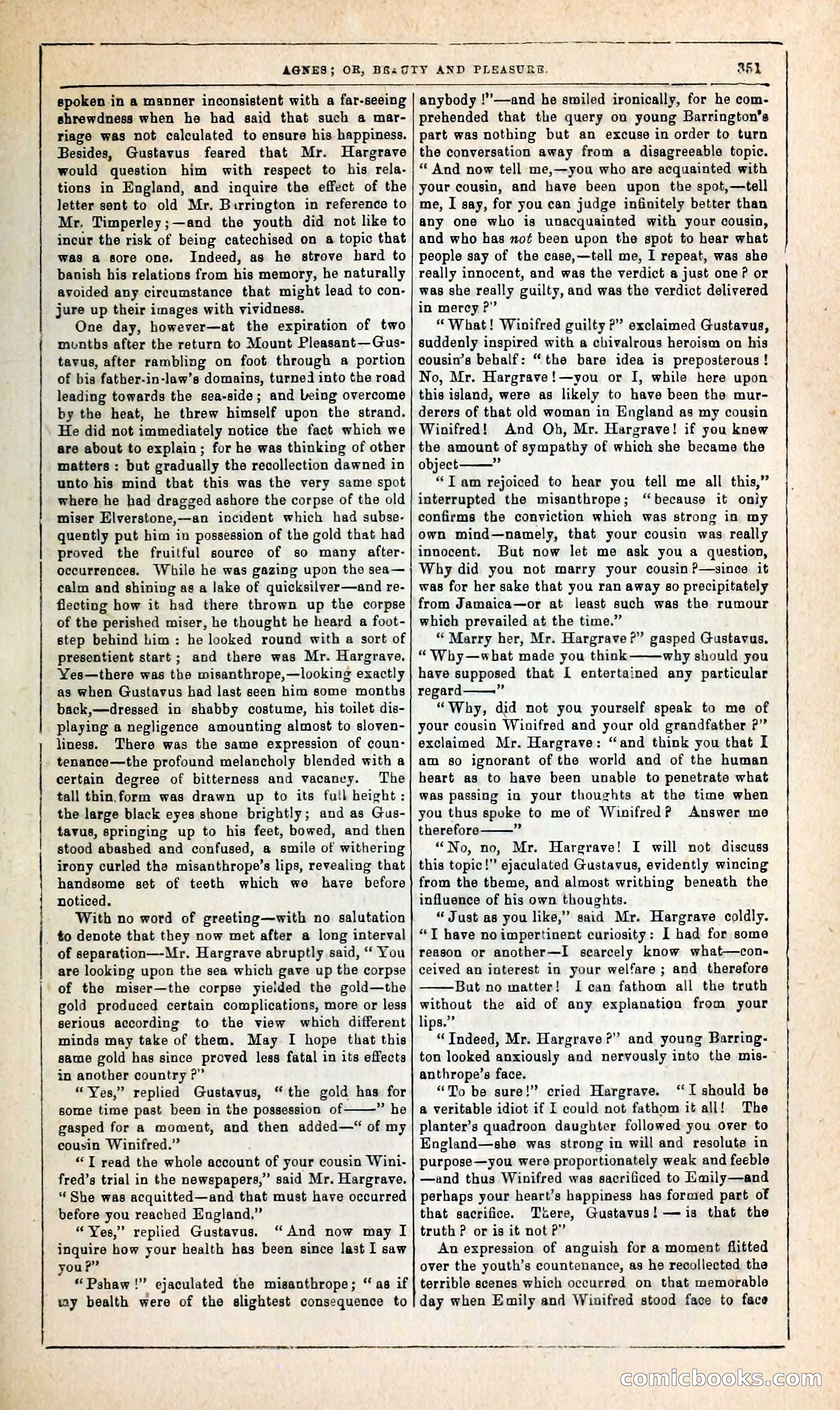
A restored page from Penny Dreadfuls, 1857. Page through the whole issue in the reader above.
📄 Transcribed text from this page (OCR, searchable)
Machine-transcribed from the original scan — historical spelling and the odd misread are preserved.
AGNES; OR, BRiUTY AND PLEASURE. epoken in a manner inconsistent with a far-seeing shrewdness when he had said that such a mar- riage was not calculated to ensure his happiness. Besides, Gustavus feared that Mr. Hargrave would question him with respect to his rela- tions in England, and inquire the effect of the letter sent to old Mr. Buirrington in reference to Mr, Timperley;—and the youth did not like to incur the risk of being catechised on a topic that was a sore one. Indeed, as he strove bard to banish his relations from his memory, he naturally avoided any circumstance that might lead to con- jure up their images with vividness. One day, however—at the expiration of two mvntbs after the return to Mount Pleasant—Gus- tavus, after rambling on foot through a portion of bis father-in-law’s domains, turned into the road leading towards the sea-side; and being overcome by the heat, he threw himself upon the strand. He did not immediately notice the fact which we are about to explain; for he was thinking of other matters : but gradually the recollection dawned in unto his mind that this was the very same spot where he had dragged ashore the corpse of the old miser Elverstone,—an incident which had subse- quently put him in possession of the gold that had proved the fruitful source of so many after- occurrences. While he was gazing upon the sea— calm and shining as a lake of quicksilyer—and re- flecting how it had there thrown up the corpse of the perished miser, he thought he heard a foot- step behind him: he looked round with a sort of presontient start; and there was Mr. Hargrave. Yes—there was the misanthrope,—looking exactly as when Gustavus had last seen him some months back,—dressed in shabby costume, his toilet dis- playing a negligence amounting almost to sloven- liness. There was the same expression of coun- tenance—the profound melancholy blended with a certain degree of bitterness and vacaney. The tall thin.form was drawn up to its full height: the large black eyes shone brightly; and as Gus- tavus, springing up to his feet, bowed, and then stood abashed and confused, a smile of withering irony curled the misanthrope’s lips, revealing that handsome set of teeth which we have before noticed. With no word of greeting—with no salutation to denote that they now met after a long interval of separation—-Mr. Hargrave abruptly said, “ You are looking upon the sea which gave up the corpse of the miser—the corpse yielded the gold—the gold produced certain complications, more or less serious according to the view which different minds may take of them. May I hope that this same gold has since proved less fatal in its effects in another country P” “Yes,” replied Gustavus, “the gold has for some time past been in the possession of ” he gasped for a moment, and then added—* of my cousin Winifred.” “T read the whole account of your cousin Wini- fred’s trial in the newspapers,” said Mr. Hargrave. “ She was acquitted—and that must have occurred before you reached England,” “Yos,” replied Gustavus. “And now may I inquire how your health has been since last I saw you?” “ Pshaw !” ejaculated the misanthrope; “as if wy bealth were of the slightest consequence to ee ee ees 5} anybody !”’—and he smiled ironically, for he com- prehended that the query on young Barrington’s part was nothing but an excuse in order to turn the conversation away from a disagreeable topic. ** And now tell me,—you who are acquainted with your cousin, and have been upon the spot,—tell me, I say, for you can judge infinitely better than any one who is unacquainted with your cousin, and who has no¢ been upon the spot to hear what people say of the case,—tell me, I repeat, was she really innocent, and was the verdict a just one? or was she really guilty, and was the verdict delivered in mercy P” “What! Winifred guilty ?” exclaimed Gustavus, suddenly inspired with a chivalrous heroism on his cousin’s behalf: “the bare idea is preposterous ! No, Mr. Hargrave!—you or I, while here upon this island, were as likely to have been the mur- derers of that old woman in England as my cousin Winifred! And Oh, Mr. Hargrave! if you knew the amount of sympathy of which she became the object “‘T am rejoiced to hear you tell me all this,” interrupted the misanthrope; “because it oniy confirms the conviction which was strong in my own mind—namely, that your cousin was really invocent. But now let me ask you a question, Why did you not marry your cousin P—since it was for her sake that you ran away so precipitately from Jamaica—or at least such was the rumour which prevailed at the time.” ** Marry her, Mr. Hargrave?” gasped Gustavus. “ Why—what made you think why should you have supposed that I entertained any particular regard as “Why, did not you yourself speak to me of your cousin Winifred and your old grandfather P” exclaimed Mr. Hargrave: ‘and think you that I am so ignorant of the world and of the human heart as to have been unable to penetrate what was passing in your thoughts at the time when you thus spoke to me of Winifred? Answer me therefore a “No, no, Mr. Hargrave! I will not discuss this topic!" ejaculated Gustavus, evidently wincing from the theme, and almost writhing beneath the influence of his own thoughts. “ Just as you like,” said Mr. Hargrave coldly. “T have noimpertinert curiosity: I had for some reason or another—I searcely know what—con- ceived an interest in your welfare ; and therefore But no matter! I can fathom all the truth without the aid of any explanation from your lips.” “Indeed, Mr. Hargrave?” and young Barring- ton looked anxiously and nervously into the mis- anthrope’s face. “To be sure!” cried Hargrave. ‘I should be a veritable idiot if I could not fathom it all! The planter’s quadroon daughter followed you over to England—she was strong in will and resolute in purpose—you were proportionately weak and feeble —and thus Winifred was sacrificed to Emily—and perhaps your heart’s happiness has formed part of that sacrifice. There, Gustavus! —is that the truth ? or is it not P” An expression of anguish for a moment flitted over the youth’s countenance, as he recollected the terrible scenes which occurred on that memorable day when Emily and Winifred stood face to face Comcooolkks Om