
Penny Dreadfuls, 1857 · page 36 of 394
Agnes, or, Beauty and Pleasure — page 36: what you’re looking at
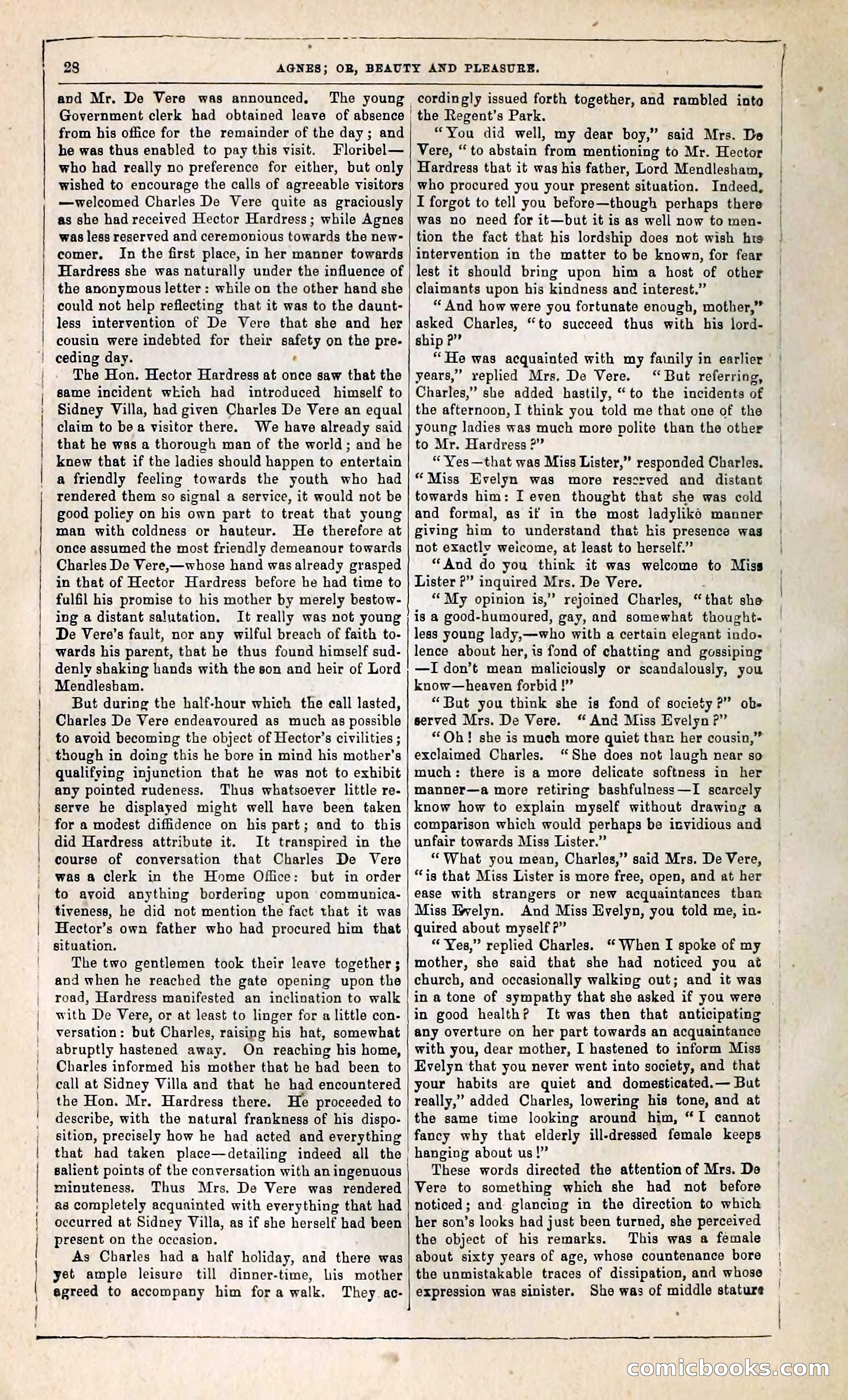
A restored page from Penny Dreadfuls, 1857. Page through the whole issue in the reader above.
📄 Transcribed text from this page (OCR, searchable)
Machine-transcribed from the original scan — historical spelling and the odd misread are preserved.
Se rr a * == —_ ° ¢ 28 AGNES; OR, BEAUTY AND PLEASURE. and Mr. De Vere was announced. The young Government clerk had obtained leave of absence from his office for the remainder of the day; and he was thus enabled to pay this visit. Floribel— who had really no preference for either, but only wished to encourage the calls of agreeable visitors —welcomed Charles De Vere quite as graciously as she had received Hector Hardress ; while Agnes was less reserved and ceremonious towards the new- comer, In the first place, in her manner towards Hardress she was naturally under the influence of the anonymous letter: while on the other hand she could not help reflecting that it was to the daunt- less intervention of De Vere that she and her cousin were indebted for their safety on the pre- ceding day. ' The Hon. Hector Hardress at once saw that the same incident wkich had introduced himself to Sidney Villa, had given Charles De Vere an equal claim to bea visitor there. We have already said that he was a thorough man of the world; and he knew that if the ladies should happen to entertain a friendly feeling towards the youth who had rendered them so signal a service, it would not be good poliey on his own part to treat that young man with coldness or hauteur. He therefore at once assumed the most friendly demeanour towards Charles De Vere,—whose hand was already grasped in that of Hector Hardress before he had time to fulfil his promise to his mother by merely bestow- ing a distant salutation, It really was not young De Vere’s fault, nor any wilful breach of faith to- wards his parent, that he thus found himself sud- denly shaking hands with the son and heir of Lord Mendlesham. But during the half-hour which the call lasted, Charles De Vere endeavoured as much as possible to avoid becoming the object of Hector’s civilities ; though in doing this he bore in mind his mother’s qualifying injunction that he was not to exhibit any pointed rudeness. Thus whatsoever little re- serve he displayed might well have been taken for a modest diffidence on his part; and to this did Hardress attribute it. It transpired in the course of conversation that Charles De Vere was a clerk in the Home Office: but in order to avoid anything bordering upon communica- tiveness, he did not mention the fact that it was Hector’s own father who had procured him that situation. The two gentlemen took their leave together ; and when he reached the gate opening upon the road, Hardress manifested an inclination to walk with De Vere, or at least to linger for a little con- versation: but Charles, raising his hat, somewhat abruptly hastened away. On reaching his home, Charles informed his mother that he had been to call at Sidney Villa and that he had encountered the Hon. Mr. Hardress there. He proceeded to describe, with the natural frankness of his dispo- sition, precisely how he had acted and everything that had taken place—detailing indeed all the Balient points of the conversation with an ingenuous minuteness. Thus Mrs. De Vere was rendered as completely acquainted with everything that had | occurred at Sidney Villa, as if she herself had been present on the occasion. As Charles had a half holiday, and there was yet ample leisure till dinner-time, lis mother agreed to accompany him fora walk. They ac- cordingly issued forth together, and rambled into | the Regent’s Park. “You did well, my dear boy,” said Mrs. De Vere, “to abstain from mentioning to Mr. Hector Hardress that it was his father, Lord Mendlesham, who procured you your present situation. Indeed, I forgot to tell you before—though perhaps there was no need for it—but it is as well now to men- tion the fact that his lordship does not wish hre intervention in the matter to be known, for fear lest it should bring upon him a host of other claimants upon his kindness and interest.” “ And how were you fortunate enough, mother,” asked Charles, “to succeed thus with his lord- ship ?” “He was acquainted with my fainily in earlier” years,” replied Mrs. De Vere. “But referring, Charles,” she added hastily, “to the incidents of the afternoon, I think you told me that one of the young ladies was much more polite than the other to Mr. Hardress ?” “Yes—that was Miss Lister,” responded Charles. “Miss Evelyn was more reserved and distant towards him: I even thought that she was cold and formal, as if in the most ladyliké manner giving him to understand that his presence was not exactly weicome, at least to herself.” “And do you think it was welcome to Miss Lister ?” inquired Mrs. De Vere. , “‘ My opinion is,” rejoined Charles, “that she is a good-humoured, gay, and somewhat thought- less young lady,—who with a certain elegant indo- lence about her, is fond of chatting and gossiping —I don’t mean maliciously or scandalously, you know—heaven forbid !”” “But you think she is fond of society?” obs served Mrs. De Vere. And Miss Evelyn ?” “Oh! she is much more quiet thar her cousin,” exclaimed Charles. “She does not laugh near so much: there is a more delicate softness in her manner—a more retiring bashfulness—I scarcely know how to explain myself without drawing a comparison which would perhaps be invidious and unfair towards Miss Lister.” ‘What you mean, Charles,” said Mrs. De Vere, ‘is that Miss Lister is more free, open, and at her ease with strangers or new acquaintances than Miss Bwelyn. And Miss Evelyn, you told me, in- quired about myself?” “Yes,” replied Charles. ‘ When I spoke of my mother, she said that she had noticed you at church, and occasionally walking out; and it was in a tone of sympathy that she asked if you were in good health? It was then that anticipating any overture on her part towards an acquaintance with you, dear mother, I hastened to inform Miss Evelyn that you never went into society, and that your habits are quiet and domesticated.— But really,” added Charles, lowering his tone, and at the same time looking around him, “I cannot fancy why that elderly ill-dressed female keeps hanging about us!” These words directed the attention of Mrs. De Vere to something which she had not before noticed; and glancing in the direction to which her son’s looks had just been turned, she perceived the object of his remarks. This was a female about sixty years of age, whose countenance bore the unmistakable traces of dissipation, and whose expression was sinister. She was of middle stature com ev Ebooks