
Penny Dreadfuls, 1857 · page 370 of 394
Agnes, or, Beauty and Pleasure — page 370: what you’re looking at
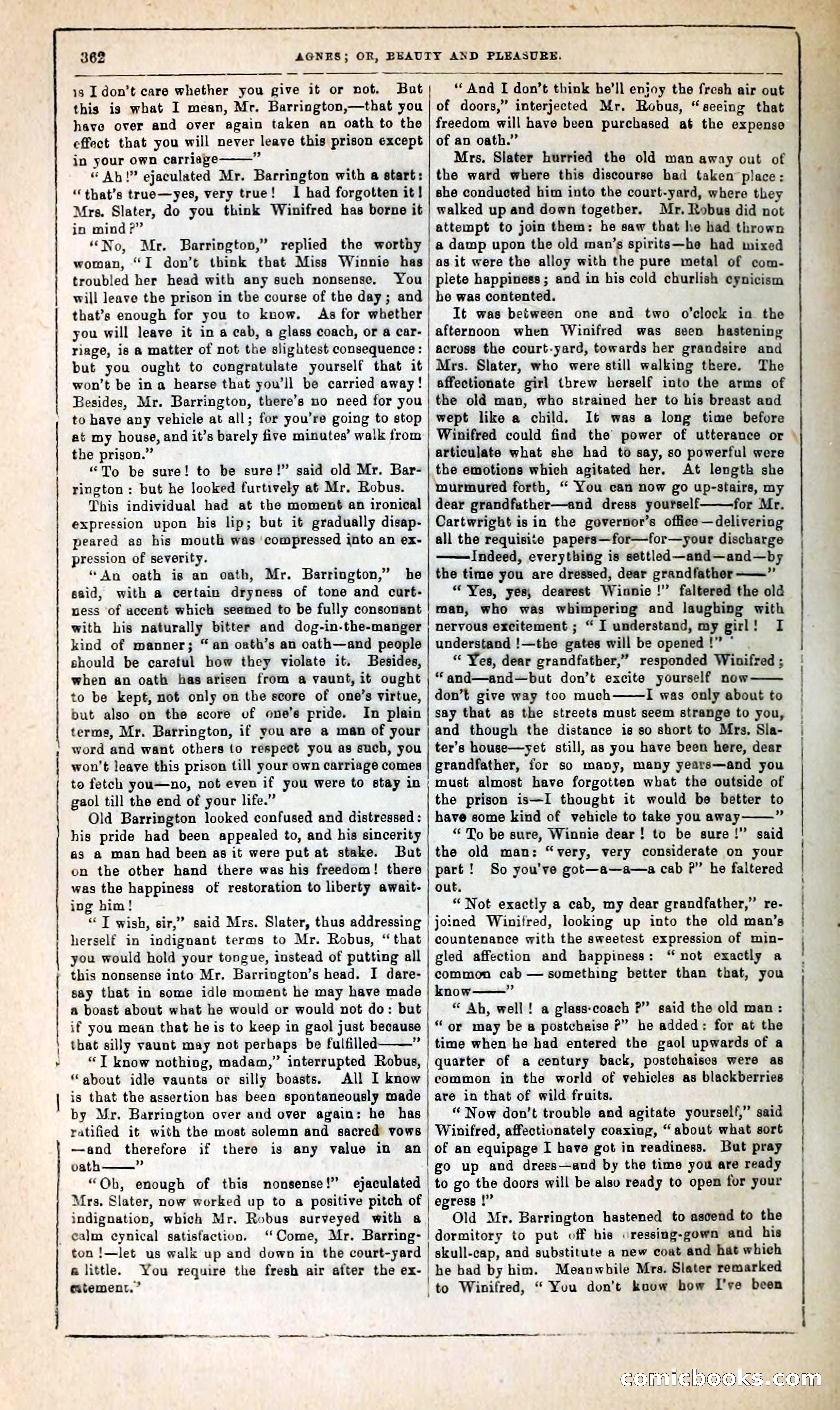
A restored page from Penny Dreadfuls, 1857. Page through the whole issue in the reader above.
📄 Transcribed text from this page (OCR, searchable)
Machine-transcribed from the original scan — historical spelling and the odd misread are preserved.
rr 362 —_— 1s don’t care whether you give it or not. But this is what I mean, Mr. Barrington,—that you have over and over again taken an oath to the effect that you will never leave this prison except in your own carriage “i “Ah!” ejaculated Mr. Barrington with a start: ‘that’s true—yes, very true! 1 had forgotten it! Mrs. Slater, do you think Winifred has borne it in mind?” ‘‘No, Mr. Barrington,” replied the worthy woman, “I don’t think that Miss Winnie has troubled her head with any such nonsense. You will leave the prison in the course of the day; and that’s enough for you to know. As for whether you will leave it in a cab, a glass coach, or a car- riage, is a matter of not the slightest consequence: but you ought to congratulate yourself that it won’t be ina hearse that you'll be carried away! Besides, Mr. Barrington, there’s no need for you to have any vehicle at all; for you’re going to stop at my house, and it’s barely five minutes’ walk from the prison.” “To be sure! to be sure!” said old Mr. Bar- rington: but he looked furtively at Mr. Robus. This individual had at the moment an ironical expression upon his lip; but it gradually disap- peared as his mouth was compressed jnoto an ex- pression of severity. “An oath ig an oath, Mr. Barrington,” he eaid, with a certain dryness of tone and curt- ness of accent which seemed to be fully consonant with his naturally bitter and dog-in-the-manger kind of manner; “ an oath’s an oath—and people should be careful how they violate it. Besides, when an oath has arisen from a vaunt, it ought to be kept, not only on the score of one’s virtue, but also on the score of one’s pride. In plain terms, Mr. Barrington, if you are a man of your word and want others to respect you as such, you won't leave this prison till your own carriage comes to fetch you—no, not even if you were to stay in gaol till the end of your life.” Old Barrington looked confused and distressed : his pride had been appealed to, and his sincerity as a man had been as it were put at stake. But on the other hand there was his freedom! there was the happiness of restoration to liberty await- ing him! “ T wish, sir,” said Mrs. Slater, thus addressing herself in indignant terms to Mr. Robus, “ that you would hold your tongue, instead of putting all this nonsense into Mr. Barrington’s head. I dare- say that in some idle moment he may have made a boast about what he would or would not do: but if you mean that he is to keep in gaol just because that silly vaunt may not perhaps be fulfilled “JT know nothing, madam,” interrupted Robus, “ebout idle vaunts or silly boasts. All I know is that the assertion bas been spontaneously made by Mr. Barrington over and over again: he has ratified it with the most solemn and sacred vows —and therefore if there is any value in an oath ” “Ob, enough of this nonsense!” ejaculated Mrs. Slater, now worked up to a positive pitch of indignation, which Mr. Robus surveyed with a calm cynical satisfaction. ‘Come, Mr. Barring- ton !—let us walk up and down in the court-yard a little. You require the fresh air after the ex- estement. ’ eee ee a | i AGNES; OR, BEAUTY AND PLEASURE. “And I don’t think he’ll enjoy the fresh air out of doors,” interjected Mr. Robus, “seeing that freedom will have been purchased at the expense of an oath.” Mrs. Slater hurried the old man away out of the ward where this discourse had taken place: she conducted him into the court-yard, where they walked up and down together. Mr. Robus did not attempt to join them: he saw that he had thrown a damp upon the old man’s spirits—he had mixed as it were the alloy with the pure metal of com- plete happiness ; and in bis cold churlish cynicism he was contented. It was between one and two o’clock in the afternoon when Winifred was seen hastening across the court-yard, towards her grandeire and Mrs. Slater, who were still walking there. The affectionate girl threw herself into the arms of the old map, who strained her to his breast and wept like a child. It was a long time before Winifred could find the power of utterance or articulate what she had to say, so powerful were the emotions which agitated her. At length she rourmured forth, “ You can now go up-stairs, my dear grandfather—and dress yourself for Mr. Cartwright is in the governor’s offiee —delivering all the requisite papers—for—for—your discharge Indeed, everything is settled—and—and—by the time you are dressed, dear grandfather ——” “Yes, yes; dearest Winnie!” faltered the old man, who was whimpering and laughing with nervous excitement ; “ I understand, my girl! I understand !—the gates will be opened!” ° “ Yes, dear grandfather,” responded Winifred ; * and—and—but don’t excite yourself now don’t give way too much I was only about to say that as the streets must seem strange to you, and though the distance is so short to Mrs, Sla- ter’s house—yet still, as you have been here, dear grandfather, for so many, many years—and you must almost have forgotten what the outside of the prison is—I thought it would be better to have some kind of vehicle to take you away - “To be sure, Winnie dear! to be sure!” said the old man: “very, very considerate on your part! So you've got—a—a—a cab P” he faltered out. * Not exactly a cab, my dear grandfather,” re- joined Winifred, looking up into the old man’s countenance with the sweetest expression of min- gled affection and happiness: “not exactly a common cab — something better than that, you know id * Ah, well! a glass:coach ?” said the old man: “or may be a postchaise P” he added: for at the time when he had entered the gaol upwards of a quarter of a century back, postchaises were as common in the world of vehicles as blackberries are in that of wild fruits. “Now don’t trouble and agitate yourself,” said Winifred, affectionately coaxing, “about what sort of an equipage I have got in readiness. But pray go up and drees—and by the time you are ready to go the doors will be also ready to open for your egress |” Old Mr. Barrington hastened to ascend to the dormitory to put off his oressing-gown and his skull-cap, and substitute a new coat and hat which he bad by him. Meanwhile Mrs. Slater remarked to Winifred, “ You don’t koow bow I’ve been Comicbooks a o-_