
Penny Dreadfuls, 1857 · page 47 of 394
Agnes, or, Beauty and Pleasure — page 47: what you’re looking at
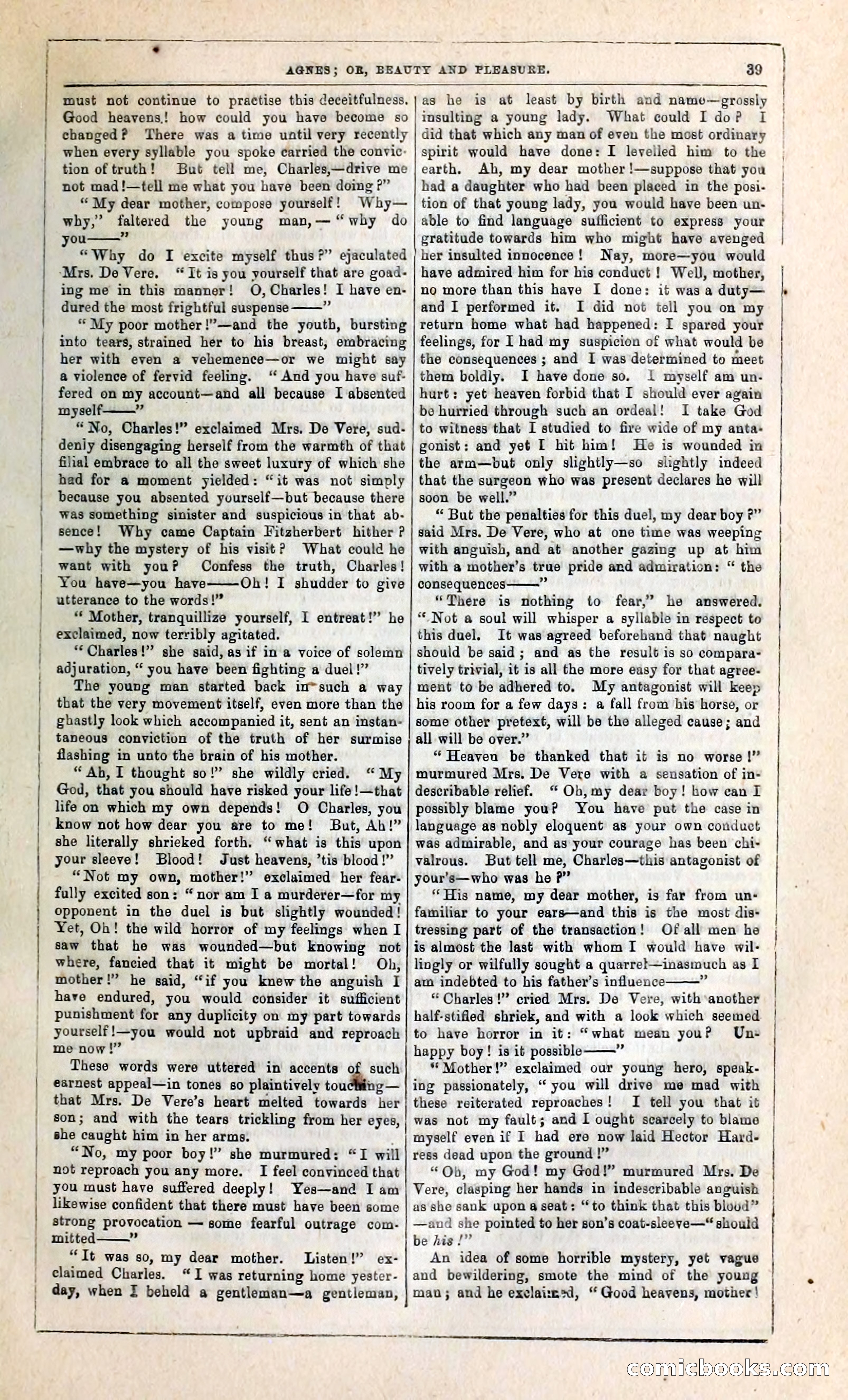
A restored page from Penny Dreadfuls, 1857. Page through the whole issue in the reader above.
📄 Transcribed text from this page (OCR, searchable)
Machine-transcribed from the original scan — historical spelling and the odd misread are preserved.
———— AGNES; OR, BEAUTY AND PLEASURE. 39 must not continue to practise this deceitfulness. Good heavens! how could you have become so changed? There was a time until very recently when every syllable you spoke carried the convic- tion of truth! But tell me, Charles,—drive me not mad!—tell me what you have been domg?” “My dear mother, compose yourself! Why— why,” faltered the young man,— “why do ou 2? “Why do I excite myself thus?” ejaculated ‘Mrs. De Vere. “It is you yourself that are goad- ing me in this manner! O, Charles! I have en- dured the most frightful suspense ‘s | ** My poor mother!”—and the youth, bursting | into tears, strained her to his breast, embracing | her with even a vehemence—or we might say | a violence of fervid feeling. ‘ And you have suf- | fered on my account—and all because I absented | myself i | j “No, Charles!” exclaimed Mrs. De Vere, sud- | deniy disengaging herself from the warmth of that filial embrace to all the sweet luxury of which she | had for a moment yielded: “it was not simply because you absented yourself—but because there was something sinister and suspicious in that ab- | sence! Why came Captain Fitzherbert hither P ! —why the mystery of his visit? What could he | want with you? Confess the truth, Charles! | You have—you have Oh! I shudder to give | utterance to the words!” | ** Mother, tranquillize yourself, I entreat!’”’ he exclaimed, now terribly agitated. : i ** Charles!” she said, as if in a voice of solemn adjuration, “ you have been fighting a duel!” The young man started back in™such a way that the very movement itself, even more than the ghastly look which accompanied it, sent an instan- taneous conviction of the truth of her surmise flashing in unto the brain of his mother. “ Ah, I thought so!” she wildly cried. “My God, that you should have risked your life!—that life on which my own depends! O Charles, you know not how dear you are to me! But, Ah!” she literally shrieked forth. “what is this upon your sleeve! Blood! Just heavens, ’tis blood!” “Not my own, mother!” exclaimed her fear- fully excited son: “nor am I a murderer—for my opponent in the duel is but slightly wounded! Yet, Oh! the wild horror of my feelings when I saw that he was wounded—but knowing not where, fancied that it might be mortal! Oh, mother!” he said, “if you knew the anguish I have endured, you would consider it sufficient punishment for any duplicity on my part towards yourself!—you would not upbraid and reproach me now!” | These words were uttered in accents — earnest appeal—in tones so plaintively touciing— that Mrs. De Vere’s heart melted towards her son; and with the tears trickling from her eyes, she caught him in her arms. “No, my poor boy!” she murmured: “I will not reproach you any more. I feel convinced that you must have suffered deeply! Yes—and I am likewise confident that there must have been some | strong provocation — some fearful outrage com- mitted ” | “It was so, my dear mother. Listen!” ex- claimed Charles. “I was returning home yester- day, when I beheld a gentleman—a gentleman, as he is at least by birth and name—grossly insulting a young lady. What could Ido? I did that which any man of even the most ordinary spirit would have done: I levelled him to the earth. Ah, my dear mother !—suppose that you had a daughter who had been placed in the posi- tion of that young lady, you would have been un- able to find language sufficient to express your gratitude towards him who might have avenged her insulted innocence! Nay, more—you would have admired him for his conduct ! Well, mother, no more than this haye I done: it was a duty— and I performed it. I did not tell you on my return home what had happened: I spared your feelings, for I had my suspicion of what would be the consequences ; and I was determined to meet them boldly. I have done so. 1 myself am un- hurt: yet heaven forbid that I should ever again be hurried through such an ordeal! I take God to witness that I studied to fire wide of my anta- gonist: and yet [ hit him! He is wounded im the arm—but only slightly—so slightly indeed that the surgeon who was present declares he will soon be well.” “ But the penalties for this duel, my dear boy ?” said Mrs. De Vere, who at one time was weeping with anguish, and at another gazing up at him with a mother’s true pride and admiration: “ the consequences £ “There is nothing to fear,” he answered. Not a soul will whisper a syllable in respect to this duel. It was agreed beforehand that naught should be said; and as the result is so compara- tively trivial, it is all the more easy for that agree- ment to be adhered to. My antagonist will keep his room for a few days: a fall from his horse, or some other pretext, will be the alleged cause; and all will be over.” * Heaven be thanked that it is no worse!” murmured Mrs. De Vere with a sensation of in- describable relief. “ Ob,my dear boy! how ean I possibly blame you? You have put the case in language as nobly eloquent as your own conduct was admirable, and as your courage has been chi- valrous. But tell me, Charles—this antagonist of your’s—who was he ?” “His name, my dear mother, is far from un- familiar to your ears—and this is the most dis- tressing part of the transaction! Of all men he is almost the last with whom I would have wil- lingly or wilfully sought a quarret—inasmuch as I am indebted to his father’s influence 4 * Charles!” cried Mrs. De Vere, with another half-stifled shriek, and with a look which seemed to have horror in it: “what mean youP Uns happy boy! is it possible 4s ** Mother!’ exclaimed our young hero, speak- ing passionately, “ you will drive me mad with these reiterated reproaches! [I tell you that it was not my fault; and I ought scarcely to blame myself even if I had ere now laid Hector Hard- ress dead upon the ground !” “Ob, my God! my God!” murmured Mrs. De Vere, clasping her hands in indescribable anguish as she sank upon a seat: “to think that this bluud” —and she pointed to her son’s coat-sleeve—* should be his!” An idea of some horrible mystery, yet vague and bewildering, smote the mind of the young man; and he exclaimed, “Good heavens, mother! “ NE ee - ee << ee (CO)